Alphabet's $20B Bond Sale Sparks Tech Selloff; Markets Retreat
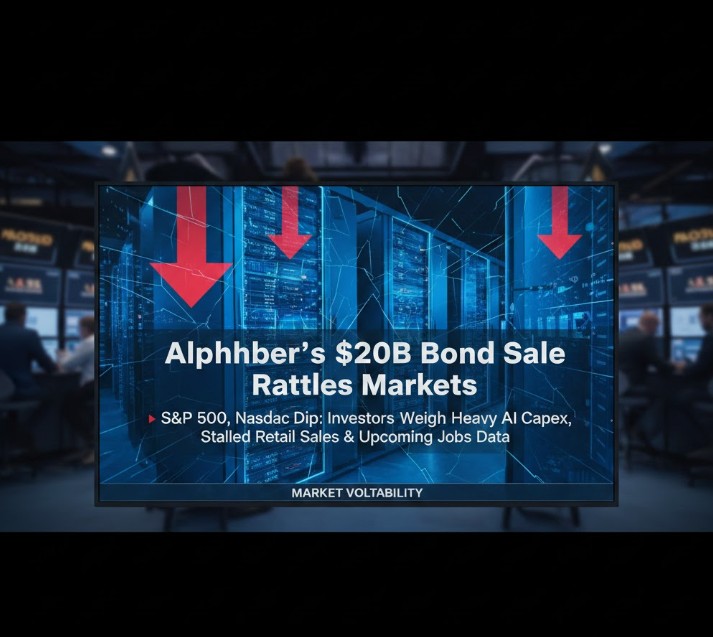
Alphabet Inc.'s announcement that it sold $20 billion of bonds on Tuesday intensified investor scrutiny of tech sector spending and helped drag the S&P 500 and Nasdaq lower, even as the Dow notched a third straight record close. The S&P fell about a third of a percent and the Nasdaq lost roughly 0.6%, with Alphabet shares singled out as a principal weight after the debt offering. The move amplified concerns about the pace and financing of massive capital expenditures tied to AI infrastructure.
Background
Alphabet is the largest company by market value among U.S. tech names and the parent of Google, with a diversified business spanning search, advertising, cloud computing, and AI research. The company has ramped data center construction and AI investments over the past year as it positions Google Cloud and its AI stack to compete with peers. Alphabet has reported solid revenue growth but has also signaled heavier capital spending recently, part of a broader industry push to build out computing capacity for generative AI and large scale model training.
Recent performance data show market participants are weighing growth against rising costs. While Alphabet's revenues have grown in recent quarters, the firm's heightened capital expenditures have drawn attention to free cash flow and margin trajectories. The $20 billion bond sale, one of the largest corporate debt offerings this year, provides cash flexibility for the company but also increases its outstanding debt and future interest obligations, a detail investors are factoring into near term risk assessments.
Analysis of the News Event
The bond sale matters because it is both a funding signal and a valuation event. Issuing $20 billion in bonds suggests Alphabet is financing part of its AI and data center investments through debt rather than equity, avoiding dilution but adding leverage. Investors are debating whether the expected revenue uplift from AI investments will justify the incremental capital and interest costs. Joe Hegener of Asterozoa Capital Management framed the concern succinctly: heavy CapEx may not be sustainable and could pressure margins if revenue growth does not keep pace.
Market reaction has been selective. Alphabet shares fell and contributed to losses in the S&P and Nasdaq, but other parts of the market outperformed. Datadog led S&P gainers after beating quarterly estimates, while Marriott surged 8.5% to a record high after forecasting a 35% rise in co branded credit card fees driven by affluent travelers. Spotify jumped nearly 15% following guidance that topped expectations for first quarter earnings, driven by user growth and price increases. These winners underscore that company specific fundamentals still drive day to day stock moves even amid broader macro concerns.
Macro context deepens the story. Commerce Department data showed U.S. retail sales unexpectedly stalled in December, with pullbacks in vehicle and big ticket purchases. That soft consumer spending reading, combined with the market's focus on heavy corporate CapEx in tech, has investors bracing for the delayed January nonfarm payrolls report. A weaker jobs print could increase recession fears, while stronger employment data could support confidence in consumer resilience and ad revenues, important for Alphabet's core business.
What Analysts Are Saying
Equity strategists and credit analysts are parsing the bond terms and capital allocation strategy. Some analysts view Alphabet's bond sale as prudent balance sheet management that preserves optionality for acquisitions and infrastructure spend without diluting shareholders. Others caution that sustained high CapEx outlays will test profit margins and free cash flow if monetization of AI products lags. Credit analysts will focus on interest coverage ratios and debt maturities in upcoming quarters to reassess Alphabet's credit profile.
What This Means for Investors
First, monitor Alphabet's capital expenditure guidance and free cash flow projections in the next quarterly report to judge whether spending is trending toward sustainable returns. Second, watch bond covenants and yields on the $20 billion issuance; higher coupons or shorter maturities could signal costlier financing and greater near term pressure. Third, consider relative valuation: if the market discounts long term AI benefits in the near term, high quality growth names may offer buying opportunities for patient investors, but risk management is essential given rising leverage across the sector.
Actionable steps include rebalancing exposure to tech if your portfolio is overweight companies relying heavily on CapEx funded growth, and setting alert thresholds for margin contraction in companies with large data center footprints. Income focused investors should scrutinize how new debt affects buybacks and dividend policy over coming quarters. For traders, earnings and macro data, particularly the forthcoming nonfarm payrolls, are likely catalysts for further volatility.
Conclusion
Alphabet's $20 billion bond sale is a clear sign that even the largest tech firms are actively reshaping balance sheets to finance an AI driven race for infrastructure. The immediate market reaction, modest declines in the S&P 500 and Nasdaq, reflects investor debate about the trade off between growth investment and margin pressure. Looking ahead, investors should focus on whether Alphabet can translate elevated CapEx into durable revenue streams and improved monetization of AI offerings, while monitoring debt metrics and macro signals that will determine broader market sentiment.
Alphabet shares dipped after the company sold $20 billion of bonds, raising investor concerns about heavy AI related capital spending and increased leverage.