Bank of America Reinstates Coverage on Microsoft; Shares Drop
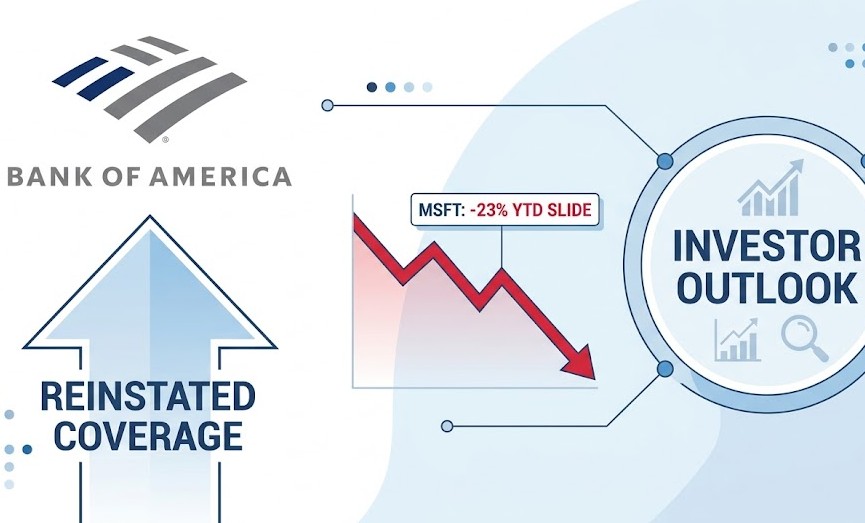
Lead Bank of America has reinstated coverage of Microsoft Corporation, a move that comes as the stock has fallen roughly 23% year-to-date through March 24.
The reinstatement underscores renewed institutional focus on the software giant amid a broader market pullback and raises questions about valuation, growth expectations and near-term catalysts for investors.
Company background and recent performance
Microsoft (MSFT) is a $2+ trillion technology conglomerate whose businesses span cloud computing (Azure), productivity software (Office, Teams), personal computing (Windows, Surface), and a growing portfolio of AI-related services.
Historically, Microsoft has combined durable revenue growth, recurring software licensing cash flows, and shareholder returns through dividends and buybacks.
Despite these strengths, MSFT has faced meaningful pressure in 2026: the stock was down about 23% year-to-date as of March 24, compared with a roughly 3.75% decline in the SPDR S&P 500 ETF (SPY).
Other large-cap peers such as Alphabet (GOOGL) and Amazon (AMZN) have also seen weakness — declines of more than 5% and about 10%, respectively reflecting stress across growth-oriented names.
Why the reinstated coverage matters
A major bank like Bank of America reinstating coverage is noteworthy because it signals that sell-side research and capital markets desks are reallocating analyst bandwidth to Microsoft.
Reinstatement typically means the bank will publish regular research notes and potentially provide updated financial models, earnings previews and conference access that can affect institutional investor flow.
For a stock that has already corrected significantly this year, renewed coverage can influence sentiment, increase liquidity, and supply fresh valuation perspectives to buy-side managers weighing fresh positions or additions.
Drivers behind the stock's recent weakness
Microsoft’s decline in 2026 reflects a confluence of factors cited by market participants.
Rising interest rates and a higher-for-longer rate outlook have compressed multiples on large-cap growth names.
Operationally, investors have scrutinized cloud revenue growth and margins, with any perceived softening in Azure expansion prompting re-rating risk.
Broader macro concerns — including PC demand cycles and enterprise IT spending patterns — have also weighed on near-term expectations.
At the same time, Microsoft remains a market leader in AI infrastructure and enterprise software, creating a tension between long-term opportunity and short-term cyclical headwinds.
Analysis of the news event and implications
Bank of America’s decision to resume coverage does not, on its own, change Microsoft’s fundamentals, but it can alter the flow of information and market attention.
Reinstated coverage typically yields updated earnings forecasts, scenario analysis around cloud and AI monetization, and clearer guidance on margin trajectories.
For investors, the practical implications are threefold:
First, coverage often leads to increased transparency around key metrics such as Azure growth rates, commercial cloud run rate, and enterprise software adoption.
Second, it provides a new set of valuation frameworks from a widely followed sell-side desk.
Third, it can catalyze trading activity if the coverage contains a materially different view — for example, a more optimistic acceleration in AI-driven revenue or a more conservative outlook on enterprise spend.
Market reaction and analyst perspectives
The market’s immediate reaction to reinstated coverage tends to be muted unless accompanied by a fresh price target or a substantive change in earnings assumptions.
In Microsoft’s case, the broader market sell-off has already priced in part of the growth-risk premium; investors will watch for any Bank of America analysis that materially revises growth or margin expectations.
Sell-side analysts and market strategists generally view reinstated coverage as a stabilizing factor — it restores an information channel between the company and large institutional investors.
Some commentators highlight that renewed coverage can lead to renewed interest from mutual funds and ETFs that rely on sell-side research for due diligence, potentially supporting demand if coverage is constructive.
What this means for investors actionable insights
- Reassess valuation vs. fundamentals: With MSFT down roughly 23% YTD, investors should revisit intrinsic and relative valuation metrics, including forward P/E, enterprise value-to-revenue for cloud segments, and discounted cash flow assumptions reflecting different growth scenarios.
- Monitor upcoming catalysts: Watch quarterly results, Azure growth rates, AI-related revenue disclosures, guidance updates, and any comments on enterprise IT spending. These items are likely to move the stock more than the coverage reinstatement itself.
- Use coverage as a research input, not a driver: Bank of America’s notes will provide useful third-party projections; investors should integrate that analysis into a broader review that includes company filings, competitor data, and macro indicators.
- Position sizing and risk control: Given elevated macro uncertainty and multiple compression among growth names, consider staged entries, defined stop-losses, or options strategies to manage downside while retaining upside exposure to AI and cloud recovery.
Conclusion and forward-looking perspective
Bank of America’s reinstatement of Microsoft coverage is a vote of institutional attention rather than a definitive directional signal on the stock.
For investors, the key takeaway is that renewed sell-side scrutiny will yield fresh forecasts and potentially increase liquidity and information flow.
Microsoft’s long-term structural position in cloud and AI remains intact, but near-term performance will hinge on enterprise demand, Azure expansion, and the pace at which AI monetization translates into revenue and profit growth.
Investors should use the forthcoming research to reassess valuation, monitor short-term catalysts, and calibrate position sizes to reflect both opportunity and macro risk.
The stock has fallen about 23% YTD due to a combination of multiple compression on large-cap growth names, concerns about cloud growth and enterprise IT spending, and broader macro pressures.