Buffett Falls From Top 10 Richest: A Shifting Wealth Landscape
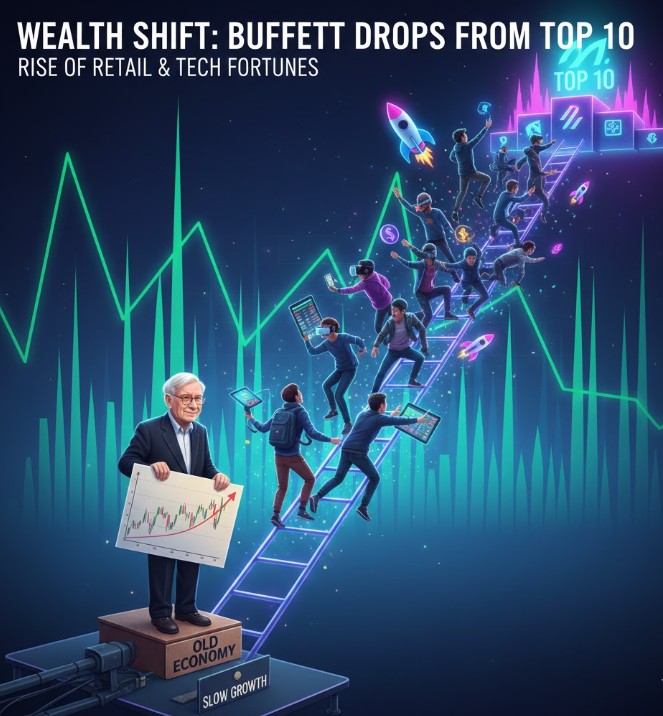
Omaha, NE – Legendary investor Warren Buffett, the guiding force behind Berkshire Hathaway, has reportedly fallen out of the top 10 wealthiest individuals globally as of early 2026. This development, occurring despite a significant personal net worth increase in 2025, signals a broader recalibration in the landscape of global wealth, where the rapid accumulation of capital by tech and retail magnates is outpacing even the most seasoned value investors. Buffett's shift in ranking, primarily attributed to the ascendance of figures like Walmart Inc. heir Jim Walton, underscores the formidable growth trajectories of certain sectors and established family fortunes. While not directly impacting Berkshire Hathaway's stock performance, this narrative offers a compelling lens through which investors can examine the evolving dynamics of wealth generation and the relative performance of diversified holding companies versus sector specific giants.
Company Background and Recent Performance
Berkshire Hathaway, under the stewardship of Warren Buffett for decades, has become synonymous with long term value investing. The conglomerate holds a diverse portfolio of wholly owned businesses, including Geico, BNSF Railway, and Dairy Queen, alongside significant equity stakes in publicly traded companies like Apple, Coca Cola, and American Express. Known for its disciplined approach, focus on intrinsic value, and aversion to speculative trends, Berkshire Hathaway has delivered exceptional returns to shareholders over the long haul, transforming modest investments into significant wealth.
At the close of 2025, Warren Buffett's personal net worth stood at an impressive $151 billion, marking a substantial increase of $9.44 billion for the year. This robust performance is a testament to the underlying strength and consistent profitability of Berkshire Hathaway's diverse operations and its well chosen public equity investments. For context, this placed Buffett as the 10th richest person in the world at year end, a position he had consistently held or exceeded for many years.
Detailed Analysis of the News Event
The news that Warren Buffett has dropped out of the top 10 richest individuals in early 2026 is less about a decline in his personal fortune and more about the extraordinary wealth creation occurring elsewhere. His net worth, largely tied to his significant stake in Berkshire Hathaway, continues its upward trajectory. The shift in ranking highlights the explosive growth seen in specific sectors, particularly technology and established retail dynasties.
Jim Walton, an heir to the Walmart Inc. fortune, exemplifies this trend. While precise figures for Walton's 2026 net worth were not explicitly detailed in the original report, his ascendance above Buffett indicates a substantial increase driven by the continued strength and perhaps a revaluation of the underlying assets of Walmart Inc., a global retail behemoth. This divergence points to the accelerated pace at which certain wealth pools are expanding, especially those rooted in scalable consumer businesses or innovative technological platforms.
It is crucial for investors to understand that Buffett's movement in a personal wealth ranking does not signal any fundamental weakness or underperformance of Berkshire Hathaway itself. Rather, it is a reflection of comparative wealth accumulation rates. While Berkshire Hathaway, with its emphasis on mature, cash generating businesses, tends to grow steadily, the valuations of high growth tech firms or legacy assets like Walmart can experience more rapid swings, propelling their owners' net worth higher at a faster rate in certain periods.
Market Reaction and Analyst Commentary
The market's reaction to Warren Buffett's personal wealth ranking is typically muted regarding Berkshire Hathaway's stock price directly. Investors generally understand that Buffett's individual net worth is intertwined with his ownership in Berkshire Hathaway but is not a primary driver of daily trading. Analysts, while acknowledging the symbolic nature of such rankings, primarily focus on Berkshire's operating results, capital allocation decisions, and the performance of its underlying businesses.
Financial commentators have often pointed to the incredible concentration of wealth in the hands of tech founders and executives, whose companies have seen unprecedented growth in market capitalization. Comparing this to Berkshire Hathaway's diversified, value oriented approach, it's clear that different economic engines are at play. Experts suggest that while Berkshire might not generate the eye popping, exponential growth of a startup, its stability, strong cash flows, and prudent management continue to make it a cornerstone investment for many.
This event, if anything, reinforces the narrative of a changing global economy where disruption and rapid scalability often lead to faster wealth generation than traditional, compounding value investing. However, the long term track record and resilience of Berkshire Hathaway remain undisputed, suggesting that while the pace might differ, the ultimate creation of shareholder value persists.
What This Means for Investors
For investors, Warren Buffett's personal ranking shift offers several key takeaways. Firstly, it's a reminder that personal wealth rankings, while interesting, are relative and dynamic; they do not necessarily reflect the health or future prospects of the underlying company, Berkshire Hathaway. The Oracle of Omaha's wealth grew significantly in 2025, which underscores Berkshire's continued financial strength.
Secondly, it highlights the different avenues of wealth creation in the modern economy. While Berkshire Hathaway epitomizes disciplined value investing and long term compounding, the rise of tech and large scale retail empires demonstrates the potential for rapid wealth generation through market disruption or leveraging vast consumer networks. Investors should consider how these diverse drivers impact their own portfolios, balancing steady, reliable growth with potentially higher growth, albeit sometimes riskier, opportunities.
Finally, this news provides an opportunity to reassess investment philosophies. While the allure of rapid returns is strong, the enduring success of Berkshire Hathaway serves as a powerful testament to the principles of patience, thorough analysis, and a focus on intrinsic value. Investors are encouraged to maintain a diversified portfolio that aligns with their risk tolerance and long term financial goals, rather than chasing every fast moving trend that influences personal wealth rankings.
Conclusion
Warren Buffett's slight dip in the global wealth rankings, occurring as his personal fortune continued to swell, is a nuanced story reflecting more on the accelerated wealth generation elsewhere than on any specific setback for the legendary investor or Berkshire Hathaway. It serves as a vivid illustration of the ongoing shifts in the global economic landscape, where traditional value investing coexists with, and at times is momentarily overshadowed by, the meteoric rise of digital and consumer focused empires.
Berkshire Hathaway remains a titan of industry, a beacon of prudent management, and a testament to the power of compounding. For investors, the takeaway is clear: while the names at the very top of the wealth list may fluctuate, the fundamental principles of sound investment, diversification, and long term perspective championed by Buffett continue to hold immense value. The "Oracle of Omaha" may have ceded a spot, but his legacy and the strength of his conglomerate are far from diminished, continuing to offer a robust foundation for discerning investors in an ever evolving market. The news is significant as it underscores the shifting landscape of global wealth accumulation, with Warren Buffett's personal net worth growth, though substantial, being outpaced by heirs of rapidly appreciating retail and tech empires, rather than indicating a direct movement in Berkshire Hathaway's stock.