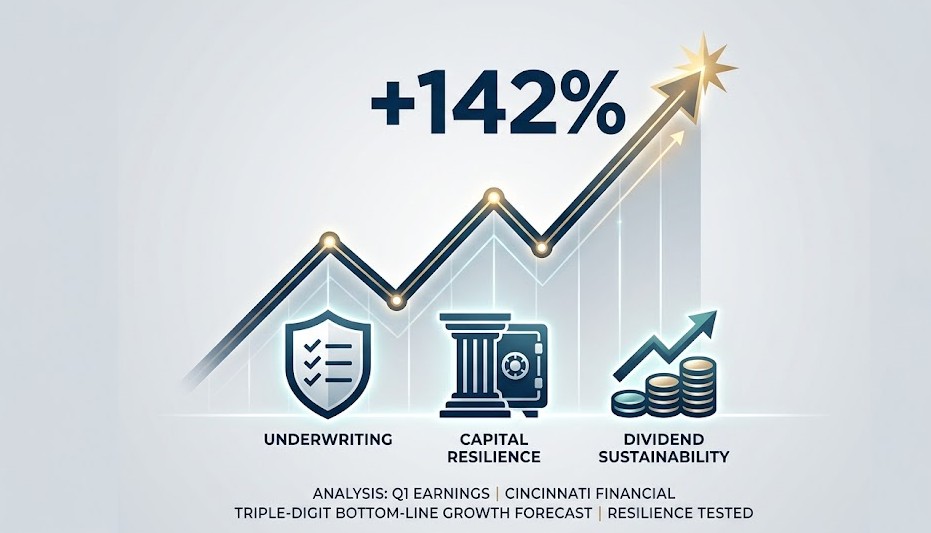
Cincinnati Financial (CINF) Poised for Triple-Digit Q1 EPS Gain

Cincinnati Financial (CINF) will report first-quarter results later this month amid analyst expectations of robust, triple-digit bottom-line growth, a development that could recalibrate investor expectations for the property-and-casualty insurer. The upcoming print matters because it will shed light on whether improved investment income and tighter underwriting trends are translating into meaningful earnings acceleration after a period of rate-driven premium growth.
Cincinnati Financial, one of the established regional property-and-casualty insurers in the U.S., operates through a portfolio of underwriting businesses and a sizable fixed-income investment portfolio. The company is known for its conservative underwriting culture and consistent dividend policy, and it typically reports results that investors scrutinize for combined-ratio trends, reserve development and investment yield.
In recent quarters, the sector has benefited from higher interest rates, and Cincinnati’s results will be watched for how much of that tailwind is showing up in net investment income. Analysts’ anticipation of triple-digit year-over-year bottom-line growth is notable because it signals an expected rebound in earnings compared with the prior-year period.
For insurers, a large percentage increase in net income often reflects a low prior-year comparable or a pronounced inflection in either underwriting results or investment returns. In Cincinnati’s case, market commentary points to a combination of higher earned premium, improved combined ratios and stronger investment income as potential drivers behind the consensus view.
Underwriting Performance Remains Key
Underwriting performance remains the core determinant of sustainable profitability for Cincinnati Financial. Investors will be looking for:
- A combined ratio that moves lower year-over-year
- Evidence of favourable reserve development
- Discipline on loss-cost trends
On the investment side, higher short- and intermediate-term yields have lifted portfolio returns across the industry. Cincinnati’s fixed-income portfolio mix and realized/unrealized gains or losses will be important to parse in order to understand recurring versus one-time earnings contributions.
Market reaction ahead of earnings often reflects positioning around those dynamics. Investors may buy the stock on the prospect of an earnings beat tied to recurring improvements, while others hedge for risk from reserve strengthening or catastrophe volatility.
What Analysts Will Focus On
Analysts covering CINF are likely to update models after the earnings release, with particular focus on:
- EPS
- Adjusted operating income
- Combined ratio
- Commentary on rate renewals
- Commercial lines exposure
Sell-side notes are also expected to emphasize whether management frames the quarter as confirming a sustained earnings trajectory or merely a shorter-term swing.
Key Metrics Investors Should Monitor
For investors, the upcoming report creates both opportunity and a checklist. Key areas to monitor include:
- Combined ratio and its components (loss ratio and expense ratio)
- Net investment income and yield on invested assets
- Reserve development and any adjustments to loss reserves
- Management commentary on pricing and catastrophe exposure
These metrics will help determine whether the triple-digit EPS forecast is driven by operational improvements or by timing and accounting effects that may not persist.
Risks Still Remain
Despite optimism, risks remain for Cincinnati Financial. Reserve volatility and catastrophe losses can quickly reverse quarterly gains, while realized investment losses or changes in capital-market assumptions could compress net income.
Additionally, if a significant portion of expected profit comes from realized investment gains or favourable prior-year reserve releases, analysts may temper forward expectations. Insurers also face macroeconomic risks such as slower premium growth if commercial pricing softens or inflationary pressures increase claim severities.
Valuation and Dividend Outlook
Valuation and income profile will also factor into investor decisions following the earnings report. Cincinnati Financial has historically traded as a relatively conservative insurer with a steady dividend profile.
If earnings strength is confirmed, the company could narrow its valuation gap with peers or prompt upward revisions to dividend coverage expectations. Conversely, if results disappoint, investors may focus on whether underwriting discipline is weakening or whether reinvestment yields are failing to translate into sustainable income growth.
Conclusion
Cincinnati Financial’s Q1 earnings report represents a pivotal near-term event for investors assessing the durability of an anticipated earnings rebound. The forecast for triple-digit bottom-line growth is a positive signal, but investors will need to closely evaluate the drivers behind the improvement — including underwriting margins, reserve development and investment income composition.
Looking ahead, the company’s ability to sustain underwriting discipline while converting higher yields into recurring income will determine whether the upcoming quarter marks the beginning of a multi-quarter earnings expansion or simply a one-time improvement.
The stock has recently moved higher on expectations of strong year-over-year EPS growth driven by improving underwriting metrics and stronger investment income.