Could $10,000 in Leveraged ETF SSO Turn Into $1 Million Over Decades?
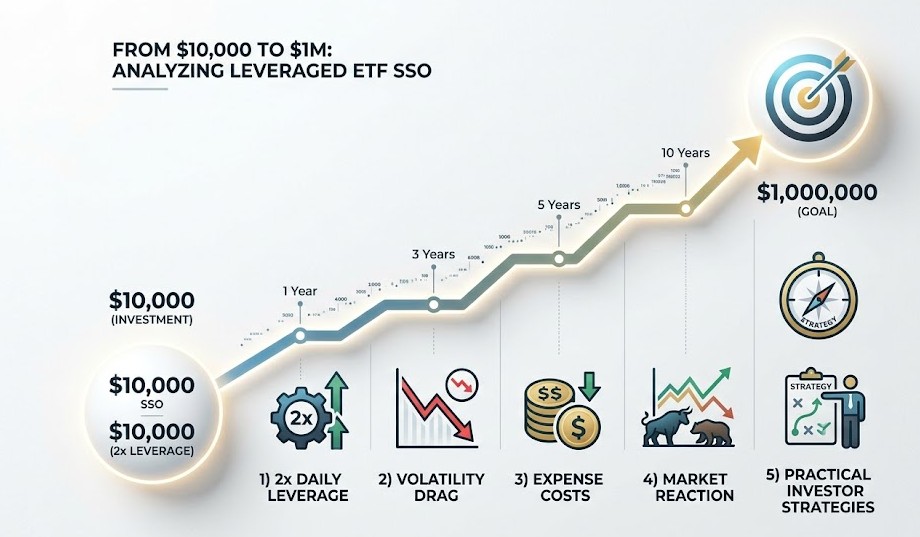
ProShares' leveraged ETF SSO has attracted renewed attention after an online article questioned whether a $10,000 investment could realistically grow into $1 million, reigniting debate around the suitability of leveraged ETFs for long-term investors.
The discussion matters because SSO seeks to deliver twice the daily performance of the S&P 500, exposing investors to amplified gains but also to volatility+drag" title="More analysis on volatility drag">volatility drag and compounding risks that can erode returns over time.
Understanding SSO and How It Works
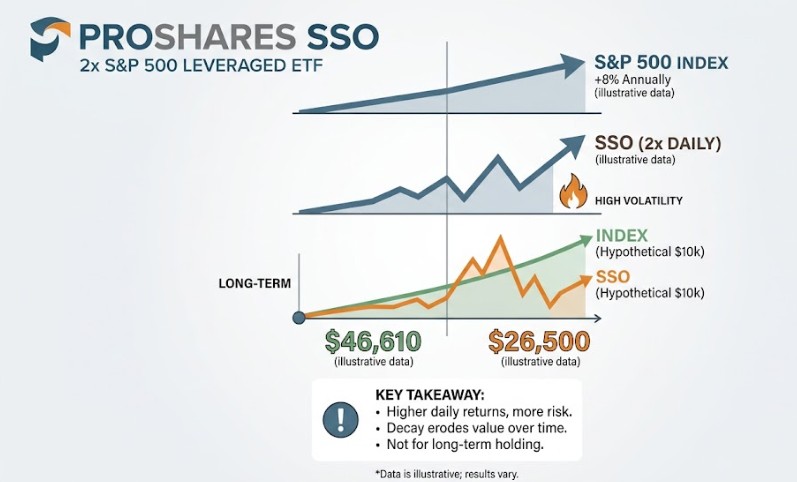
ProShares Ultra S&P500 ETF (SSO) is designed to achieve 2x the daily return of the S&P 500 index. The ETF is commonly used by active traders and tactical portfolio managers rather than traditional long-term buy-and-hold investors.
The fund carries an expense ratio of roughly 0.90% and relies on derivatives and swap agreements to obtain leverage. That structure introduces additional risks, including counterparty exposure and tracking error alongside the inherent leverage effects.
Historically, leveraged exposure can significantly outperform the broader market during strong multi-year bull markets. However, in volatile or sideways markets, the outcome often reverses as compounding effects begin to work against investors.
The $10,000 to $1 Million Hypothetical
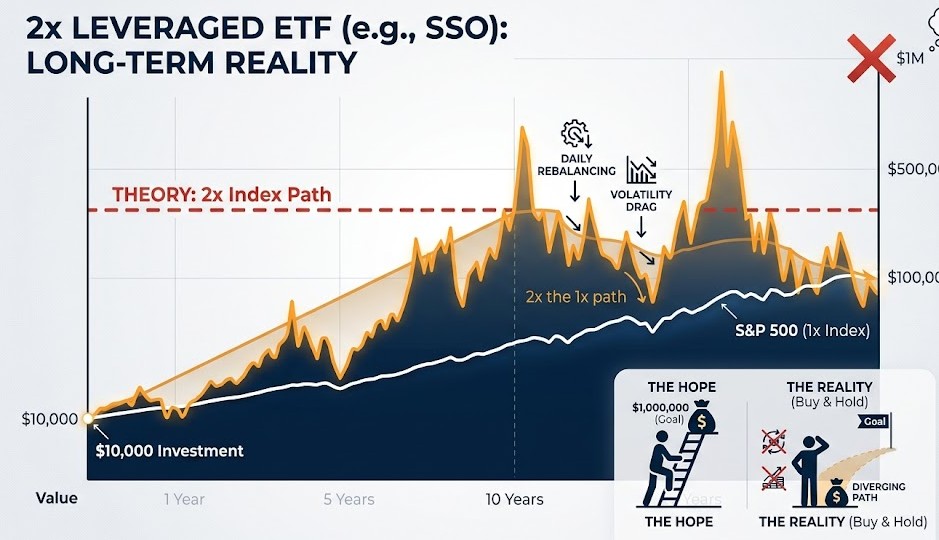
The article that sparked renewed interest framed a hypothetical scenario in which a $10,000 investment could compound into $1 million if SSO consistently delivered outsized annualized returns over decades.
While technically possible in an uninterrupted bull market, that assumption overlooks one of the most important mechanics of leveraged ETFs: daily reset compounding.
Because SSO targets 2x the daily return of the index, long-term performance can diverge significantly from simply doubling the S&P 500’s long-term return.
Volatility Drag Explained
One of the biggest challenges with leveraged ETFs is volatility drag, where market fluctuations reduce geometric returns over time.
For example:
- If the S&P 500 rises 5% on day one and falls 5% on day two, the index ends slightly negative at roughly -0.25%
- A 2x leveraged ETF would rise 10% on day one and fall 10% on day two, ending down approximately 1% overall

Repeated over months or years, similar sequences can materially reduce long-term returns relative to investor expectations.
This mathematical reality explains why many financial professionals caution against using leveraged ETFs as permanent portfolio holdings.
Research Shows Long-Term Performance Challenges
Empirical studies and backtests of leveraged ETF strategies show that the gap between actual long-term returns and the expected multiple of index returns widens as volatility increases.
In environments where annualized volatility exceeds 15% and markets experience repeated 10% or greater drawdowns, leveraged ETFs can substantially underperform what investors might expect from a simple 2x multiplier.
The longer the holding period and the more volatile the market environment, the greater the divergence becomes.
Market Response Remains Limited
Market reaction to the recent article was relatively muted. While SSO experienced episodic inflows from retail traders, there was no immediate structural shift in overall assets under management.
Financial advisors and institutional asset managers largely reiterated a familiar message:
Leveraged ETFs are tactical trading tools, not core long-term portfolio holdings.
Independent analysts also point to alternative leverage strategies such as margin accounts, futures or options structures that may offer more controlled risk exposure for sophisticated investors.
Alternative Approaches to Leveraged Exposure
Investors seeking leveraged market exposure may consider several alternatives:
- Using a small tactical allocation, such as 5% to 10% of a portfolio, with strict risk controls
- Employing options strategies like long-dated call options or covered call overlays
- Using professionally managed margin or futures exposure with disciplined risk management
For conservative investors, low-cost index ETFs such as SPY or VOO remain more suitable for long-term core equity exposure because they avoid leverage decay while still participating in market growth.
Investor Checklist Before Buying SSO
Before allocating capital to leveraged ETFs like SSO, investors should evaluate:
- Investment time horizon
- Expected market volatility
- Maximum acceptable drawdown
- Position sizing limits
- Stop-loss rules
- Tax implications
- Counterparty risk
Tactical traders who continue using leveraged ETFs should maintain disciplined entry and exit rules, rebalance positions regularly and account for expense ratios when evaluating long-term performance.
Conclusion
Leveraged ETFs such as SSO can be effective tactical tools capable of amplifying gains during favorable market conditions. However, they are also exposed to structural decay during volatile or range-bound markets due to the mechanics of daily compounding.
Retail investors should view headlines about turning $10,000 into $1 million as theoretical thought experiments rather than realistic long-term investment blueprints.
SSO recently drew renewed retail attention after headlines highlighted the possibility of outsized long-term gains, despite continued warnings from analysts regarding volatility drag, compounding risk and the challenges associated with holding leveraged ETFs over extended periods.