Dick's Sporting Goods Slides 3% as Market Advances; Investors Watch
Dick's Sporting Goods Shares Fall Despite Broader Market Rally as Investors Reassess Near-Term Catalysts
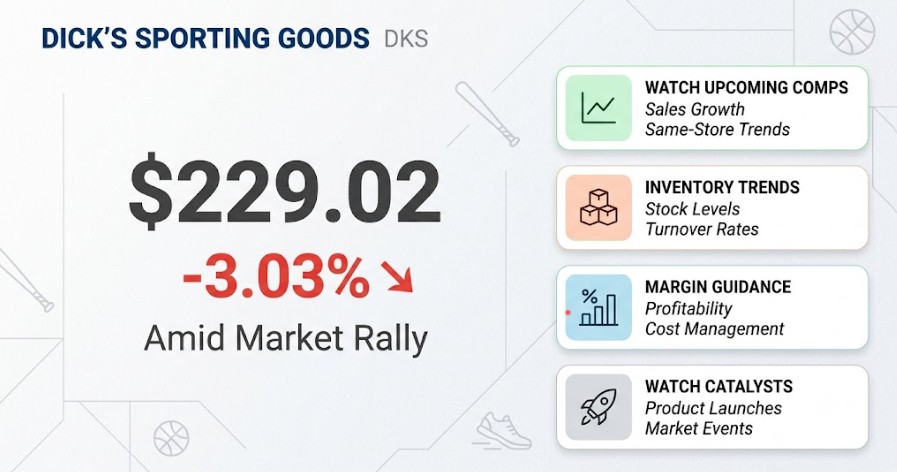
Dick's Sporting Goods shares fell 3.03% to $229.02 in the latest trading session, underperforming a broader market rally and signaling relative weakness in the sporting goods retailer. The decline was notable because it occurred without any company-specific announcement, prompting investors to reassess near-term catalysts such as earnings, inventory levels, and margin outlook.
Company Background and Recent Performance
Dick's Sporting Goods is one of the largest specialty sporting goods retailers in the United States, operating a broad network of physical stores and e-commerce platforms focused on apparel, footwear, and sporting equipment.
In recent years, the company has emphasized private-label brands, omnichannel integration, and disciplined inventory management to strengthen margins and improve customer engagement. While these initiatives have helped Dick's outperform many traditional retailers, the stock remains closely tied to consumer spending trends">consumer spending trends and seasonal demand for sporting goods.
Analysis of the Share Price Decline
The 3.03% decline to $229.02 stood out because it came during a session when the broader market advanced. With no reported company-specific news, the pullback appears to reflect short-term profit-taking, technical selling near resistance levels, or sector rotation as investors shifted capital into other areas of the market.
For a retailer like Dick's, investor sentiment is heavily influenced by comparable-store sales, gross margin performance, and inventory management. Any indication that demand may slow or margins could come under pressure often results in outsized market reactions.
Market expectations also play an important role. Investors frequently price in strong seasonal and holiday demand, and even subtle concerns about future sales growth or profitability can trigger valuation adjustments.
Additionally, Dick's premium valuation relative to many retail peers can make the stock more vulnerable to profit-taking after periods of strong performance.
Market Reaction and Analyst Commentary
Dick's relative weakness attracted attention from traders and retail-sector analysts because it diverged from the broader market's positive performance.
Without new earnings, updated guidance, or management commentary, analysts generally attributed the decline to technical factors and investor positioning rather than changes in the company's fundamentals.
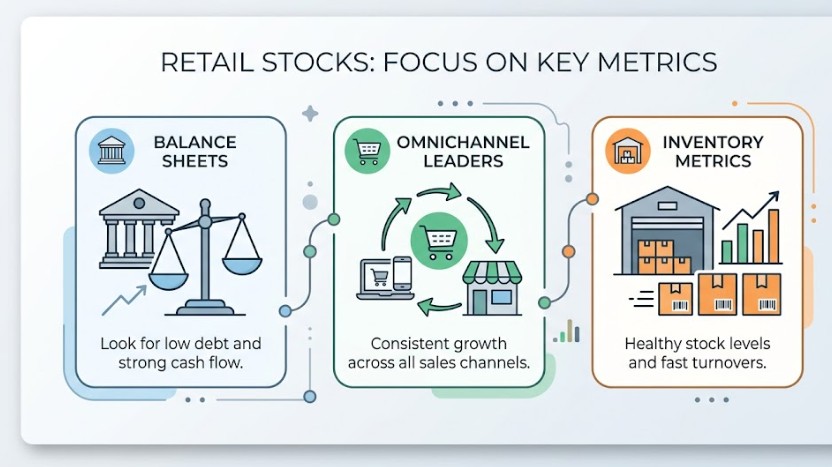
Market observers continue to monitor several operating metrics that will shape investor sentiment in upcoming quarters, including:
- Comparable-store sales growth.
- E-commerce performance.
- Inventory turnover.
- Adjusted operating margins.
- Private-label sales momentum.
Investors should also watch for any pre-earnings announcements, promotional updates, or management commentary that could provide additional insight into business trends.
Near-Term Catalysts and Risks
Several factors could influence Dick's share price over the coming months.
Key catalysts include:
- Quarterly earnings results.
- Comparable-store sales performance.
- Holiday and seasonal sales trends.
- Inventory management updates.
- Management guidance on promotional activity and margins.
Key risks include:
- Softer consumer spending.
- Increased promotional discounting.
- Inventory overhang.
- Freight and supply chain cost pressures.
- Higher interest rates affecting discretionary spending.
Ultimately, changes in guidance or comparable-store sales are likely to have a greater impact on the stock than a single-day market move.
Valuation and Long-Term Outlook
Dick's typically trades at a premium valuation compared with many smaller retail peers due to its scale, strong cash-flow generation, and consistent operational execution.
That premium, however, depends on management's ability to continue delivering steady sales growth and healthy margins.
Long-term investors should monitor the company's progress in:
- Expanding private-label brands.
- Growing its loyalty program.
- Increasing digital sales.
- Maintaining inventory discipline.
- Protecting gross margins.
Successful execution could support additional valuation expansion, while weakening sales trends or inventory issues could lead to further multiple compression.
What This Means for Investors
Investors should consider the following:
- Review position sizing: A 3% decline without company-specific news may represent short-term volatility rather than a deterioration in fundamentals.
- Monitor upcoming earnings: Comparable-store sales, earnings, and margin guidance will provide a clearer picture of business momentum.
- Track inventory trends: Rising inventory levels or aggressive promotions could pressure profitability, while disciplined inventory management would support margins.
- Compare valuation with peers: Reviewing valuation metrics such as price-to-earnings and enterprise value-to-EBITDA can help determine whether the recent weakness presents a buying opportunity.
- Focus on technical and fundamental signals: Short-term traders may monitor support levels and moving averages, while long-term investors should prioritize earnings quality and cash-flow generation.
Conclusion and Forward-Looking Perspective
Dick's Sporting Goods' 3.03% decline to $229.02 during an otherwise positive market session reflects stock-specific weakness driven primarily by investor positioning rather than new corporate developments.
The company's longer-term outlook remains tied to its ability to sustain omnichannel growth, manage inventory effectively, expand private-label offerings, and maintain healthy margins. Investors should closely monitor upcoming earnings, comparable-store sales, inventory trends, and management guidance to determine whether the recent pullback represents a temporary buying opportunity or the beginning of a more prolonged period of weakness.
Dick's Sporting Goods shares declined 3.03% to $229.02 as investors engaged in short-term profit-taking and sector rotation despite the absence of company-specific news, leaving upcoming earnings and operating metrics as the next major catalysts.