Freshpet Drops Nearly 9% to $58.93 as Investors Weigh Growth Risks
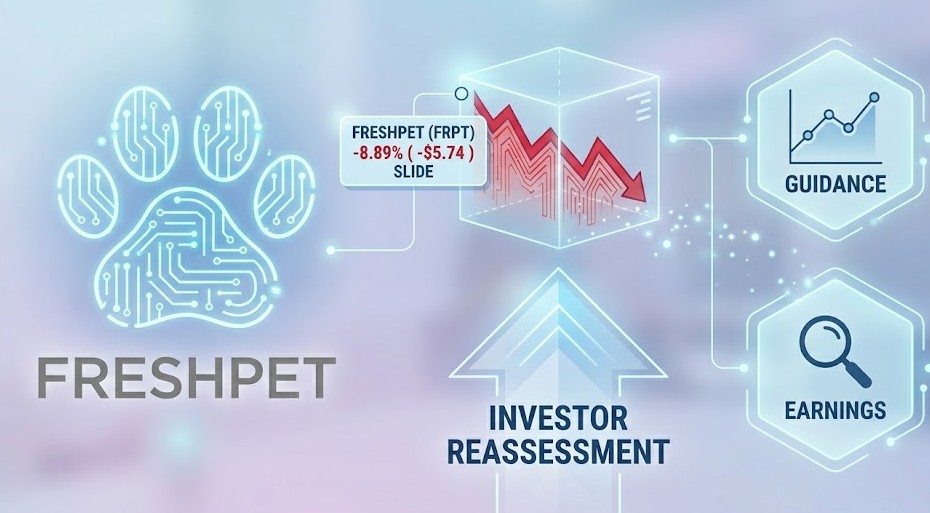
Freshpet Inc. (NASDAQ: FRPT) closed the most recent trading day at $58.93, a decline of 8.89% from the previous session.
The move erased roughly $5.74 per share from the prior close of about $64.67 and came as the stock fell more steeply than the broader market.
The sell-off is notable because Freshpet is a high-profile player in the refrigerated natural pet food segment, a category that has seen elevated investor interest for its perceived resilience and pricing power.
While the company continues to benefit from secular tailwinds in pet ownership and premiumization of pet food, the share drop underscores investor sensitivity to growth visibility, margin trends and any near-term guidance or earnings-related headlines.
Company background and recent performance
Freshpet develops, manufactures and markets refrigerated fresh pet food and treats in the U.S. and Canada. The company has built a differentiated model focused on fresh ingredients and cold-chain distribution, positioning itself away from traditional shelf-stable kibble.
That strategy has supported premium pricing and category expansion, allowing Freshpet to capture shelf space at grocery and specialty retailers.
In recent years Freshpet has shown revenue growth driven by expanding household penetration and higher same-store sales metrics in core channels.
The business remains capital intensive because of refrigerated manufacturing and distribution, which makes margins and cash flow sensitive to volume growth, operational efficiency and commodity costs.
Investors have rewarded the stock for growth prospects but also have periodically reacted to any signs of margin compression or slower-than-expected unit growth.
Detailed analysis of the news event
The available trade data shows an 8.89% intraday decline to $58.93, a relatively sharp move for a consumer-packaged-goods name.
Absent a single confirmed catalyst provided in the initial report, several objective factors commonly drive such moves: changes in near-term guidance, an earnings or revenue miss, analyst downgrades, broader sector rotation away from growth-oriented consumer names, or concerns about input costs and distribution expense.
Given Freshpet’s business model, investors typically watch sequential volume trends, pricing cadence, gross margin and the impact of freight and raw material inflation on operating margins.
Any hint that volume growth might slow or that costs will pressure margins could prompt revaluation, particularly after prior periods of multiple expansion.
Additionally, the stock’s liquidity and ownership profile if held disproportionately by growth funds can exacerbate declines during short-term market stress.
Market reaction and analyst commentary
At the time of writing there were no publicly disclosed analyst price-target revisions or firm statements tied specifically to this intraday move in the input material provided.
Market behavior suggests traders were quicker to sell, while long-term investors may view the decline as a reassessment rather than a decisive structural setback.
In prior episodes where Freshpet experienced steep single-day moves, industry analysts typically scrutinize upcoming quarterly results, management commentary on forward guidance, and any updates on distribution or manufacturing capacity.
Analysts also monitor competitive dynamics in the premium pet food space, including private-label pressure and new product introductions from larger packaged-food peers.
What this means for investors actionable insights
- Check the calendar for upcoming catalysts: Investors should confirm the dates of Freshpet’s next earnings release, investor presentations or guidance updates. Near-term earnings and guidance will be central to understanding whether the move reflects a transient reaction or a shift in fundamentals.
- Review margin drivers: Examine recent gross margin trends, commodity exposure (proteins, oils), and freight/distribution costs. Because Freshpet’s cold-chain model is cost-sensitive, margin data will be pivotal.
- Evaluate valuation vs. growth: Compare current valuation metrics to historical multiples and to peers in the pet-food and broader consumer-packaged-goods sectors. A sharp decline can create buying opportunities if long-term growth is intact, but only if margins and free cash flow trajectory are credible.
- Assess concentration and liquidity risk: Large institutional holders or concentrated retail positioning can amplify volatility. Investors should size positions relative to risk tolerance and the potential for continued short-term swings.
Professional conclusion and forward-looking perspective
Freshpet’s near-9% decline to $58.93 is a reminder that growth-oriented consumer names remain vulnerable to rapid re-pricing when clarity around near-term performance is limited.
The company retains structural advantages in the premium refrigerated pet food category, but its capital-intensive model makes margins and cash flow central to any valuation case.
For investors, the next set of public disclosures quarterly results, guidance, or material analyst commentary will be decisive.
Absent a confirmed fundamental shock, the decline may represent an opportunity for disciplined investors who have a medium- to long-term horizon and who can quantify margin and volume recovery scenarios.
Short-term traders should be prepared for continued volatility as the market digests fresh data and re-assesses growth expectations.
FRPT fell 8.89% to $58.93 as investors reassessed growth visibility and margin sensitivity amid limited near-term catalysts and increased volatility.