Global Dividend ETFs Outpace S&P 500 as Yields Top 5% Globally
Global Dividend ETFs Yielding 5%+ Gain Attention as S&P 500 Income Falls to Three-Decade Low
Meta Title
Global Dividend ETFs Yielding 5%+ Attract Investors as S&P 500 Yield Hits 1.2%
Meta Description
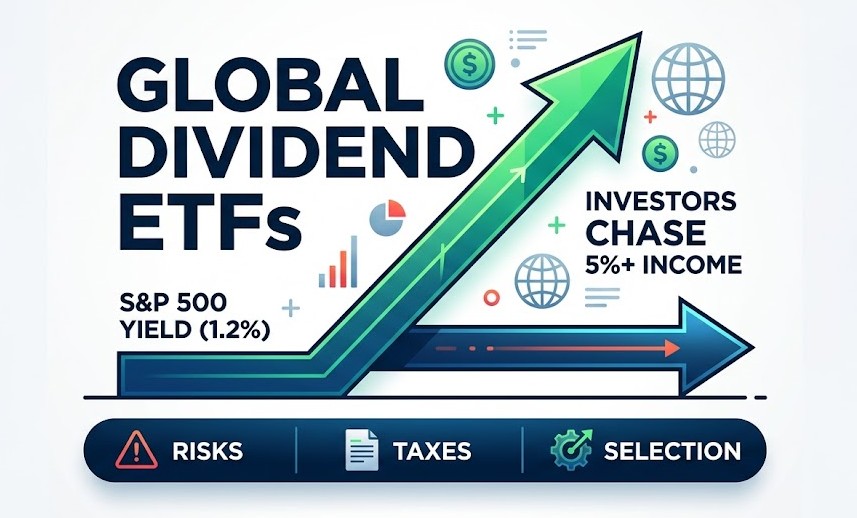
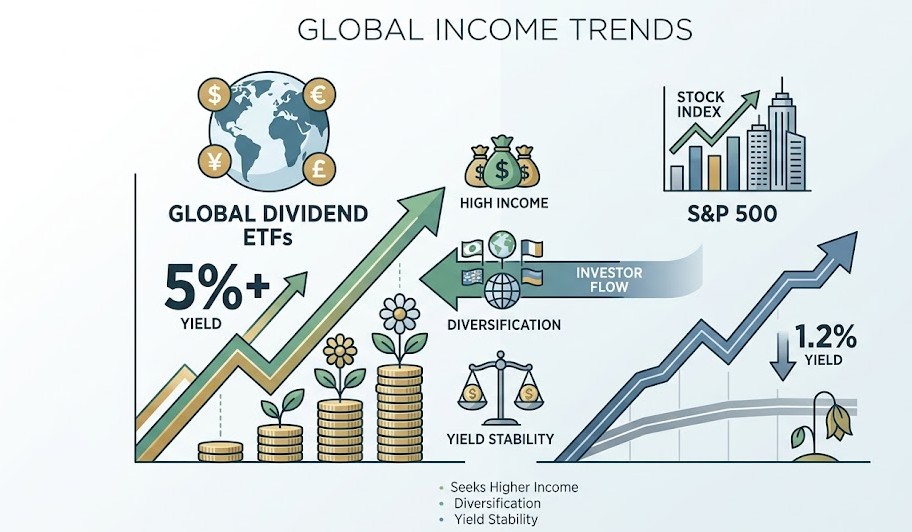
Investors are shifting toward global dividend ETFs offering yields above 5% as the S&P 500 dividend yield falls to 1.2%, its lowest level in more than 30 years.
Global Dividend ETFs Offering 5%+ Yields Draw Investors as S&P 500 Income Dries Up
Income-focused investors are increasingly looking beyond U.S. equities as the S&P 500's dividend yield has dropped to just 1.2%, its lowest level since the early 1990s. With growth-oriented technology companies dominating the index and prioritizing reinvestment over shareholder payouts, global dividend exchange-traded funds (ETFs) yielding more than 5% are emerging as attractive alternatives for investors seeking consistent cash flow.
The widening yield gap has accelerated interest in international and emerging-market dividend strategies that offer significantly higher distributions while providing diversified exposure across multiple countries and sectors.
Why the S&P 500 Dividend Yield Has Fallen So Sharply
The composition of the U.S. stock market has changed dramatically over the past decade. Large-cap technology companies now represent a substantial portion of the S&P 500, and many of these businesses focus on growth rather than paying large dividends.
As share prices have appreciated much faster than dividend growth, the index's overall yield has compressed to around 1.2%, reducing its appeal for investors who depend on portfolio income. Historically, the S&P 500 typically offered dividend yields between 2% and 3%, providing a more meaningful source of cash returns during periods of Volatility" title="More analysis on Market Volatility">market volatility.
Today's lower yield reflects both elevated valuations and the increasing influence of companies that either pay minimal dividends or none at all.
Global Dividend ETFs Are Filling the Income Gap
In response, investors are allocating capital toward dividend-focused ETFs investing across Europe, Asia, Latin America, and other international markets where corporate payout policies differ significantly from those in the United States.
Many of these funds currently advertise yields above 5%, primarily because they invest in sectors such as:
- Utilities
- Financial services
- Energy
- Materials
- Telecommunications
- Resource-based industries
These industries often generate stable cash flows and maintain higher payout ratios than technology companies, making them attractive for income-oriented portfolios.
For investors seeking higher current income without purchasing individual foreign stocks, diversified dividend ETFs provide a convenient solution while reducing single-company risk.
Higher Yields Come With Additional Risks
Although a 5% dividend yield appears attractive compared with the S&P 500's 1.2%, investors should recognize that headline yield alone does not guarantee superior long-term performance.
Several important risks accompany international dividend investing:
Currency Exposure
Foreign dividend payments are converted back into U.S. dollars. Currency fluctuations can reduce the effective income investors receive even if local dividends remain stable.
Dividend Sustainability
Some companies may temporarily offer unusually high yields because earnings are under pressure or stock prices have declined significantly. Unsustainable payout ratios and weak cash generation can eventually lead to dividend cuts.
Geopolitical and Economic Risk
Emerging markets often face political uncertainty, regulatory changes, and economic volatility that can affect both share prices and dividend payments.
Tax Withholding
Many countries impose withholding taxes on dividends paid to foreign investors, reducing net income unless tax treaties or fund structures help recover part of those amounts.
Dividend Quality Matters More Than Yield Alone
Market analysts emphasize that investors should evaluate the underlying quality of dividend-paying companies rather than focusing exclusively on advertised yields.
Key indicators include:
- Consistent free cash flow generation
- Conservative payout ratios
- Strong balance sheets
- Sustainable dividend histories
- Low leverage
- Stable earnings growth
Companies that maintain healthy cash flow and disciplined capital allocation are generally better positioned to preserve dividends during economic downturns.
Conversely, firms relying heavily on debt or cyclical earnings may struggle to maintain payouts when conditions deteriorate.
Total Return Still Remains the Ultimate Measure
High dividend income does not automatically translate into superior investment performance.
Investors should compare total returns over three-year and five-year periods to determine whether elevated yields have been accompanied by competitive capital appreciation.
Many international dividend funds trade at lower valuation multiples than mega-cap technology stocks, creating potential upside if value-oriented sectors outperform. However, sectors such as energy and financials can experience greater earnings volatility, which may pressure future distributions.
Balancing yield with long-term growth potential remains essential.
Practical Considerations Before Investing
Financial professionals generally recommend several due diligence steps before allocating capital to global dividend ETFs:
- Review country and sector diversification to avoid excessive concentration.
- Examine historical dividend stability and growth trends.
- Evaluate free cash flow coverage and payout ratios.
- Consider currency-hedged share classes if foreign exchange volatility is a concern.
- Keep allocations aligned with overall portfolio objectives and risk tolerance.
- Compare expense ratios and portfolio turnover across competing funds.
These factors can significantly influence long-term returns beyond the advertised distribution yield.
Rotation Toward Income Strategies Continues
Asset managers have reported increasing interest in dividend-oriented ETFs as investors search for dependable cash flow in an environment where U.S. equity valuations remain elevated.
Institutional portfolios have modestly increased allocations to international income strategies, while retail investors are also turning toward ETF structures that provide diversified exposure and professional management.
If the S&P 500's dividend yield remains near historical lows, global dividend funds may continue attracting capital from investors seeking stronger income generation without relying on concentrated individual stock positions.
Outlook
The future performance of global dividend ETFs will depend on several variables, including dividend growth, currency movements, interest rate policy, and overall economic conditions.
While yields above 5% can provide an attractive income stream, investors should actively monitor dividend sustainability, underlying fundamentals, and valuation risks rather than chasing yield alone.
For many portfolios, combining quality U.S. holdings with diversified global dividend ETFs may offer a balanced approach that supports both long-term growth and current income while reducing dependence on any single market or investment style.