Global Dividend ETFs Outperform S&P 500; 3 Funds Yield Over 5%
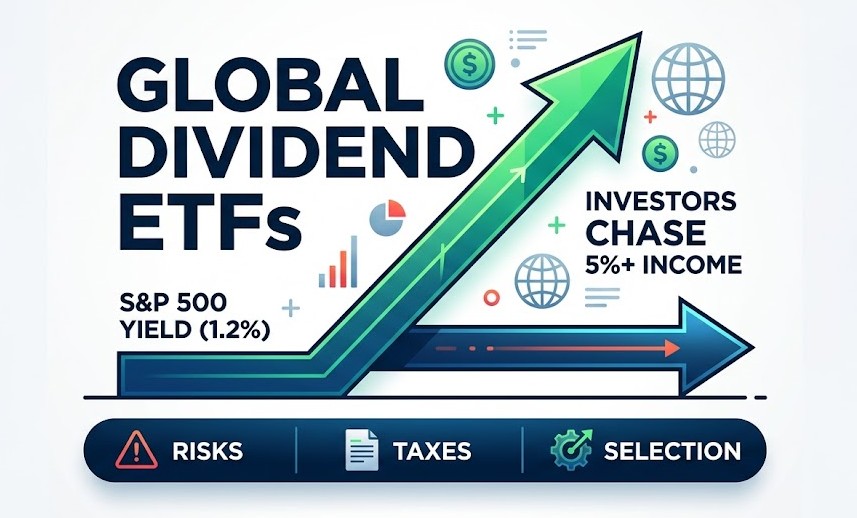
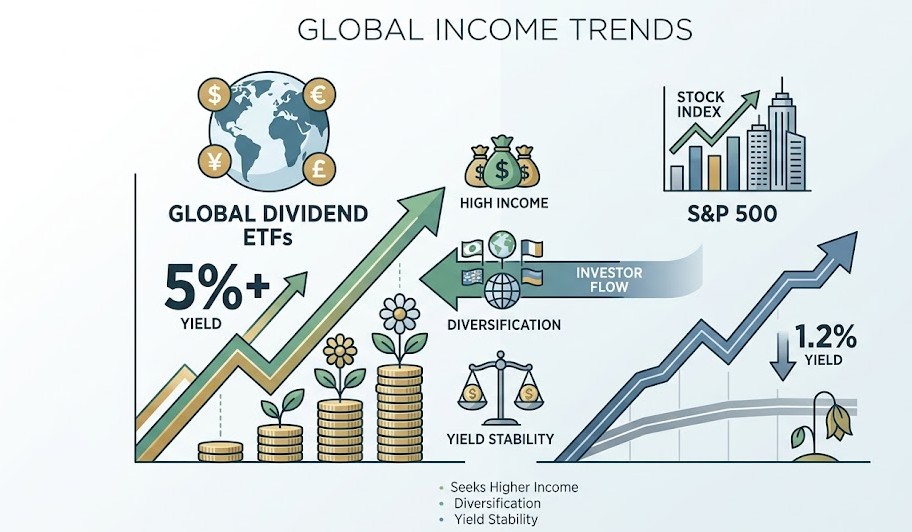
Global dividend-focused ETFs have outperformed the S&P 500 this year, attracting investors with yields above 5% while the S&P 500’s dividend yield has fallen to roughly 1.2%. With U.S. equity markets increasingly dominated by growth-oriented technology stocks, investors seeking income are turning toward international and emerging-market dividend strategies for higher cash flow and diversification.
Background and Market Context
The S&P 500’s dividend yield has dropped to one of its lowest levels since the early 1990s technology boom, reflecting the heavy influence of large-cap growth companies that typically prioritize reinvestment over dividend payouts.
In contrast, many international and emerging-market companies maintain higher payout ratios and operate in sectors traditionally associated with stable dividends, including utilities, financials, energy, telecommunications, and consumer staples.
As a result, several global dividend ETFs currently offer yields above 5%, significantly higher than broad U.S. equity benchmarks.
Why Global Dividend ETFs Are Outperforming
The primary driver behind the recent outperformance has been income generation.
When the S&P 500 yield compresses, the contribution of dividends to total return declines. Investors focused on income therefore shift toward markets and sectors where dividend payouts remain materially higher.
Higher starting yields can significantly improve total return performance in environments where equity price appreciation is slower or more volatile.
Several structural differences also support higher international dividend yields:
- Non-U.S. companies often prioritize larger shareholder payouts
- Valuations in many overseas markets remain lower than U.S. equities
- Certain international sectors historically distribute a greater percentage of earnings as dividends
- Emerging-market and European equities generally trade at lower valuation multiples, boosting effective yields
Understanding the Risks Behind High Yields
High yields alone do not guarantee strong investment outcomes.
In some cases, elevated dividend yields result from falling share prices rather than improving business fundamentals. This is especially important in emerging markets, where dividend payments can fluctuate due to commodity cycles, currency volatility, economic instability, or geopolitical risk.
Investors should carefully evaluate:
- Payout ratios
- Free cash flow coverage
- Dividend sustainability
- Historical dividend consistency
- Balance-sheet strength
A high distribution yield supported by weak fundamentals may not be sustainable over the long term.
Tax and Currency Considerations
Global dividend investing introduces additional complexities beyond traditional U.S. equity exposure.
Foreign dividends may be subject to withholding taxes that reduce net income received by investors. Some ETFs attempt to improve after-tax yield through tax-efficient structures or reclaim processes, but these vary by fund.
Currency fluctuations also play an important role. Unhedged international dividend ETFs can experience increased volatility due to exchange-rate movements, while currency-hedged versions may reduce volatility at the cost of higher expenses.
Investors should weigh these trade-offs based on their investment horizon and income objectives.
Market Reaction and Investor Flows
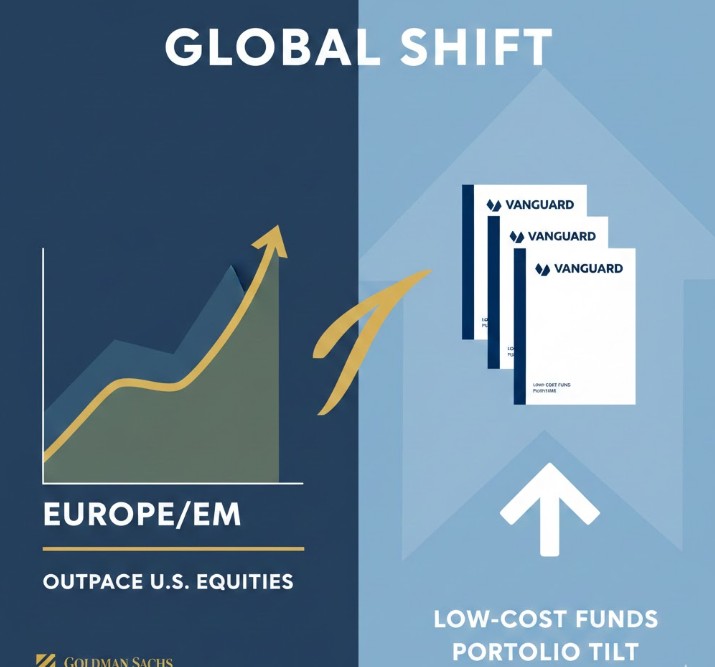
Portfolio managers and income-focused investors have increasingly rotated into global dividend strategies as yields on traditional U.S. equities remain compressed.
Analysts note that these ETFs can provide:
- Higher current income
- Lower portfolio volatility
- Diversification outside U.S. technology concentration
- Exposure to undervalued international sectors
However, they also caution that avoiding U.S. growth stocks entirely can limit long-term capital appreciation potential during strong technology-led market cycles.
Practical Considerations for Investors
Investors considering global dividend ETFs should focus on total return rather than headline yield alone.
A fund yielding 5% while experiencing significant capital losses may ultimately underperform a lower-yielding investment with stronger price appreciation.
Important evaluation factors include:
- Expense ratios
- Sector concentration
- Geographic diversification
- Historical drawdowns
- Dividend growth trends
- Trading liquidity
Using diversified global dividend ETFs rather than concentrated single-country funds can help reduce geopolitical and currency-related risks.
Portfolio Implementation Strategies
For most investors, global dividend ETFs work best as a complement to a diversified portfolio rather than a full replacement for U.S. equities.
Gradual allocation shifts and periodic rebalancing can help manage risk while maintaining exposure to both income and long-term growth opportunities.
Conservative investors may also consider combining dividend ETFs with short-duration bonds or fixed-income ladders to improve income stability and reduce overall portfolio volatility.
Conclusion and Forward Looking Perspective
The widening gap between the S&P 500’s low dividend yield and the higher yields available in global dividend ETFs reflects a broader market shift toward income-focused investing.
For investors seeking stronger cash flow and diversification, international and emerging-market dividend strategies can offer compelling opportunities. However, higher yields come with additional risks tied to currencies, taxes, geopolitical exposure, and payout sustainability.
The most effective approach is likely a balanced one: using global dividend ETFs as part of a diversified allocation strategy rather than relying on yield alone as the primary investment decision factor.
As interest rates, inflation, and global market conditions continue evolving, disciplined portfolio construction and careful ETF selection will remain critical in determining whether higher yields ultimately translate into stronger long-term returns.