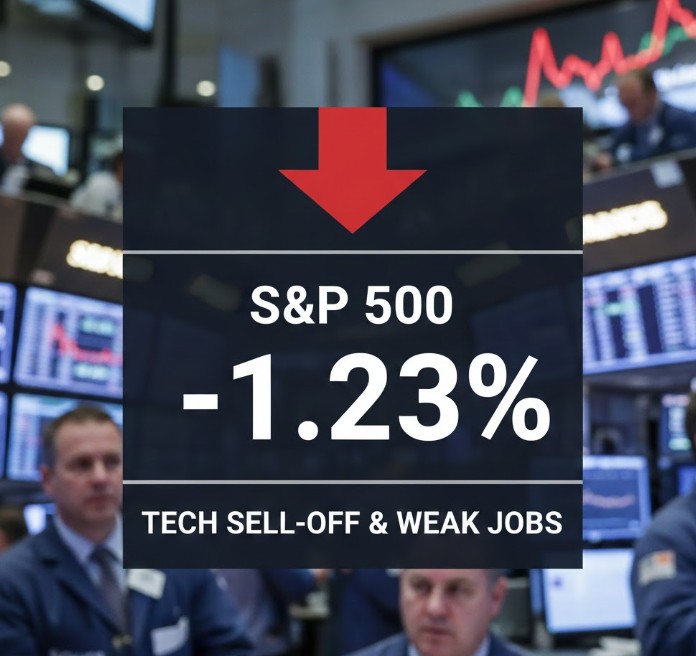
Goldman Sachs CEO: Tech Sell-Off 'Too Broad' for Software Stocks
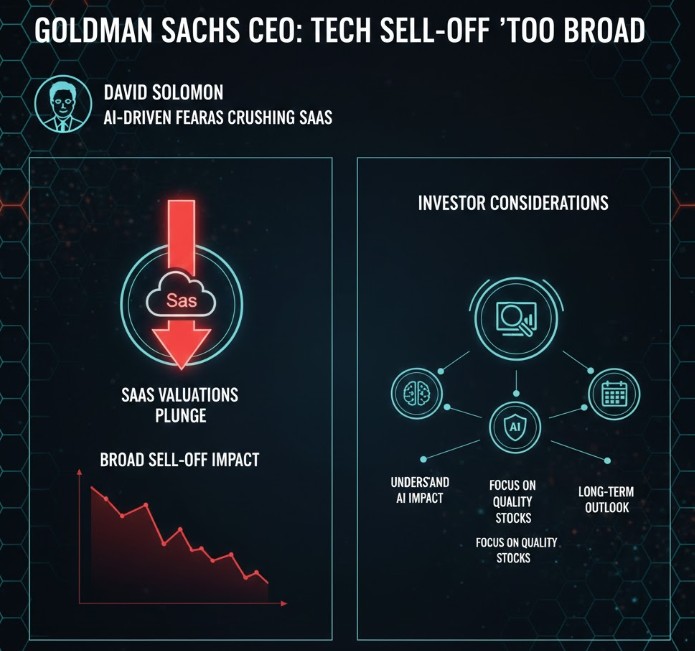
Goldman Sachs CEO David Solomon said the recent technology sell-off has been “too broad,” a blunt assessment that underlines growing concern over how artificial intelligence could reshape the software-as-a-service (SaaS) business model. His comments matter because they come from a leading Wall Street CEO at a moment when investors are aggressively repricing high-growth software names.
Company Background and Recent Performance
Goldman Sachs Group Inc. (NYSE: GS) is a diversified global investment bank and financial services firm, and David Solomon has been its CEO since 2018. While Goldman is not a software company, Solomon’s views carry weight across markets because of the firm’s central role in advising corporates, underwriting securities, and running large proprietary and client-facing trading operations.
In recent months, markets have rotated; growth and software-linked stocks have lagged while value and rate-sensitive sectors have regained investor interest. That rotation has pressured multiples on many SaaS businesses and forced investors to reassess forward revenue growth and margin durability in the face of rapid AI adoption.
Detailed Analysis of the News Event
Solomon’s characterization of the sell-off as “too broad” signals a pushback against a market narrative that treats all software incumbents and high-growth platforms as uniformly vulnerable to disruption from generative AI. Investors have been worried that automation and new AI-native competitors will undercut recurring revenue streams and compress lifetime customer value for legacy SaaS providers. Those fears have driven steep multiple contraction in parts of the sector.
But Solomon’s point is twofold.
First, the risk of AI disruption is heterogeneous: it varies by product category, customer concentration, contract duration, and the degree to which AI is an incremental feature rather than a foundational replacement.
Second, public markets sometimes overreact to headline technology trends, producing outsized declines that are not always justified by near-term fundamentals.
For many SaaS companies with predictable renewal rates, sticky enterprise adoption, and multi-year contract visibility, AI may be an opportunity to enhance product value and pricing power rather than a binary threat.
Market Reaction and Analyst Commentary
The immediate market reaction to Solomon’s comments was a modest relief in sentiment among traders focused on software. While the broader tech sell-off had already driven notable declines among cloud and SaaS names, investors paused to recalibrate risk premia after a high-profile banker questioned the breadth of the sell-off.
Analysts noted that pockets of the sector remain vulnerable particularly smaller vendors with limited balance-sheet flexibility, high customer churn, or concentrated revenue bases but also emphasized that higher-quality franchises with gross margins above 70% and net retention rates north of 100% exhibit durable economics.
Several strategists pointed out that the sell-off accelerated multiple compression rather than signaling immediate revenue shortfalls. In other words, equity investors are shaving valuations to reflect a longer-term discount rate and uncertain cash-flow profiles. The dialogue sparked by Solomon emphasizes due diligence: not all software companies face the same probability of obsolescence, and stock price moves that treat them as a monolith may create selective buying opportunities.
What This Means for Investors Actionable Insights
- Differentiate between defensive and vulnerable names: Prioritize companies with diversified client bases, long-term contracts, low churn, and high gross margins. These attributes increase resilience to AI-enabled competition.
- Revisit valuation assumptions: Analysts are increasingly using lower terminal multiples and higher discount rates for growth stocks. Investors should stress-test models for slower growth and delayed profitability rather than rely on consensus momentum.
- Watch AI adoption pathways: Companies that integrate AI to increase customer ROI and expand addressable markets may see revenue upside. Assess whether AI features lead to increased pricing power or merely cost reductions that compete away margin advantages.
- Maintain liquidity to act on dislocations: If the market has indeed over-rotated, selective purchasing of high-quality SaaS franchises at lower multiples can improve long-term returns; but maintain position sizing discipline to manage execution risk.
Conclusion and Forward-Looking Perspective
David Solomon’s public rebuke of what he called an overly broad tech sell-off is a reminder that market-driven repricings often blur important distinctions among companies. For investors, the takeaway is to combine macro awareness of AI-driven disruption with micro-level analysis of business models.
The next phase of the market will likely separate companies that can monetize AI as a growth lever from those that will primarily see margin pressure. Careful portfolio construction, rigorous valuation work, and patience will be essential as investors navigate an era where technological change and market sentiment interact more rapidly than in prior cycles.
Goldman CEO David Solomon's comment highlighted that the tech sell-off may be an overreaction to AI fears, prompting traders to reassess broad-based declines in SaaS valuations.