Goldman Sachs Urges Vanguard Europe, EM Funds to Beat S&P Over Decade
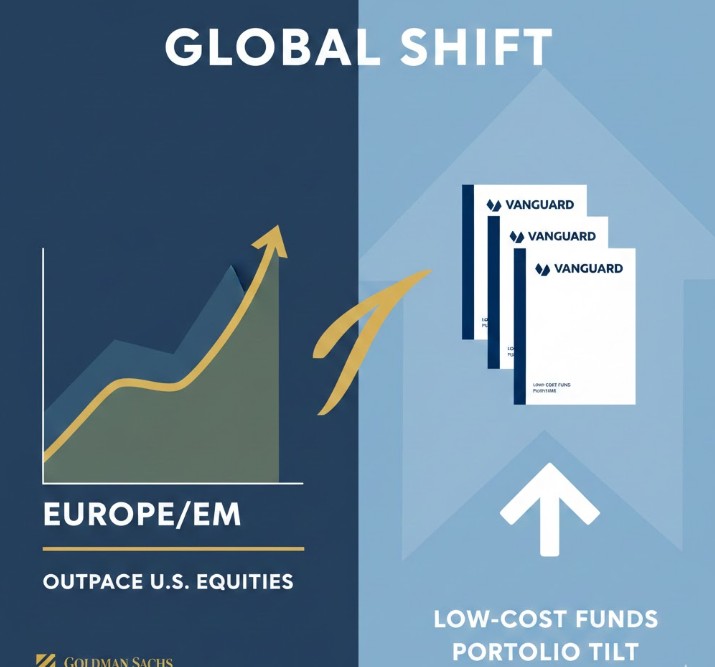
Goldman Sachs released research this week arguing that European and emerging-market equities are poised to outperform the U.S. stock market over the next decade, and Wall Street analysts highlighted Vanguard index funds as efficient vehicles for investors to capture that opportunity. The call matters because it challenges the long-running dominance of U.S. equities in many portfolios and could influence trillions in global asset allocations and ETF flows.
Company Background and Market Context
Goldman Sachs (GS) is one of the largest global investment banks and a major provider of market research and asset management advice. Its macro and equity strategists regularly publish long-horizon return expectations that institutional investors and asset managers use to set strategic asset allocations.
Vanguard, while privately held and not traded, is the world’s largest provider of index mutual funds and ETFs; its low-cost, broad-based funds are the practical instruments many advisors recommend for long-term exposure to regions outside the U.S.
U.S. equities have led global markets for much of the past decade, driven by large-cap technology firms and strong earnings growth. That leadership produced outsized returns for U.S.-heavy indices such as the S&P 500, prompting investors to increase domestic exposures. However, valuations, sector composition, and macroeconomic cycles can rotate leadership among regions. Goldman’s projection that Europe and emerging markets will outperform reflects several secular and cyclical factors that could alter relative returns over a 10-year horizon.
Detailed Analysis of the Outlook
Goldman’s case centers on valuation disparities, sector composition, and cyclical recovery. European equities trade at meaningful valuation discounts relative to the U.S., and European markets offer heavier exposure to cyclical sectors such as financials and industrials that could benefit from global growth and higher commodity prices.
Emerging markets typically trade at deeper discounts but also offer higher potential growth driven by younger demographics, urbanization, and faster GDP growth in several large economies. Over long horizons, these structural differences can translate into higher realized returns, especially when starting valuations are lower.
For investors, Vanguard’s suite of international index funds and ETFs known for expense ratios often well below 0.20% and in many cases under 0.10% serves as a low-cost, tax-efficient way to gain region-specific exposure. Allocations to developed Europe funds or broad emerging-market funds reduce single-country risk while providing diversified exposure to companies that could benefit from cyclical tailwinds. Vanguard’s scale and passive approach mean investors can implement Goldman’s allocation tilt without taking on stock-specific active manager risk or high fees.
Market Reaction and Analyst Commentary
The market reaction to Goldman’s note was measured. Equity futures and major indices did not display an abrupt regime shift because the bank’s view reinforces an ongoing narrative among some institutional investors rather than introducing a surprise. However, strategists and asset allocators on the sell-side and buy-side acknowledged that Goldman’s high-profile endorsement of non-U.S. allocations adds conviction to a strategy many were already considering.
ETF flows to international funds have shown episodic strength in past months as investors rebalance from a long U.S. bias, and a sustained consensus could increase demand for Europe and emerging-market ETFs.
Analysts pointed to implementation details. Passive advocates highlight that low-cost Vanguard funds are a simple way to capture regional exposure: broad international ETFs avoid active manager selection risk and keep fees low, which can materially boost long-term returns. Others cautioned about near-term volatility and idiosyncratic risks political uncertainty in Europe, China growth concerns, currency swings, and liquidity differences in certain emerging markets.
As a result, several strategists recommended a staged approach: overweight international equities incrementally, hedge currency exposure where appropriate, and maintain diversification across sectors and market caps.
What Investors Should Consider
- Reassess strategic allocations: Investors with heavy U.S. concentrations should evaluate whether their long-term allocation reflects the possibility of higher relative returns from Europe and emerging markets.
- Use low-cost ETFs for regional tilts: Vanguard index funds offer broad exposure and expense ratios that support long-horizon compounding; they are efficient building blocks for global equity allocations.
- Manage currency and geopolitical risk: Consider hedged share classes or gradual implementation if concerned about near-term currency volatility or country-specific events.
- Maintain discipline on rebalancing: A rules-based rebalancing plan can capture mean-reversion opportunities and prevent emotional tilts during market swings.
For taxable investors, Vanguard’s tax-efficient structures and dividend treatment can help after-fee returns, but it’s important to account for withholding taxes and local dividend policies that can affect net distributions. Institutional investors will weigh Goldman’s research against their return assumptions, liability profiles, and risk tolerances before altering strategic asset allocations.
Conclusion
Goldman Sachs’ projection that European and emerging-market equities may outpace the U.S. over the next decade is a consequential signal for long-term investors. It does not imply immediate outperformance or eliminate the risks inherent in non-U.S. allocations, but it increases the case for a diversified, globally tilted portfolio implemented with low-cost vehicles such as Vanguard index funds.
Investors with a 10-year horizon should weigh the reallocation benefits against currency and political risks and consider incremental, cost-efficient steps using passive Vanguard funds to capture potential long-term gains beyond the S&P 500.
The news influenced investor allocation views because Goldman Sachs' high-profile research advocating a shift toward European and emerging-market equities increases conviction in reallocating portfolios and could drive ETF flows.