Intuit’s AI Lead Fails to Stop SaaS Stock Selloff and Investor Panic
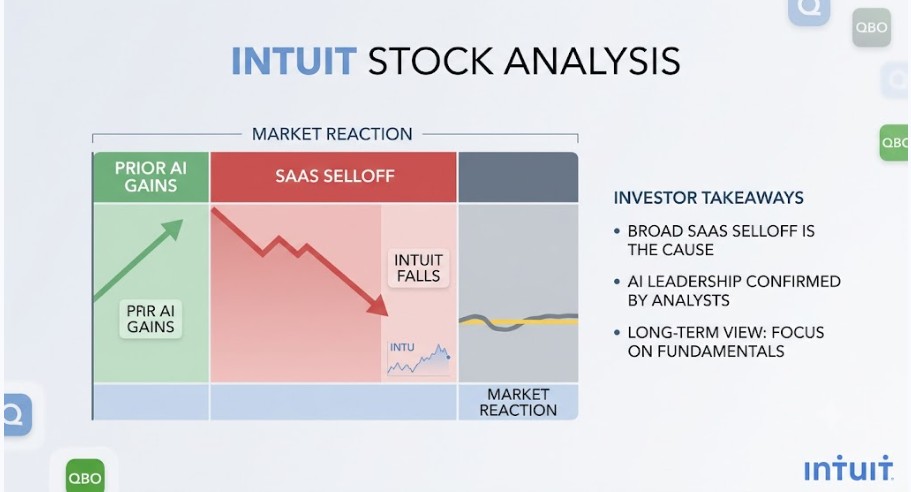
Intuit Inc. has long been viewed as a pioneer in applying artificial intelligence to consumer and small-business financial software, but recent market moves show that technological leadership alone was not enough to shield the stock from a broader software-sector selloff. Shares declined as investors rotated out of high-multiple SaaS names, reflecting concerns over valuation resets and growth durability despite Intuit's continued investment in AI-driven products and human-expert services.
Company Background and Recent Performance
Intuit (INTU) operates market-leading brands including TurboTax, QuickBooks, and Credit Karma, and has spent years integrating machine learning, natural language processing, and human expert networks into its offerings to automate tax preparation and small-business accounting.
The company has emphasized AI as a competitive moat, rolling out features such as automated bookkeeping, predictive cash-flow tools, and a hybrid human-AI tax adviser experience. That strategy has historically delivered steady revenue growth and strong free-cash-flow generation, making Intuit a core holding for many long-term investors.
Analysis of the Recent Selloff
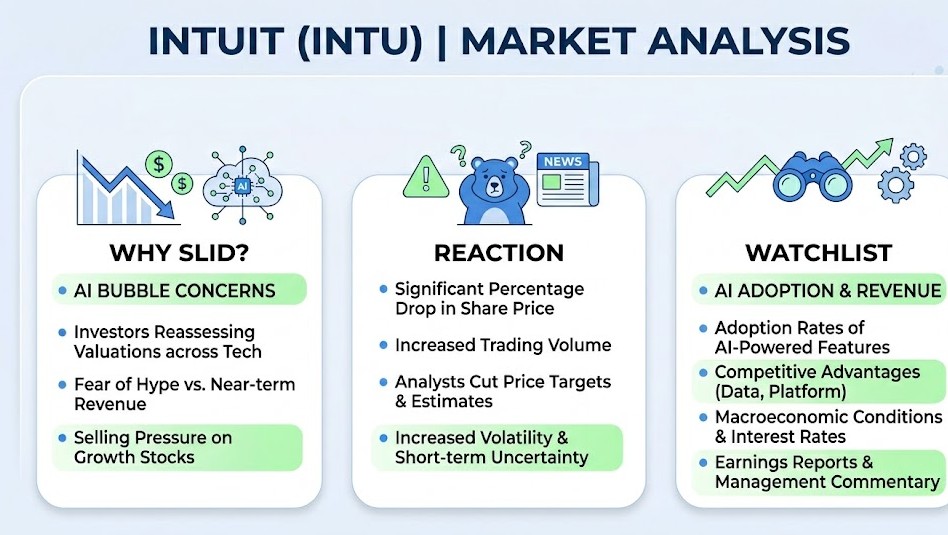
Investors began reassessing Intuit after a broad wave of selling across software stocks, a trend some market participants have labeled the "SaaSpocalypse," as higher interest rates and valuation compression raised the bar for growth.
Even with AI-driven product improvements, investors shifted their focus toward revenue acceleration, margin leverage, and forward guidance, resulting in short-term multiple contraction. The disconnect between Intuit's fundamental execution and investor sentiment illustrates how quickly favorable narratives can be overshadowed by macroeconomic and market-structure forces.
Management continues to point to durable demand for automated financial tools and remains committed to research and development spending. However, higher sales and marketing costs associated with acquiring small-business customers and integrating acquisitions can pressure near-term profitability.
Regulatory scrutiny and intensifying competition from fintech firms and major cloud providers also mean that AI-led differentiation must translate into stronger customer retention and higher average revenue per user (ARPU) to justify premium valuations.
In short, AI is necessary but not sufficient. Execution, unit economics, and predictable guidance remain central to investor confidence.
Market Reaction and Analyst Commentary
Market reaction was swift, with funds rotating out of growth-oriented software stocks and into value and cyclical sectors. Some quantitative trading strategies further amplified the decline by reducing exposure to companies with stretched valuation multiples.
Analysts covering Intuit largely maintained confidence in the company's long-term competitive position, although several indicated that near-term earnings estimates and price targets may need adjustment to reflect the new valuation environment.
A number of market strategists advised investors to distinguish between secular growth drivers and cyclical headwinds when determining portfolio exposure.
What This Means for Investors
For investors, the recent selloff highlights the importance of valuation discipline, even when investing in companies with durable competitive advantages and advanced technology platforms.
Long-term shareholders should monitor:
- Revenue guidance trends and growth sustainability.
- Customer churn rates across key segments.
- Adoption rates of AI-powered products and services.
- Evidence that AI features are increasing ARPU or reducing servicing costs.
- Margin recovery and free-cash-flow generation.
Short-term traders may find opportunities amid heightened volatility, but should remain mindful of the potential for additional multiple compression if macroeconomic conditions weaken further.
Practical actions include:
- Reassessing position size relative to overall software-sector exposure.
- Monitoring quarterly guidance for signs of margin stabilization.
- Comparing Intuit's free-cash-flow yield and valuation metrics against peers.
- Establishing valuation-based entry points tied to sustainable revenue growth and margin expansion.
Acquisition Strategy and Margin Considerations
Historically, Intuit has supplemented organic innovation with acquisitions such as Credit Karma and Mailchimp to broaden its addressable market and accelerate cross-selling opportunities.
While these transactions have diversified revenue streams, they have also required integration spending and created transitional costs that can weigh on margins in the near term.
Investors should evaluate whether recent margin pressure reflects temporary investment cycles or a more permanent reassessment of profitability assumptions.
Key metrics to watch include:
- Adoption rates for AI-enabled modules.
- Net retention rates among QuickBooks customers.
- Changes in customer lifetime value across both consumer and business segments.
If AI investments materially improve productivity and lower service costs, Intuit could justify premium valuation multiples through higher sustainable margins. Conversely, if competition drives customer acquisition costs higher or weakens pricing power, valuation pressure could persist.
Forward-Looking Perspective
Two scenarios currently dominate investor thinking.
In the first, Intuit's AI investments translate into measurable revenue acceleration and margin expansion over the next 12 to 18 months, supporting a recovery in valuation multiples.
In the second, secular growth remains intact but slows, leaving the stock trading within a lower valuation range for an extended period.
History suggests that software companies demonstrating resilient subscription growth and clear paths to margin improvement tend to recover more quickly following valuation resets. As a result, Intuit's recovery will likely depend less on narrative and more on consistent financial execution.
For now, investors should balance confidence in Intuit's durable franchise against ongoing market volatility and establish clear, data-driven criteria for adding to or trimming positions.
Intuit shares declined as investors rotated out of high-multiple SaaS stocks, repricing the company amid concerns over valuation, margin pressure, and near-term guidance despite its significant AI investments.