Microsoft's Dividend Appeal: A Tech Hold for 20 Years of Growth
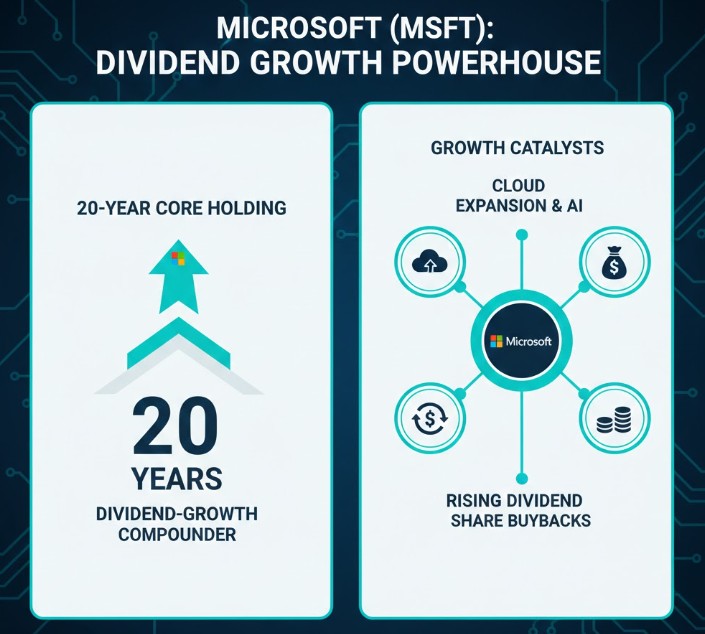
Microsoft’s combination of scale, recurring cloud revenue, and a disciplined capital-return policy positions it as a compelling dividend-growth holding for long-term investors. The argument is simple: durable free cash flow and conservative payout metrics give the company room to raise dividends and return capital while funding growth initiatives.
Company Background and Recent Performance
Microsoft Corporation (MSFT) is a trillion-dollar software and cloud leader with core franchises in Windows, Office, Azure cloud services, LinkedIn, and a growing portfolio of AI products and services. Revenue has expanded materially over the last several years, driven by Azure and enterprise software, with cloud revenue growing at double-digit rates. The company generates substantial free cash flow; historically its dividend yield has been modest relative to traditional income names, but its payout ratio has remained conservative, supporting dividend increases and heavy share-repurchase programs.
Analysis of the News Event
The headline that top tech stocks “offer significant dividend growth potential” reflects a broader shift in investor focus toward income plus growth in software stalwarts like Microsoft. Unlike high-yield, slow-growth utilities, Microsoft’s dividend story rests on rising cash flow from high-margin software and cloud services. If the company sustains mid-to-high single-digit revenue growth and expands operating margins modestly, incremental free cash flow can be allocated to both capital investment and shareholder returns providing a runway for dividend compounding over decades.
Financial Mechanics That Support Dividend Growth
Microsoft’s capital allocation has prioritized a balanced mix of dividends and buybacks. A relatively low payout ratio historically a fraction of earnings provides headroom for above-inflation dividend increases in strong years. At the same time, continued buybacks reduce share count and amplify per-share metrics, translating to higher EPS and potentially larger dividend per share over time. For investors, the combination of steady dividend increases and sizeable repurchases is the core reason to view Microsoft as a long-term income-growth candidate.
Market Reaction and Analyst Commentary
Markets typically react to durable income narratives with valuation expansion among income-oriented investors and exchange-traded funds focused on dividend growth. Analysts have pointed to the stability of Microsoft’s enterprise contracts and recurring software revenue as evidence that dividend increases can be sustained even through periodic macro slowdowns. Commentators also note potential volatility tied to AI-related spending cycles and regulatory scrutiny, but emphasize that strong free cash flow generation remains the dominant driver for shareholder returns.
Risk Factors and Counterpoints
Investors should weigh risks: high valuation multiples can compress if growth slows, and a material change in enterprise spending or increased regulatory penalties could reduce free cash flow available for dividends. Additionally, Microsoft’s yield is typically lower than traditional income stocks, so total return depends on dividend growth plus capital appreciation. Currency swings and macroeconomic weakness in enterprise IT budgets are additional variables that could influence dividend trajectory.
What This Means for Investors Actionable Insights
Income investors seeking long-duration dividend growth can consider allocating a portion of their dividend-growth sleeve to Microsoft, treating the position as a mix of income and growth exposure. Dollar-cost averaging or staged purchases on valuation weakness can mitigate timing risk. Investors focused strictly on current yield rather than growth should compare Microsoft to higher-yielding alternatives, recognizing the trade-off between current income and potential dividend escalation over time.
Portfolio Positioning and Practical Steps
A practical approach is to size Microsoft positions relative to an investor’s growth and income objectives: conservative income portfolios might limit exposure and complement Microsoft with higher-yield, lower-growth names, while growth-oriented income portfolios can overweight Microsoft for secular cloud and AI exposure plus dividend upside. Monitor metrics such as free cash flow margin, payout ratio, buyback cadence, and annual dividend increases as signals of management’s commitment to shareholder returns.
Forward-Looking Perspective and Conclusion
Over a 20-year horizon, Microsoft’s combination of recurring revenue, secular cloud adoption, and strategic buybacks creates a credible pathway for meaningful dividend growth, even if the current nominal yield is modest. For long-term investors who value the compounding of rising payouts alongside capital appreciation, Microsoft represents a blend of stability and upside. That said, valuation discipline and active monitoring of cash flow trends are essential; investors should expect intermittent volatility but can view share price weakness as potential entry opportunities for patient, income-oriented portfolios.
Investor interest in durable dividend-growth opportunities lifted demand for Microsoft shares, driven by its strong free cash flow, cloud momentum, and capital-return strategy.