Netflix's Warner Bros. Deal Sparks Doubt as NFLX Slides 12% This Year
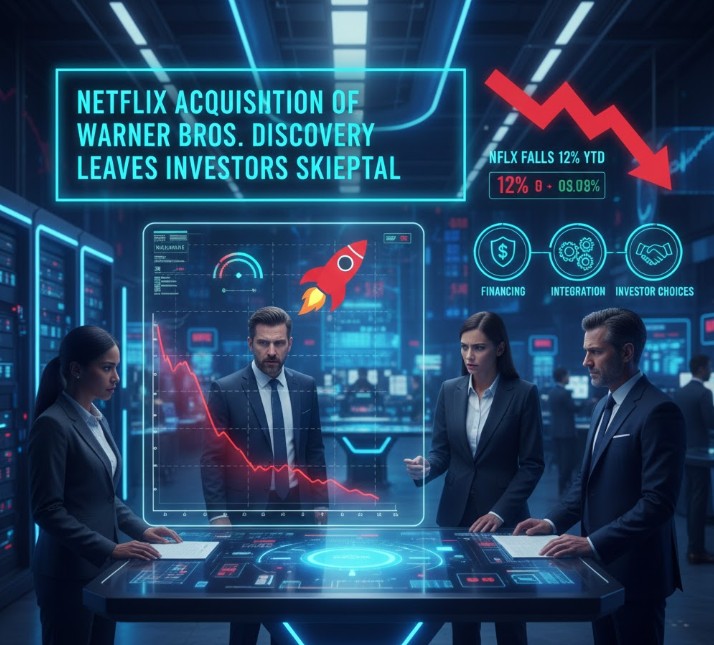
Lead: Netflix on Tuesday faced growing investor skepticism after the company’s announcement that it will acquire Warner Bros. Discovery, a move that has sent NFLX shares down 12% year-to-date and rekindled debate over whether the streaming giant can justify the price and execution risk. The deal, positioned as a bet on scale and content ownership to defend long-term subscriber growth and margins, shifts Netflix from a pure streaming operator toward a broader media conglomerate, and investors are asking whether the trade-off is worth it.
Company background and recent performance
Netflix’s path to dominance has been driven by content investment,
international expansion and consistent improvement in monetization through
price increases and an ad-supported tier. The company reported accelerating
revenue growth in recent quarters and had outpaced many peers on subscriber
revenue per user. Nonetheless, 2026 began with investor nerves frayed: NFLX is
down roughly 12% year-to-date, and commentators who forecasted Netflix to crush
the S&P 500 between 2026 and 2030 are now reassessing the timeline in light
of the acquisition.
Strategic rationale behind the acquisition
The Warner Bros. Discovery purchase represents one of the most consequential
M&A moves in streaming history in scale and cultural footprint. Management
argues the combined content catalog, franchises and distribution capabilities
will deliver multi-year synergies and improve Netflix’s competitive moat. For
investors, the critical questions are the price paid, the financing mix, the
timeline to realize cost and revenue synergies, and whether integration will
dilute Netflix’s unit economics or buoy them through broader monetization
opportunities such as theatrical releases, merchandising and live events.
Financial implications and valuation concerns
Market concerns center on near-term financials. Large content deals often
require substantial cash, debt issuance or equity dilution, each path carrying
implications for margins and returns. If Netflix finances the transaction with
cash and debt, leverage ratios could rise and constrain buybacks or
dividend-like capital returns. If Netflix uses stock, current shareholders face
dilution risk and earnings-per-share pressure until synergies materialize.
Even with conservative assumptions, analysts model multi-year integration costs and a lag before net benefits appear, which explains the adjustment in valuation multiples and the share price reaction this year.
Operational and competitive risks
Operational risks are equally relevant. Integrating two large media cultures,
one built on technology-forward subscriber management and the other steeped in
legacy studio operations, poses execution challenges. Content licensing
agreements, talent contracts and regional distribution rights can complicate
consolidation. Moreover, global streaming remains intensely competitive:
Disney+, Amazon Prime Video and regional platforms continue to invest heavily
in originals and local-language content.
Netflix will need to maintain subscriber growth while extracting greater value from an expanded catalog, which depends on marketing efficiency, algorithmic recommendations and price elasticity across markets.
Analyst commentary and market reaction
Analysts and market commentators have issued cautious takes. Several sell-side
analysts reduced near-term price targets, citing dilution and integration
timelines; independent media analysts reminded investors that even successful
roll-ups historically take three to five years to generate meaningful
shareholder returns. Conversely, a subset of strategists highlighted long-term
upside if Netflix can convert Warner’s vast intellectual property into
higher-margin channels such as theatrical windows, premium television and
global franchise exploitation, arguing these could materially lift average
revenue per user over time.
Market reaction has been tangible. The stock’s 12% year-to-date decline reflects a re-rating as investors price in execution risk and a longer horizon for payoff. Trading volumes around the announcement spiked, indicating institutional repositioning. Options-implied volatility rose, signaling elevated short-term uncertainty. Meanwhile, competitors’ stocks showed muted moves, suggesting investors view the deal as a company-specific risk rather than a sector-wide catalyst.
What this means for investors: actionable insights
Investors assessing Netflix now should adopt a disciplined approach and model
multiple scenarios:
- A base case where synergies take three years to deliver.
- A downside case with higher integration costs and slower subscriber growth.
- An upside case where new franchises and distribution channels accelerate average revenue per user growth.
Pay attention to the financing structure the company discloses, specifically the proportion of cash, debt and equity, as well as any commitments on cost-saving targets and revenue synergies. Monitor free cash flow trends, subscriber growth in key markets and ARPU progression across ad-supported and ad-free tiers.
Actionable steps include setting valuation thresholds tied to free cash flow yield and expected return on invested capital post-deal. Risk-tolerant investors may view current weakness as a buying opportunity if they believe in long-term synergies and can tolerate multi-year volatility; more conservative investors should wait for clearer proof points such as milestone-driven integration successes and demonstrable ARPU improvement. Active investors could consider staggered buying or option strategies to limit downside while capturing potential upside.
Conclusion
Netflix’s acquisition of Warner Bros. Discovery is a strategic pivot that could
reshape the company’s growth profile, but it is not a binary guarantee of
shareholder value. The market’s reaction, visible in a 12% year-to-date
decline, reflects skepticism about near-term dilution and execution risk.
Investors should evaluate the deal through the lens of financing, integration
timelines and realistic ARPU gains, and adjust positions according to risk
tolerance. Over the next 12 to 36 months, key milestones such as disclosed
synergy realizations, subscriber trends and free cash flow trajectory will
determine whether the acquisition becomes a transformational value creator or a
protracted integration challenge.
NFLX fell 12% year-to-date as investors reacted to concerns about the price, financing structure and execution risk of its Warner Bros. Discovery acquisition.