Nokomis Initiates Stake in Apple Hospitality as Demand Stabilizes
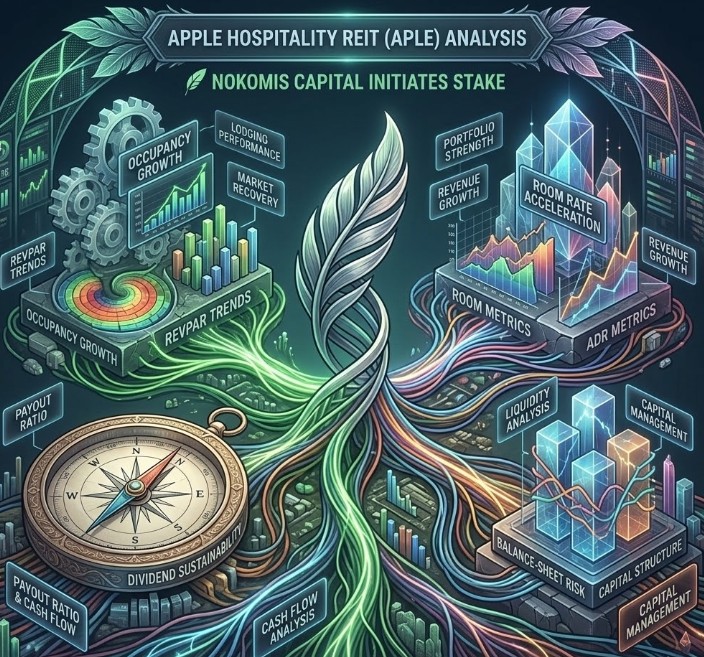
Nokomis Capital’s disclosed initiation of a
position in Apple Hospitality REIT (APLE) has put renewed investor focus on one
of the nation’s hotel-focused real estate investment trusts as lodging demand
shifts from rebound to normalization. The move matters because it signals
institutional confidence in cash-flow stability tied to branded Marriott and
Hilton properties and highlights investor interest in income-generating,
asset-backed REITs amid an uncertain macro backdrop.
Company
Overview and Business Model
Apple Hospitality owns and operates a
portfolio concentrated in upscale, predominantly full-service hotels that
operate under the Marriott and Hilton flags.
As a REIT, Apple Hospitality emphasizes
predictable distributions and asset-level income rather than high-growth
expansion, making it a common play for yield-oriented investors.
The company has managed to navigate the
pandemic-era shock via cost controls, selective capital investment and
strategic brand alignments that underpin room-rate pricing power when demand
recovers.
Lodging
Sector Context
Since the post-pandemic recovery accelerated,
the lodging sector has moved through a rapid rebound phase into a more
normalized travel cycle.
Demand drivers now include:
- Corporate
travel
- Group
bookings
- Leisure
stays
Branded hotels—particularly those under
Marriott and Hilton—benefit from loyalty-program flow and centralized sales
channels.
For Apple Hospitality, the key variables for
near-term performance are:
- Occupancy
levels
- Average
daily rate (ADR) trends
- The
company’s ability to convert those metrics into stable funds from
operations (FFO) to cover its dividend
Details of
the Investment
The substance of the news is straightforward:
Nokomis Capital, a money manager that files quarterly 13F disclosures, reported
initiating a stake in APLE.
While the filing did not disclose activist
intentions or the precise thesis behind the buy, the move is noteworthy for
several reasons.
First, institutional purchases in REITs often
reflect confidence in both the underlying real estate and the company’s capital
allocation framework.
Second, the timing suggests belief that the
lodging cycle has reached a steadier phase—one where branded, downtown-adjacent
and group-capable properties can sustain occupancy and room rates without the
outsized volatility seen earlier in the recovery.
Investor
Implications
For investors, the implications are both
strategic and tactical.
Strategic
Implications
A new institutional investor can improve
liquidity and support valuation multiples for the stock, particularly if the
holding is sizable.
Tactical
Implications
The filing can prompt short-term trading
interest, increasing volume and narrowing spreads for retail holders.
More importantly, the move calls attention to
APLE’s:
- Dividend
yield profile
- Balance-sheet
health
These are two critical factors for REIT
investors in an environment where interest rates and credit costs remain key
risks.
Market
Reaction and Analyst Commentary
Market reaction to the filing has been
measured.
In similar instances, 13F disclosures attract
attention from yield-seeking funds and REIT-focused investors, sometimes
producing a modest share-price bump as demand increases.
Analysts tracking lodging REITs are watching
for confirmation that Apple Hospitality’s:
- Occupancy
levels
- ADR
trends
- Group
booking cadence
remain stable across major markets through the
next two quarters.
Market observers have also noted that brand
affiliation with Marriott and Hilton provides distribution advantages and
pricing discipline.
However, exposure to group-heavy properties
can become a risk if corporate travel softens.
Key Risks
for Investors
The principal risks for APLE remain
macro-driven:
- A
slowdown in business travel
- Pressure
on ADR from increased supply in certain markets
- Higher
financing costs affecting leverage and refinancing schedules
Investors should scrutinize:
- Leverage
ratios
- Debt
maturities
- Interest-rate
sensitivity
Elevated borrowing costs can compress adjusted
funds from operations (AFFO) and reduce dividend coverage margins.
Conversely, sustained occupancy above
historical averages and modest room-rate growth could support dividend coverage
and justify valuation expansion.
Actionable
Takeaways for Investors
- Assess
dividend sustainability: Review the company’s most recent AFFO
per share relative to its declared dividend.
- Examine
balance-sheet maturity profile: Identify near-term refinancing needs and
exposure to rising interest rates.
- Evaluate
market-level performance: Focus particularly on corporate and
group-dependent markets and compare performance with industry peers.
- Consider
position sizing: Evaluate exposure within the broader
context of REIT allocation and interest-rate risk in the portfolio.
Strategic
Perspective
Nokomis’s move is a data point, not a
definitive endorsement.
It should prompt investors to re-evaluate APLE
through the lens of income quality and cyclical exposure, rather than
serving as a standalone catalyst for long-term outperformance.
For income-oriented portfolios, Apple
Hospitality can remain attractive if:
- AFFO
coverage remains strong
- Liquidity
metrics stay robust
- Management
maintains prudent capital allocation
This includes balancing dividend maintenance
with necessary property-level investments.
Outlook for
Apple Hospitality
Looking ahead, APLE’s near-term outlook will
hinge on several operational metrics:
- Occupancy
rates
- Average
daily rate (ADR)
- Revenue
per available room (RevPAR)
Investors should also monitor management
commentary on:
- Group
booking visibility
- Strategic
capital deployment
If branded demand holds and financing
conditions stabilize, Apple Hospitality could consolidate gains as a defensive,
yield-bearing REIT tied to established national brands.
However, if demand weakens or credit
conditions tighten materially, pricing power and dividend sustainability could
face pressure.
Conclusion
Nokomis Capital’s initiation of a stake in
Apple Hospitality is a signal worth noting for income-focused investors and
REIT watchers.
It underscores the continued relevance of
branded hotels in a normalized travel cycle and invites a fresh review of
APLE’s:
- Dividend
coverage
- Balance-sheet
resilience
- Sensitivity to lodging-market dynamics