Oil Spike Sends U.S. Futures Lower as Peace Talks Collapse Monday

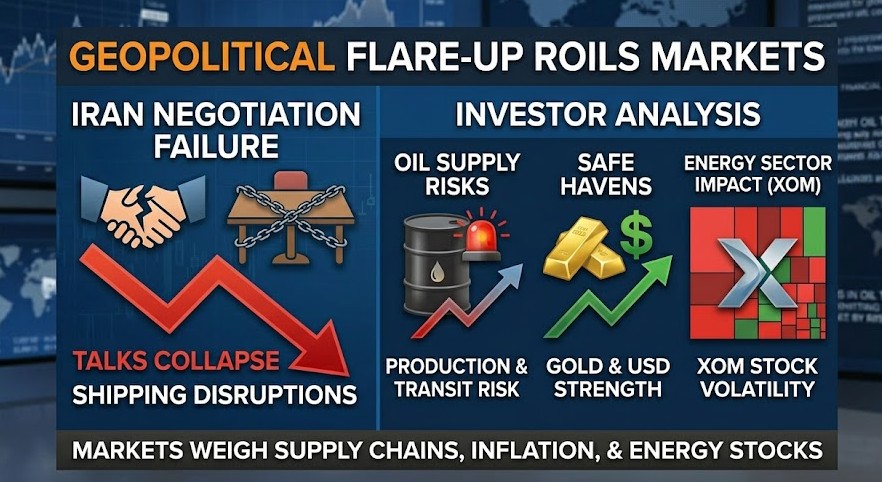
U.S. stock futures tumbled Sunday evening as oil prices surged after weekend peace talks failed, reviving fears of escalation in the Strait of Hormuz and sending global investors back into risk-off mode.
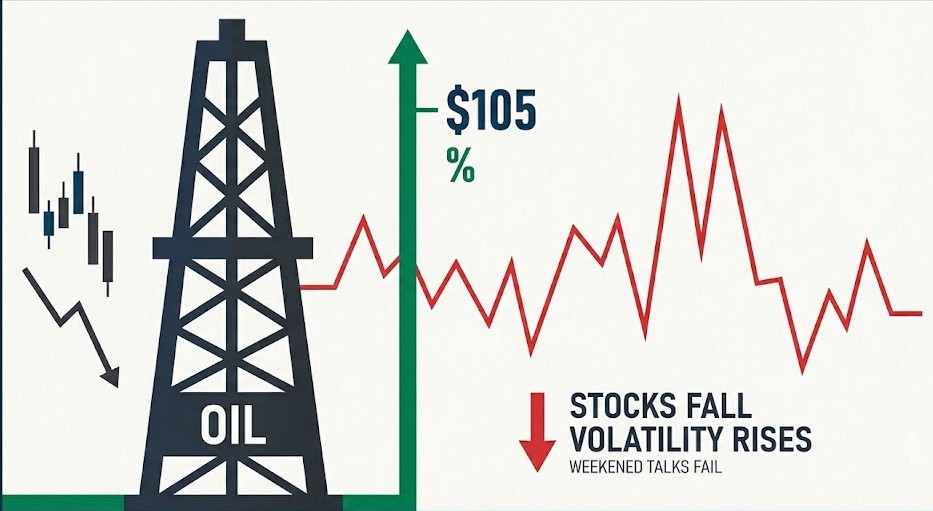
U.S. crude futures jumped about 9.2% to roughly $105 a barrel, reversing last week's slump after a temporary ceasefire had eased tensions.
Market trigger and immediate reaction
The immediate driver was the breakdown of weekend diplomacy aimed at averting confrontation in the Persian Gulf.
Market participants interpreted the failed talks as increasing the likelihood of supply disruptions through the Strait of Hormuz, a key transit route for approximately a fifth of global seaborne oil shipments.
With physical supply at risk and traders facing the prospect of tighter balances, prompt-month Brent and WTI futures moved sharply higher, reversing the prior week's declines that followed a two-week ceasefire announcement from the White House.
Focus on energy majors
Exxon Mobil Corporation (XOM) is the primary company in focus because integrated oil majors are most directly sensitive to sudden crude price swings.
Exxon, with a market capitalization exceeding $350 billion and a broad portfolio spanning upstream production, refining and chemicals, typically sees its earnings trajectory and cash flow sensitivity rise with sustained higher crude prices.
Last week the energy sector underperformed as oil tumbled on hopes for de-escalation; the abrupt reversal underscores how geopolitical risk can quickly recalibrate sector leadership.
Market mechanics and sector impact
For equity investors, the mechanism is straightforward.
Higher crude futures typically lift revenues and cash flow for upstream producers and integrated majors, while raising input costs for oil-intensive industries and amplifying inflationary pressure that can influence central bank rhetoric.
A sustained move toward triple-digit oil prices would likely widen energy sector margins and improve dividend coverage for companies like Exxon, while imposing incremental cost pressure on airlines, logistics firms and utilities.
Broader market reaction
Market reaction was broad and swift.
Equity futures slipped as risk appetite diminished, parity faded for cyclical sectors and safe-haven currencies and Treasuries saw buying interest.
Energy names outperformed in intraday sessions, with sector ETFs and major integrated producers catching early bid flows as traders repositioned.
The pricing action in the oil complex a roughly 9% jump in U.S. crude to around $105 a barrel dominated order books and drove commodity-linked equity moves.
Analyst perspective and trading dynamics
Analysts and strategists framed the development as a reminder that geopolitical risk remains a live tailwind for energy prices.
Market strategists noted that while temporary spikes are common, the path to a sustained rally depends on whether the breakdown in talks leads to tangible supply disruptions or merely elevates premiums in risk-sensitive contracts.
For Exxon specifically, energy analysts emphasized that the company’s integrated model cushions short-term volatility; upstream volumes and Brent-linked realizations would be the main drivers of any earnings upside if prices hold above $90–$100 for several quarters.
Traders are likely to increase use of options to express directional views on crude and energy equities, pushing implied volatility higher in both commodities and correlated stocks.
Short-dated call skew on WTI and Brent tends to widen in these episodes as participants buy protection against further supply shocks, while equity put buying can accelerate as risk-off flows broaden.
Cross-asset implications
Fixed-income markets may price a modest rise in inflation expectations, lifting breakevens and pressuring longer-term real yields, which in turn can weigh on growth-sensitive parts of the equity market.
Portfolio managers should consider using call spreads on energy names to capture upside while limiting premium outlay, or collar strategies on cyclical holdings to preserve upside with defined downside protection.
What this means for investors
First, value can be found in integrated majors such as Exxon and peers, which typically benefit from higher commodity prices through improved free cash flow and shareholder returns.
Second, volatility is likely to rise: allocate position sizes and employ stop-loss or options strategies to manage drawdown risk.
Third, consider hedging or reducing exposure to oil-dependent sectors such as airlines and transportation if elevated price expectations persist.
Finally, monitor shipping and insurance markets closely for indications that physical disruptions are being priced in, as these signal a more durable shock to supply.
Risk scenarios and outlook
Risk-management decisions should include scenario planning.
If crude prices sustain a move above $100 for several months, expect revisions to earnings estimates across energy and consumer discretionary sectors and potential policy responses from central banks concerned about higher headline inflation.
Conversely, a de-escalation or renewed diplomatic progress would likely unwind much of the recent premium and restore the recent momentum in risk assets.
Conclusion
The collapse of weekend talks injected a spike of geopolitical risk into markets, quickly translating to a near double-digit move in U.S. crude and prompting a risk-off response in equity futures.
For Exxon Mobil and other integrated producers, the move offers a potential earnings tailwind if elevated prices persist; for broader markets, it increases inflation and growth uncertainty.
Investors should weigh sector-specific upside against macro risks, adjust position sizing, and use hedging tools to navigate elevated volatility.
Looking ahead, market participants will watch further diplomatic communications, shipping and tanker tracking data, and OPEC+ responses for clues on whether the shock will be transitory or structural.
Absent clear indicators of sustained supply loss, volatility may remain elevated but mean-revert; however, any confirmed disruption to flows through the Strait of Hormuz would likely sustain higher oil prices and materially alter earnings trajectories across energy-intensive industries.
Stock futures fell because the failure of weekend peace talks raised the risk of supply disruptions through the Strait of Hormuz, pushing crude prices up about 9.2% to roughly $105 and prompting a risk-off move.