Oneok Rises 1.1% to $90.94 as Midstream Strength Counters
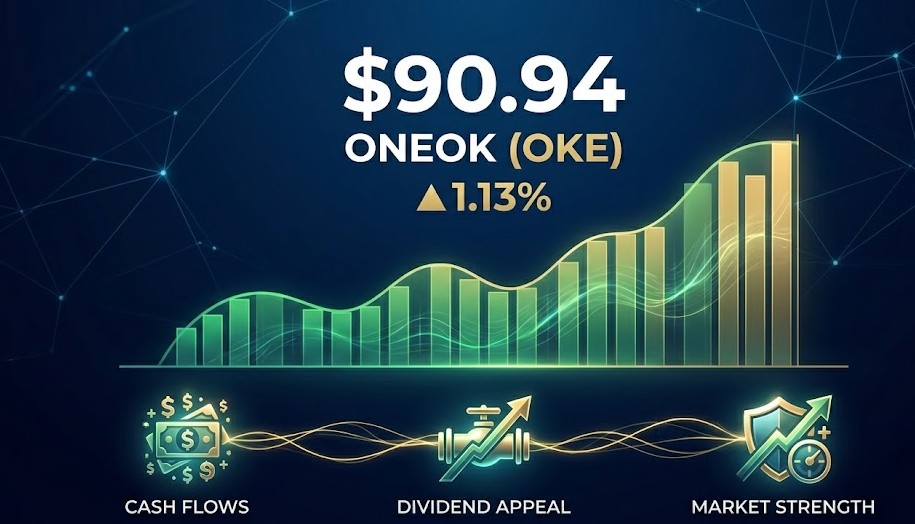
Oneok Inc. (OKE) closed at $90.94 in the most recent trading session, advancing 1.13% from the prior day as investors favored the midstream operator’s predictable cash flows and dividend profile amid a wider market pullback.
The gain came despite weakness in broader equities, underscoring investor preference for energy+infrastructure" title="More analysis on energy infrastructure">energy infrastructure names that offer yield and stability.
Background and recent performance
Oneok is a Tulsa-based midstream energy company that owns and operates natural gas and natural gas liquids (NGL) pipelines, processing and fractionation assets, and related infrastructure across major U.S. producing basins. The company is known for fee-based contracts and long-term customer agreements that generate recurring cash flow, positioning it as an income-oriented holding for institutional and retail investors.
Over the past year, Oneok has navigated a volatile commodity backdrop, with cash flow and volumes influenced by regional production trends and seasonal demand for NGLs. While commodity price swings affect throughput economics, Oneok’s mix of firm transportation and processing contracts helps stabilize earnings relative to pure commodity producers.
The recent close at $90.94 represents the latest point in a recovery trend that has seen the stock oscillate with sector rotations and macroeconomic news.
Detailed analysis of the move
A 1.13% uptick on a single session is modest in absolute terms, but it is notable given the context of a broader market decline. Income-oriented midstream names like Oneok can attract inflows when equity markets soften because investors rotate toward dividend-paying, cash-generative companies perceived as lower-beta alternatives.
Oneok’s business model anchored by long-term agreements, take-or-pay provisions and diversified pipeline networks reduces direct commodity price exposure and makes near-term cash flows relatively predictable.
Other drivers likely supporting the move include investor attention to distribution coverage metrics and free cash flow trends. Analysts and investors routinely track metrics such as distributable cash flow (DCF), adjusted EBITDA and leverage ratios to assess a midstream company’s ability to sustain dividends and fund growth projects.
Any recent indications that Oneok’s DCF coverage of its dividend remains healthy would reinforce confidence and explain positive price action.
Market reaction and analyst perspective
Market participants responding to the session’s price action emphasized the defensive attributes of midstream infrastructure. While brokerage reports and public commentary vary, common analyst themes for Oneok include steady dividends, disciplined capital allocation and project pipelines that expand fee-based revenue.
Some analysts have highlighted the stock’s relative value compared with peers when yield and payout sustainability are prioritized by investors.
Importantly, short-term moves in Oneok’s share price can also reflect technical flows, options-expiration dynamics and sector ETF rebalancing. Institutional buyers reallocating assets into energy infrastructure or individual investors seeking yield can produce upward pressure even when broader indices decline.
There is no single quoted analyst revision tied to the one-day move, but the session’s behavior aligns with historical patterns where midstream stocks gain on risk-off days.
What this means for investors
Income investors: Oneok’s appeal remains its dividend and the predictability of fee-based cash flows. Investors focused on income should review recent quarterly reports for DCF coverage ratios, payout ratios and management commentary on distribution policy. Confirming that cash generation comfortably covers the dividend is central to an income allocation decision.
Total-return investors: For those seeking total return, Oneok offers potential upside from multiple vectors—modest organic volume growth, incremental fee-based projects and occasional buybacks—balanced against sensitivity to broader economic conditions and interest-rate movements. Assessing valuation relative to peers and historical multiples can help determine whether the current price reflects reasonable upside.
Risk-aware investors: Key risks include reductions in production volumes in the basins Oneok serves, regulatory constraints, and the impact of interest-rate volatility on dividend valuation. Midstream companies also face longer-term energy transition considerations; investors should weigh near-term cash generation against evolving demand patterns for hydrocarbon-based products.
Actionable steps
- Review the latest quarterly DCF and adjusted EBITDA figures to confirm dividend coverage.
- Compare Oneok’s yield and leverage metrics with peer midstream operators to gauge relative value.
- Monitor regional volume trends in major basins served by Oneok for signs of demand growth or contraction.
- Consider position sizing and diversification if using Oneok as an income substitute during broader market weakness.
Conclusion and outlook
Oneok’s 1.13% rise to $90.94 during a risk-off session highlights the continued investor interest in midstream names for income and relative stability.
While the move is not transformative on its own, it reflects the sector’s defensive characteristics and the value placed on fee-based cash flow models.
Investors should remain attentive to quarterly cash-flow metrics, basin production trends and capital-allocation updates from management to assess dividend sustainability and long-term return potential.
As macro volatility persists, Oneok will likely continue to trade as a barometer for investor appetite for yield within the energy complex.
Oneok’s 1.13% gain to $90.94 was driven by investor demand for midstream companies offering predictable fee-based cash flows and dividend stability amid broader market weakness.