Oscar Health (OSCR) Drops 2.3% as Market Gains: Key Takeaways
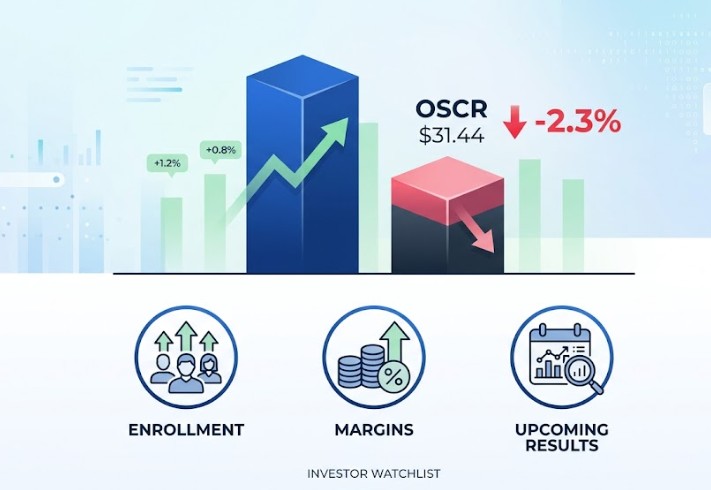
Oscar Health Inc. (NYSE: OSCR) closed the latest trading session at $31.44, down 2.3%, even as broader U.S. equity markets advanced.
The decline was relatively modest in absolute terms, but the stock's underperformance stands out because it occurred during an otherwise positive market session. The move highlights the market's continued focus on Oscar Health's ability to translate membership and premium growth into sustainable profitability.
For investors, the key issue is not simply whether Oscar can continue growing. The bigger question is whether that growth can produce improving unit economics, stronger margins and consistent earnings over time.
Oscar Health's Growth Story
Oscar Health is a technology-focused health insurance company serving primarily individual and small-group markets.
Since its public-market debut in 2021, the company has attempted to differentiate itself through:
- Digital-first customer experiences
- Technology-driven healthcare management
- Product innovation
- Geographic expansion
- Data-driven underwriting
- Digital member engagement
The company's growth has been closely tied to membership expansion and premium revenue.
However, insurance businesses operate under a different set of economic dynamics than traditional technology companies. Higher membership does not automatically translate into higher profitability.
The cost of treating those members, the pricing of insurance plans and regulatory decisions can have a significant impact on the company's financial results.
That makes medical costs, medical loss ratios and operating expenses particularly important for investors evaluating Oscar.
Why the Stock Fell
The latest 2.3% decline does not appear to have been triggered by a major company-specific announcement.
Instead, the move appears consistent with continued investor sensitivity toward growth-stage insurers and their path toward sustainable profitability.
When broader markets rise but a stock declines, investors are often reassessing expectations specific to that company or sector.
For Oscar, several factors can influence that reassessment:
- Membership growth
- Premium pricing
- Medical utilization
- Medical loss ratio
- Provider costs
- Customer acquisition costs
- Operating expenses
- Regulatory decisions
- Earnings guidance
The market is increasingly looking beyond headline revenue growth and asking whether additional members are producing attractive economic returns.
Medical Loss Ratio Remains Critical
One of the most important metrics for Oscar investors is the medical loss ratio, or MLR.
MLR measures how much of an insurer's premium revenue is being used to pay for medical care.
If medical costs rise faster than premiums, the MLR can increase and pressure profitability.
Conversely, improving medical-cost management and appropriate pricing can help reduce the MLR and expand margins.
This creates an important dynamic for Oscar.
The company can report strong membership growth and rising premium revenue while still experiencing pressure on earnings if claims costs increase faster than expected.
Investors should therefore pay close attention to whether revenue growth is accompanied by improving or deteriorating medical economics.
Membership Growth Is Not Enough
Membership growth remains an important part of Oscar's investment story, but the quality of that growth matters just as much as the number of members.
Investors should consider:
- How quickly membership is expanding
- Which markets are generating growth
- The risk profile of new members
- Member retention
- Premium levels
- Medical utilization
- Customer acquisition costs
Rapid expansion can create significant long-term opportunities if Oscar can achieve economies of scale.
However, aggressive growth can also increase costs and put pressure on margins if pricing and medical expenses are not properly aligned.
The market is therefore likely to reward evidence that Oscar's expanding membership base is becoming increasingly profitable.
Technology Could Become a Margin Advantage
Oscar's technology-focused model remains one of its key differentiators.
Digital tools can potentially improve:
- Member engagement
- Claims management
- Administrative efficiency
- Customer service
- Healthcare navigation
- Data analysis
- Risk management
If these investments successfully reduce administrative costs or improve healthcare utilization, they could eventually strengthen Oscar's margins.
However, technology investment also requires upfront spending.
This creates a familiar challenge for growth companies: investors must determine whether today's spending is building a durable competitive advantage or simply delaying profitability.
The market will increasingly look for measurable evidence that Oscar's technology investments are producing better unit economics.
Market Reaction and Investor Sentiment
Oscar's weakness during a broader market rally suggests that investors remain selective toward growth-oriented healthcare companies.
Capital can quickly rotate toward companies with stronger current earnings, clearer cash-flow visibility or more predictable margins when market sentiment becomes more selective.
Oscar's relatively growth-oriented profile makes it particularly sensitive to changes in expectations.
A company can continue growing revenue while its stock declines if investors believe future margins will be lower than previously expected.
That appears to be an important consideration behind the current trading behavior.
Key Metrics Investors Should Monitor
The next quarterly results will be particularly important for determining whether the recent weakness represents temporary positioning or a broader change in expectations.
1. Membership
Investors should monitor both total membership growth and the composition of new members.
2. Medical Loss Ratio
A rising MLR could indicate increasing claims costs and pressure on profitability.
An improving MLR would provide evidence that underwriting and medical-cost management are becoming more effective.
3. Premium Revenue
Revenue growth needs to remain strong enough to offset increasing medical and operating expenses.
4. Operating Expenses
Investors should determine whether Oscar is achieving operating leverage as it scales.
5. Margin Trends
Consistent improvement in margins would provide stronger evidence that the company's growth model is becoming economically sustainable.
6. Management Guidance
Management's outlook for membership, medical costs and profitability could have a significant impact on investor expectations.
What This Means for Investors
Oscar Health's latest decline does not necessarily indicate a fundamental deterioration in the business.
Instead, it highlights the importance of profitability visibility for a company that has historically been valued partly on its growth potential.
Investors evaluating OSCR should focus less on the single-session price movement and more on whether the company's financial trajectory is improving.
A stronger investment case would be supported by:
- Continued membership growth
- Stable or improving MLR
- Better operating leverage
- Lower acquisition costs
- Improving margins
- Stronger cash generation
- Consistent management guidance
On the other hand, persistent increases in medical costs, weaker membership economics or continued margin pressure could keep investor sentiment subdued.
Near-Term Catalysts
Several developments could materially influence Oscar's stock over the coming quarters.
Quarterly earnings will provide the clearest evidence of whether revenue growth is translating into profitability.
Enrollment updates will help investors determine whether membership momentum remains intact.
Medical-cost trends will provide an early indication of potential MLR pressure.
Regulatory developments could affect premium rates, product structures and the economics of Oscar's insurance plans.
Management guidance will also be closely watched because the market needs greater visibility into the company's path toward sustainable earnings.
Two Possible Paths
The bullish scenario is relatively straightforward.
Oscar continues expanding membership while improving medical-cost management and operating efficiency. Revenue continues growing, MLR remains controlled and margins gradually expand.
Under that scenario, investors could begin assigning greater value to the company's improving unit economics rather than simply viewing it as a growth-stage insurer.
The more cautious scenario involves continued revenue growth but weaker profitability.
If medical costs increase, acquisition expenses remain elevated or membership growth becomes less attractive economically, Oscar could struggle to demonstrate meaningful operating leverage.
In that environment, the stock could remain sensitive to quarterly results and broader market rotations.
Outlook
Oscar Health's 2.3% decline to $31.44 during a broader market advance highlights a key issue facing the company: investors want to see growth translate into durable profitability.
The company's technology-driven model, expanding membership base and focus on healthcare innovation provide potential long-term growth opportunities. But those advantages must ultimately show up in measurable financial results.
For the next phase of Oscar's investment story, the most important signals will likely come from membership growth, medical loss ratios, operating expenses, margins and management guidance.
A single down session does not establish a long-term trend. However, continued underperformance alongside stable or improving broader markets could indicate that investors are demanding stronger evidence of profitability before assigning the stock a higher valuation.
For investors considering OSCR, the central question remains whether Oscar can scale its insurance platform while simultaneously improving the economics of each member it serves. That balance between growth and profitability will likely determine the stock's trajectory over the coming quarters.