Software Valuations Strain Markets Amid Geopolitical Uncertainty
Investors are increasingly questioning whether public markets can sustain lofty software valuations amid a swirl of geopolitical shocks, rising interest rates, and slowing macro growth. The perceived overvaluation of many software companies has become a focal point, testing market breadth and investor resolve across large-cap tech names and high-growth software firms alike.
Microsoft (MSFT), the largest pure-play software company by market value, is emblematic of the challenge. With an approximate market capitalization of $2.5 trillion as of mid-2024, its stock has helped lift broader indices even as analysts debate how much future cloud growth is already priced in. More generally, enterprise software and SaaS firms have commanded premium multiples often materially higher than the S&P 500 on expectations of durable recurring revenue and margin expansion.
After a prolonged run since the pandemic, many software stocks posted double-digit gains in 2021–2023, followed by a period of consolidation as interest rates climbed and growth forecasts were reset. Investors are now balancing resilient subscription economics against slower net new customer additions, rising customer acquisition costs, and increased scrutiny of profitability timelines.
What Is Driving the Re-Pricing?
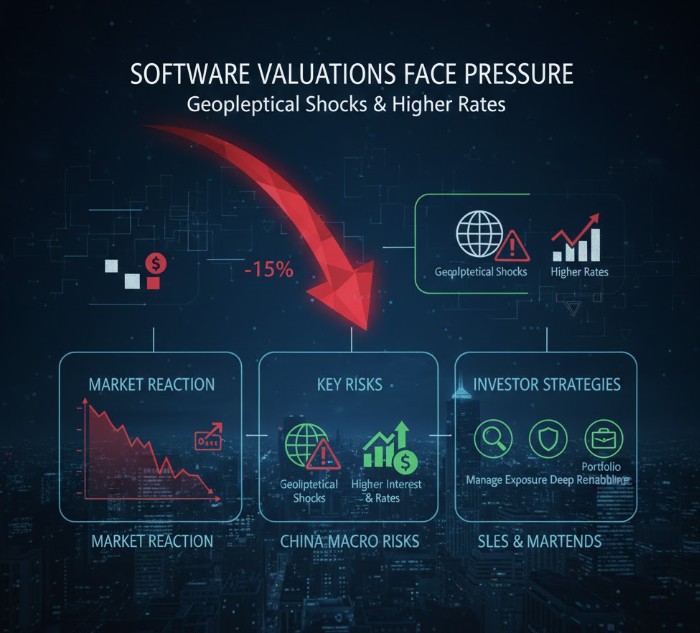
The underlying concern is straightforward: when valuations are extended, macro or geopolitical shocks can amplify downside. Recent headlines from supply chain disruptions and tensions in Europe and the Middle East to trade frictions create execution risk for companies dependent on multinational customers and predictable renewal cycles. Those risks feed into a reassessment of growth durability and acceptable valuation multiples.
High-valuation software stocks are particularly sensitive to shifts in discount rates and earnings visibility. A 100-basis-point rise in the discount rate compresses the present value of long-duration revenue streams, making future free cash flows less valuable today. That dynamic has forced investors to demand clearer evidence of durable margins or to rotate into cash-flow-positive, lower-multiple names.
Market Reaction
Market reaction has been heterogeneous. Large-cap platform names with diversified revenue streams and a clear path to free cash flow, such as Microsoft, have shown relative resilience. In contrast, smaller pure-play SaaS firms have experienced more pronounced volatility.
During recent selloffs, implied volatility and put-call skew rose across software names, reflecting increased hedging activity and investor caution. Exchange-traded funds that concentrate on high-growth software and cloud names have seen divergent flows as investors rebalance.
Passive vehicles that track software-heavy indices can amplify moves during market swings because large-cap winners exert outsized index weight. Meanwhile, actively managed portfolios have used volatility to harvest gains and rotate into value or more cyclically exposed technology names. This dynamic often magnifies price action for smaller-cap SaaS firms, where lower liquidity and concentrated institutional ownership can produce sharp intraday repricing.
Analyst Shifts in Focus
Analysts have increasingly pushed companies to prioritize profitability alongside growth. Several sell-side reports have trimmed forward revenue estimates by low to mid-single digits for vulnerable SaaS segments, while upgrading established cash generators on valuation defensibility.
Research desks are emphasizing:
- Net revenue retention
- Gross margin expansion
- Free cash flow conversion
- Operating leverage trends
- Balance sheet strength
These metrics now serve as primary determinants of which software companies can justify premium multiples in a higher-rate environment.
Risk Differentiation: What Investors Should Do
For investors, the core lesson is risk differentiation. That means scrutinizing unit economics and balance sheets before backing a name at a premium multiple.
Key evaluation criteria:
- Recurring revenue and multi-year contracts
- Net revenue retention above 100%
- Clear path to sustainable free cash flow
- Gross margins with room for expansion
- Conservative leverage and strong liquidity
Tactical steps:
- Rebalance toward quality within tech
- Trim positions where revenue guidance appears aggressive
- Consider partial profit-taking on outsized winners
- Use options or portfolio hedges where appropriate
- Dollar-cost average selectively into high-quality franchises during pullbacks
Valuation discipline remains paramount. Even high-quality businesses can deliver poor returns if purchased at excessive multiples.
Scenario Analysis
Under a base case of modest IT spending deceleration, high-quality software names can justify premium valuations if they sustain net retention above 110% and convert revenue growth into free cash flow within three years.
Under a stress case involving sharper economic slowdown and renewed geopolitical disruption, projected cash flows would be discounted more heavily. Multiples could compress by several turns, leading to double-digit price declines in the most extended names.
Investors should run sensitivity analyses on:
- Revenue growth assumptions
- Margin expansion trajectories
- Discount rate adjustments
- Customer churn risks
Pricing risk appropriately helps prevent overexposure to optimistic scenarios.
Broader Macro Considerations
Macro and geopolitical conditions remain unpredictable. Investors should prepare for episodic volatility and establish firm risk controls:
- Thoughtful position sizing
- Stop-loss disciplines
- Scenario-based stress testing
- Monitoring enterprise IT spending surveys
- Tracking corporate budget commentary
Currency movements and supply-chain disruptions can indirectly affect software demand through client budget tightening and deferred IT projects.
Conclusion
Markets can continue climbing even amid geopolitical uncertainty, but the margin for error narrows when valuations are elevated. The coming quarters will test whether software companies can deliver repeatable revenue growth and margin expansion in an environment of higher rates and geopolitical friction.
Prudent investors will demand clearer proof points and reward companies that demonstrate durable economics, disciplined capital allocation, and long-term cash generation.
Summary: The market is re-pricing software stocks because stretched valuations are vulnerable to geopolitical shocks and higher discount rates that reduce the present value of long-duration revenue.