Stock Futures Fall After Peace Talks Fail; Oil Jumps to $105

trends in cloud computing, artificial intelligence and digital payments, driving outsized returns versus the broader market in recent years. The current Nasdaq pullback stemmed from a combination of rising Treasury yields, profit-taking after a prolonged tech rally, and renewed investor scrutiny of stretched valuations. VGT, with its concentration in high-beta names, typically amplifies market moves — falling more than the S&P 500 in down markets and outperforming on recoveries. For investors, the magnitude of the decline matters: a moderate correction that trims valuations can improve forward returns, while a deeper, fundamental-driven downturn would require reassessing growth assumptions. Market participants reacted quickly: ETF flows into broad technology funds slowed this week while volatility spiked, according to exchange-traded fund monitors and market breadth indicators. Analysts who cover the sector emphasize differentiation among names — semiconductors tied to AI hardware may see faster earnings upgrades, while some software and consumer-facing internet companies face more cyclical demand risk. Several strategists suggested that selective buying in diversified tech ETFs like VGT can be an effective way to capture upside without betting on single-stock outcomes. Practical investor responses depend on time horizon and risk tolerance. Long-term investors can consider dollar-cost averaging into VGT to smooth volatility and take advantage of lower entry prices, while shorter-term traders should use position sizing and stop-losses to manage downside. Diversification remains key: pairing VGT exposure with broad market or value-oriented allocations can reduce portfolio concentration risk. Valuation is the central consideration. VGT's sector tilt means its price-to-earnings multiple is often higher than the S&P 500's, reflecting expected future growth rather than current cashflows. Buying during a correction improves the margin of safety, but investors should test scenarios where growth slows and evaluate whether earnings estimates already price in optimistic outcomes. History suggests that disciplined investors who bought into technology-focused ETFs during prior corrections were rewarded over multi-year horizons, but past performance is not a guarantee of future results. For investors weighing VGT now, the ETF offers efficient access to the secular winners of the digital economy, but it demands active portfolio oversight and tolerance for volatility. Monitoring macro indicators such as inflation trends, Federal Reserve policy and AI-driven demand cycles will be important to time additions or trim exposures. To illustrate, consider two scenarios over a 12-month horizon: in a base case where economic growth remains steady and AI investment accelerates, VGT could recover earlier than the broader market as earnings revisions favor technology; in a downside case where rates stay elevated and consumer demand weakens, VGT could lag until valuation multiples contract and fundamentals stabilize. Investors should run sensitivity checks on expected returns using assumptions for revenue growth between 10% and 25% for high-growth constituents and terminal multiples that compress by 10% to 30% in stress cases. Such modeling helps determine position size and stop-loss thresholds consistent with an investor's risk budget. Practical implementations include layering purchases across several weeks or months, rebalancing quarterly to lock in gains from any rebound, and using covered calls to generate income if volatility remains elevated. Investors who prefer lower idiosyncratic risk can tilt smaller allocations toward VGT while maintaining core holdings in broad-based ETFs such as the S&P 500 or a total market ETF. For taxable investors, be mindful of capital gains distributions and tax-loss harvesting opportunities that corrections may create. In short, VGT represents a focused, cost-efficient way to gain exposure to the technology sector and the current Nasdaq correction provides a lower-cost entry point for patient investors. The ETF's concentration in growth names increases both upside potential and downside risk, so disciplined allocation and risk controls are essential. Investors who combine a long-term view with tactical dollar-cost averaging and portfolio diversification can position themselves to benefit from a technology-led recovery. Comparing VGT to peers like Invesco QQQ (QQQ) and XLK, VGT offers narrower sector-specific exposure and often lower expense ratios; QQQ tracks Nasdaq-100 and includes non-tech names while XLK is another large-cap tech ETF. Investors should weigh tracking index, turnover, liquidity and tax efficiency. Historically, ETFs concentrated in information technology have led market rallies during secular innovation cycles, but they also exhibit higher standard deviation — a trade-off that investors must accept. Ultimately, VGT is a tactical tool best used within a diversified allocation framework.VGT fell as part of a broad Nasdaq sell-off driven by rising Treasury yields, profit-taking and renewed scrutiny of stretched tech valuations.
Vanguard Information Technology ETF (VGT): Is the Nasdaq Correction Creating a Buying Opportunity?
The recent Nasdaq correction has brought renewed attention to the Vanguard Information Technology ETF (VGT), as declining technology stock prices have created a potential entry point for long-term investors.
The pullback has reignited debate over whether now is the right time to gain concentrated exposure to the technology sector or whether further downside remains possible.
VGT Provides Focused Exposure to Technology Leaders
VGT is Vanguard's technology-focused exchange-traded fund, offering investors concentrated exposure to major U.S. information technology companies.
Its portfolio is heavily weighted toward industry leaders in:
- Software
- Semiconductors
- Digital infrastructure
- Technology services
The fund includes significant positions in companies such as Apple, Microsoft and NVIDIA, making it one of the most popular vehicles for targeted technology investing.
With a low expense ratio of 0.10%, VGT has attracted substantial investor assets while benefiting from long-term trends including cloud computing, artificial intelligence and digital transformation.
Nasdaq Pullback Has Pressured Technology Valuations
The recent decline in technology stocks has been driven by several factors:
- Rising Treasury yields
- Profit-taking after an extended rally
- Investor concerns about elevated valuations
Because VGT is concentrated in high-growth technology companies, it often experiences larger price swings than the broader market.
During market downturns, the ETF typically declines more than the S&P 500, but it has also historically participated strongly in technology-led recoveries.
For investors, the key question is whether the correction represents a temporary valuation reset or signals deeper challenges for future earnings growth.
Market Sentiment Has Become More Selective
Recent market activity suggests investors are becoming increasingly selective within the technology sector.
ETF inflows into technology-focused funds have moderated, while volatility has increased as investors reassess growth expectations.
Analysts generally distinguish between different segments of the industry:
- Semiconductor companies benefiting from AI infrastructure demand may continue to see strong earnings growth.
- Some software businesses and consumer internet companies could face greater cyclical pressure if economic conditions weaken.
Many strategists believe diversified technology ETFs like VGT provide an efficient way to participate in sector growth while reducing company-specific risk compared with individual stock selection.
Valuation Remains the Key Investment Question
Technology companies typically trade at higher valuation multiples than the broader market because investors expect stronger future growth.
The recent correction has lowered entry prices and may improve long-term return potential, but investors should also consider scenarios where:
- Revenue growth slows
- Interest rates remain elevated
- Valuation multiples compress further
- Earnings expectations prove too optimistic
A disciplined assessment of future growth assumptions is essential before increasing exposure.
Investment Strategies for Different Time Horizons
Long-Term Investors
Dollar-cost averaging into VGT over time can help reduce the impact of market volatility while gradually building exposure at potentially more attractive prices.
Short-Term Traders
Active traders should focus on:
- Position sizing
- Stop-loss strategies
- Risk management rules
- Monitoring technical support levels
Technology ETFs can experience significant short-term price swings that require disciplined trading plans.
Portfolio Diversification
Even investors with a positive outlook on technology should avoid excessive concentration.
Pairing VGT with:
- Broad market index funds
- Value-oriented investments
- Other sector allocations
can reduce overall portfolio risk while maintaining exposure to long-term innovation trends.
Scenario Analysis
Base Case
If economic growth remains stable and investment in artificial intelligence continues to accelerate, VGT could recover more quickly than the broader market as technology earnings improve.
Downside Case
If interest rates stay elevated for longer and economic activity slows, valuation multiples could compress further, delaying a sustained recovery despite solid long-term fundamentals.
Investors should stress-test expected returns under different revenue growth and valuation assumptions before determining appropriate position sizes.
Practical Portfolio Implementation
Several approaches may help manage risk while maintaining exposure:
- Build positions gradually over several weeks or months.
- Rebalance periodically to maintain target allocations.
- Consider covered call strategies if elevated volatility persists.
- Keep VGT as part of a diversified portfolio rather than a standalone investment.
Tax-conscious investors may also find opportunities for tax-loss harvesting during periods of market weakness.
Comparing VGT With Other Technology ETFs
Compared with alternatives such as Invesco QQQ and XLK, VGT offers concentrated exposure specifically to the information technology sector while maintaining relatively low costs.
QQQ includes a broader mix of Nasdaq-listed companies beyond technology, while XLK provides another large-cap technology-focused approach with different portfolio construction.
Investors should compare:
- Expense ratios
- Index methodology
- Portfolio concentration
- Liquidity
- Tax efficiency
before selecting the most appropriate vehicle.
Conclusion
The recent Nasdaq correction has created a lower-cost entry point into VGT, potentially improving long-term opportunities for patient investors who believe in the continued growth of the technology sector.
However, the ETF's concentration in high-growth companies means it carries both greater upside potential and increased downside risk during periods of market volatility.
For disciplined investors, combining gradual accumulation, portfolio diversification and long-term conviction may provide the most effective approach to benefiting from future technology-driven growth while managing near-term uncertainty.
VGT declined alongside the broader Nasdaq as rising Treasury yields, profit-taking and renewed concerns over elevated technology valuations weighed on high-growth stocks and prompted investors to reassess sector exposure.
okay so now do for this one : - U.S. stock futures tumbled Sunday evening after weekend peace talks failed, while U.S. crude futures surged about 9.2% to roughly $105 a barrel. The abrupt reversal underscores renewed geopolitical risk centered on the Strait of Hormuz and has immediate implications for oil markets and risk assets. Last week, U.S. equities logged their largest weekly gains of the year after President Trump's shift from aggressive rhetoric to the announcement of a two‑week ceasefire calmed markets and sent oil prices lower. That rally reversed course as investors priced in the prospect of an escalating conflict that could threaten shipping through the Hormuz chokepoint, a conduit for a notable portion of global seaborne crude. The sudden move highlights the market's sensitivity to geopolitical developments and energy supply concerns. Energy names and related sectors typically respond first to shifts in oil prices; major integrated producers such as Exxon Mobil and Chevron, refiners, and oilfield services firms can see rapid swings in earnings expectations when crude moves sharply. Exchange‑traded funds that track WTI futures and energy stocks similarly amplify investor exposure. Over the past month, the energy sector underperformed broader indices as oil fell, but a rapid rebound in crude would reverse that dynamic and lift cash flows for producers. Failure of the weekend talks raises the probability that shipping through the Strait of Hormuz — a narrow waterway linking Persian Gulf producers to global markets — will face increased threats from naval confrontations, sanctions enforcement, or attacks on tankers. Traders reacted swiftly: spot and futures markets priced a risk premium into crude, sending U.S. West Texas Intermediate futures up more than 9% to roughly $105 a barrel. Higher oil lifts input costs across the economy, feeding through to gasoline prices, shipping costs and potentially to headline inflation; that prospect can tighten financial conditions by pushing longer-term Treasury yields higher and eroding equity valuations. For equities, the immediate effect is sector rotation toward energy and defense names and away from rate‑sensitive, high‑multiple growth stocks. Market desks reported heavy premarket selling in equity futures, with implied volatility rising across asset classes as investors sought to reprice risk. In commodity markets, traders and hedge funds covered short positions and rebuilt crude carry positions, contributing to the sharp move higher. Analysts at major banks note that a sustained disruption in Hormuz transit would be bullish for oil and could add $10–$20 per barrel to the market risk premium depending on duration and scope, though the firms caution that much depends on actual physical disruptions and spare capacity available from non‑Gulf producers. Credit markets also reacted: insurers and shipping underwriters will reassess premiums while sovereign risk spreads for regional states could widen. For investors, the immediate priorities are risk management and selective positioning. Equity holders should consider trimming exposure to high‑beta growth stocks vulnerable to rising yields and reallocating a portion of portfolios into energy equities, commodity producers, and select defensive cyclicals that benefit from rising oil. Fixed‑income investors need to watch Treasury yield moves and inflation breakevens; a sustained oil shock increases the likelihood the Federal Reserve faces a more restrictive backdrop, which could pressure longer‑dated securities. Traders seeking direct oil exposure can use liquid instruments such as WTI futures, the United States Oil Fund (USO), or diversified energy ETFs, but must account for contango, roll costs and higher volatility. Options strategies — protective puts or collar structures — may be appropriate to hedge near‑term geopolitical risk. Practically, integrated oil majors such as Exxon Mobil (XOM) and Chevron (CVX) stand to benefit from higher realized crude prices, improving upstream margins and free cash flow if levels near $100 persist; refiners may see mixed outcomes depending on crack spreads and regional gasoline demand. Airlines and freight carriers are direct losers as jet fuel and bunker costs rise; companies with hedged fuel positions will be relatively insulated in the short term. Defense contractors and security services could see increased demand for private sector risk mitigation, while regional banks with exposure to trade finance may face higher tail risk. Equity investors should evaluate company‑level balance sheets, cash conversion cycles and existing commodity hedges before increasing exposure. Watch key data points: daily spot tanker tracking for transits, weekly U.S. gasoline and crude inventories from the EIA, OPEC+ statements on spare capacity, and Treasury yields for signs of shifting monetary expectations. Option implied volatilities for energy stocks and VIX term structure will provide clues on how risk is being priced. Investors should set triggers for rebalancing — for example, trimming cyclicals if the 10‑year Treasury yield rises more than 25 basis points in a week, or adding energy exposure if WTI closes above $100 on sustained volume. Investors should monitor developments in the region closely: any confirmation of attacks, shipping detentions or broader military engagement will extend the oil rally and widen market volatility. Conversely, a rapid diplomatic de‑escalation or confirmation of alternative supply assurances from producers could reverse price moves and restore equity leadership for cyclical and growth sectors. Over the coming weeks, volatility is likely to remain elevated; disciplined hedging, diversified exposures and a clear plan for reassessing positions as facts emerge will serve investors best.Stock futures fell and oil surged because failed weekend peace talks raised geopolitical risk around the Strait of Hormuz, prompting a risk premium in crude prices and equity repricing.
Stock Futures Fall as Oil Surges Following Failed Peace Talks
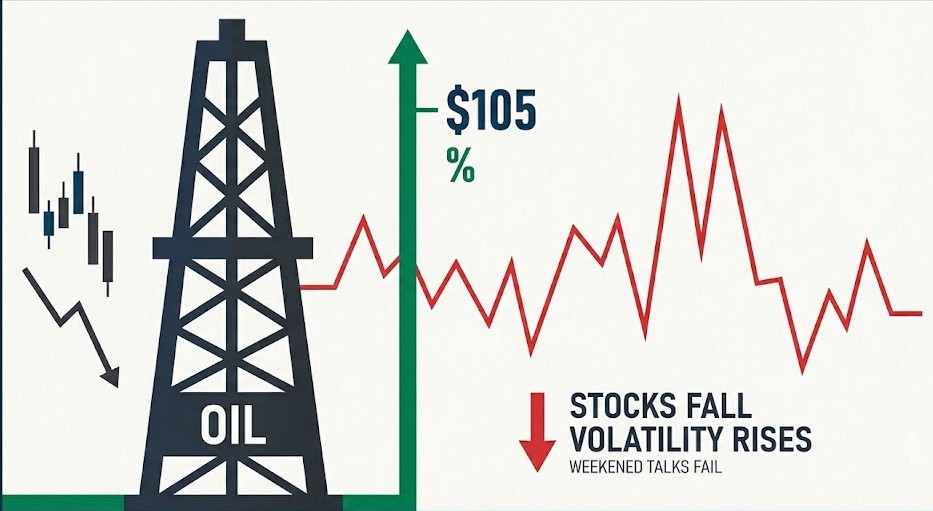
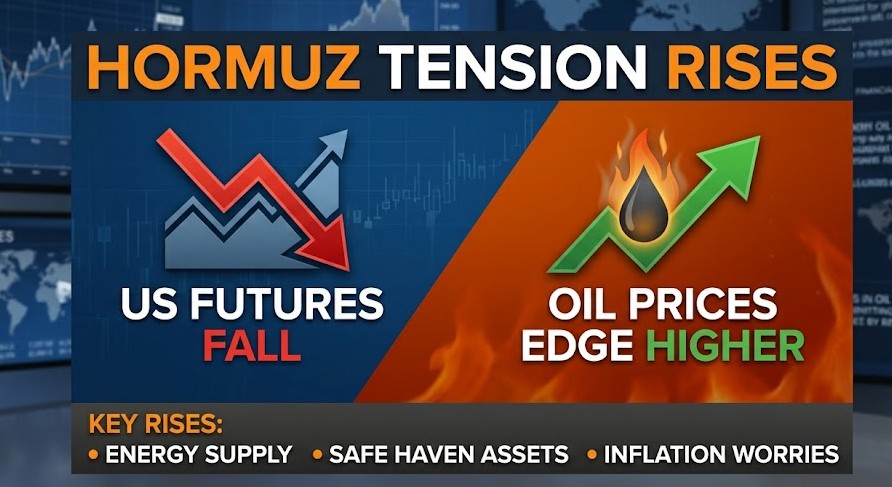
U.S. stock futures declined sharply Sunday evening while U.S. crude oil futures surged approximately 9.2% to around $105 per barrel after weekend peace talks failed, reigniting concerns about geopolitical tensions and potential disruptions to global energy supplies.
The reversal highlights how quickly financial markets can react to developments involving the Strait of Hormuz, one of the world's most important oil transportation routes.
Markets Reverse After Last Week's Rally
The move comes after U.S. equities posted their strongest weekly gains of the year, driven by optimism surrounding a temporary ceasefire announcement that eased fears of broader conflict and pushed oil prices lower.
That optimism faded rapidly as investors reassessed the risk of escalating tensions that could threaten shipping activity through the Strait of Hormuz, a critical passage for global crude exports.
The renewed uncertainty has triggered a broad risk-off response across financial markets.
Why the Strait of Hormuz Matters
The Strait of Hormuz serves as one of the world's most strategically important energy chokepoints, connecting major oil-producing nations in the Persian Gulf to global markets.
Any disruption to shipping through the region can significantly impact:
- Global oil supplies
- Transportation costs
- Energy prices
- Inflation expectations
Even the possibility of supply interruptions often leads traders to price a geopolitical risk premium into crude oil markets.
Oil Prices Surge as Traders Reprice Risk
Following the breakdown in negotiations, traders moved quickly to increase exposure to crude oil while covering bearish positions.
The result was a sharp rally in oil futures, with prices climbing above the psychologically important $100-per-barrel level.
Higher oil prices generally benefit energy producers but can create challenges across the broader economy by increasing costs for:
- Consumers
- Manufacturers
- Transportation companies
- Airlines
- Freight operators
These higher costs can eventually contribute to slower economic growth and rising inflation.
Energy Stocks and Defense Names Attract Interest
Historically, periods of geopolitical instability and rising oil prices have led investors to rotate toward sectors that may benefit from those conditions.
Potential beneficiaries include:
- Integrated oil producers
- Exploration and production companies
- Energy service providers
- Defense contractors
Major energy companies such as Exxon Mobil and Chevron may see improved earnings expectations if elevated crude prices persist.
Higher realized oil prices can strengthen:
- Revenue growth
- Free cash flow generation
- Dividend coverage
- Share repurchase capacity
Growth Stocks Face Additional Pressure
At the same time, higher energy prices may increase inflation expectations, potentially pushing Treasury yields higher.
This environment often creates headwinds for:
- High-growth technology stocks
- Rate-sensitive sectors
- Companies with elevated valuations
- Businesses reliant on consumer discretionary spending
As a result, investors frequently reduce exposure to growth-oriented sectors during periods of rising geopolitical uncertainty.
Credit and Insurance Markets Also React
The impact extends beyond equities and commodities.
Market participants are also monitoring:
- Shipping insurance costs
- Tanker freight rates
- Sovereign credit spreads
- Corporate borrowing conditions
If tensions persist, shipping insurers and underwriters may raise premiums, increasing transportation costs throughout global supply chains.
Key Indicators Investors Should Monitor
Several data points will help determine whether current market moves prove temporary or evolve into a longer-lasting trend:
Energy Markets
- Daily tanker transit data
- Weekly U.S. crude inventories
- Weekly gasoline inventories
- OPEC+ production announcements
Financial Markets
- Treasury yields
- Inflation expectations
- Energy-sector volatility
- VIX volatility index trends
Geopolitical Developments
- Shipping disruptions
- Military activity in the region
- Diplomatic negotiations
- Alternative supply commitments from oil-producing nations
Portfolio Considerations
Investors navigating the current environment may consider:
Reviewing Sector Exposure
Energy and commodity-related investments may provide a hedge against higher oil prices, while highly valued growth stocks could remain vulnerable to rising yields.
Maintaining Diversification
A diversified portfolio can help reduce the impact of sudden geopolitical events and commodity price swings.
Using Risk Management Tools
Protective options strategies, position sizing rules and periodic portfolio rebalancing may help manage volatility during uncertain periods.
Focusing on Financial Strength
Companies with strong balance sheets, healthy cash flows and pricing power are generally better positioned to navigate periods of rising costs and economic uncertainty.
Outlook
The failure of weekend peace talks has reintroduced a significant geopolitical risk premium into both energy and financial markets.
If tensions escalate and oil supplies face actual disruptions, crude prices could remain elevated while broader market volatility increases. Conversely, renewed diplomatic progress or assurances regarding supply stability could quickly reverse some of the recent moves.
For investors, the focus should remain on disciplined risk management, diversification and monitoring developments closely as markets continue to react to changing geopolitical conditions.
Stock futures fell and oil prices surged after failed peace talks increased concerns about potential disruptions to energy supplies through the Strait of Hormuz, prompting investors to reprice risk across global markets.