TXO Partners Rises 2.2% to $13.02 Amid Market Weakness, Outlook
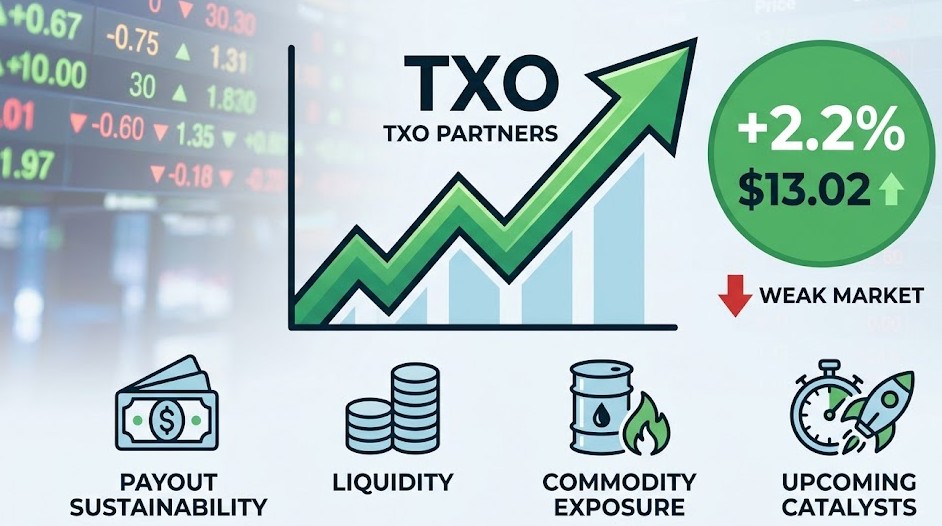
TXO Partners LP (TXO) closed at $13.02 in the most recent trading session, up 2.2% from the prior day, a gain of about $0.29.
The advance stood out as it occurred while broader equity indices declined, underscoring idiosyncratic drivers behind the limited partnership’s performance.
Company Overview
TXO Partners LP is a publicly traded limited partnership that attracts:
- Income-focused investors
- Small-cap market participants
As a small-cap energy issuer, its share price is influenced by:
- Company-specific operational updates
- Commodity price movements
- Liquidity dynamics typical of partnerships
Recent Price Movement
The move to $13.02 represents:
- A 2.2% gain
- Approximately $0.29 increase in dollar terms
While modest in absolute value, such moves are significant for:
- Low-priced securities
- Low-liquidity names where percentage swings impact yield calculations and sentiment
Stocks that rise during broader market declines often attract attention from traders and income-focused investors.
What Likely Drove the Move
There was no widely reported company-specific news tied to the session, suggesting the move may be driven by market microstructure factors.
Potential drivers include:
- Low trading volume amplifying price movements
- Block trades or institutional rebalancing
- Technical buying at support/resistance levels
- Energy sector flows
Additionally, energy partnerships often track:
- Crude oil (WTI) prices
- Natural gas (Henry Hub) benchmarks
Key Fundamental Drivers
Investors should focus on three core structural factors:
1. Production and Reserves
Changes in production guidance or reserves directly impact future cash flow expectations.
2. Distribution Policy
- Stability or growth in distributions attracts income investors
- Weak coverage may trigger selling pressure
3. Balance Sheet and Leverage
Debt levels and covenant flexibility are critical in volatile commodity environments.
Market Behavior and Liquidity Dynamics
Limited partnerships with low analyst coverage often experience:
- Sharp intraday price swings
- Price impact from single large trades
- ETF or fund rebalancing effects
Institutional activity in low-liquidity stocks can significantly influence price action.
Investor Takeaways
For Short-Term Traders
- The 2.2% gain may signal momentum
- Confirm with volume and technical indicators
For Long-Term Investors
Focus on:
- Cash flow generation
- Distribution sustainability
- Upcoming filings (10-K, 10-Q)
- Operational updates
Practical Action Steps
Investors should:
- Review SEC filings for:
- Distribution coverage ratios
- Leverage metrics
- Track commodity prices and hedging strategy
- Monitor trading volume and bid-ask spreads
When entering positions:
- Define entry points
- Size positions appropriately
- Use stop-loss or hedging strategies
Trading and Technical Considerations
To separate signal from noise:
- Compare session volume to 30-, 60-, and 90-day averages
- High volume = stronger conviction
- Low volume = likely technical move
Also monitor:
- Bid-ask spreads
- Market depth
- Short interest and options activity (if available)
Tax and Structural Considerations
Limited partnerships have unique characteristics:
- Distributions are reported via K-1 forms, not 1099
- This can increase tax complexity
Investors should evaluate:
- Whether distributions come from operating cash flow
- Sustainability of payouts
- After-tax yield compared to peers
Valuation and Strategy
Due to liquidity constraints, limited partnerships often trade at discounts to intrinsic value.
Investors should:
- Define target returns and time horizons
- Conduct scenario analysis:
- Impact of ±20% commodity price changes
- Set clear exit strategies
Institutional investors may gain additional insights through:
- Earnings calls
- Investor presentations
Key Catalysts to Watch
- Quarterly earnings results
- Operational updates
- Distribution announcements
- Movements in oil and gas prices
These factors will provide clearer direction for medium-term performance.
Conclusion
TXO Partners’ 2.2% rise to $13.02 during a broader market decline highlights the idiosyncratic nature of small-cap energy stocks.
In the absence of company-specific news, the move appears driven by:
- Liquidity dynamics
- Technical factors
- Commodity-linked sentiment
Disciplined investors should prioritize fundamentals such as cash flow, distribution sustainability, and leverage, while traders may explore short-term technical opportunities.
Summary:
The 2.2% uptick appears driven primarily by idiosyncratic factors thin
liquidity, technical buying, and sector/commodity dynamics rather than any
disclosed company-specific news.