Vanguard Information Technology ETF: Buy the Nasdaq Dip Now?
The recent pullback in the Nasdaq and wider market has pushed the Technology+ETF" title="More analysis on Vanguard Information Technology ETF">Vanguard Information Technology ETF (VGT) lower, creating a potential opportunity for long-term investors.
As growth-oriented technology stocks trade at reduced multiples, history suggests buying during meaningful corrections can reward patient investors.
Background and ETF overview
VGT is a large, diversified ETF that tracks the MSCI US Investable Market Information Technology 25/50 Index and holds dominant technology names including Apple, Microsoft, Nvidia and Broadcom.
The fund concentrates on large-cap software, semiconductor and hardware leaders and has outperformed the broader market over the past decade thanks to persistent revenue growth and margin expansion across its holdings.
Investors have flowed into VGT as secular trends cloud computing, artificial intelligence, and data center spending have driven earnings upgrades, but that exposure also increases sensitivity to growth re-pricing.
Drivers behind the recent decline
The current market move reflects a combination of factors: rising Treasury yields, concerns about peak earnings growth for high-multiple stocks, and rotation into value and cyclical sectors.
When interest rates rise, discount rates used to value future earnings climb, disproportionately pressuring growth-oriented names that dominate VGT.
The ETF's concentration in mega-cap names amplifies moves; a 5% slump in a handful of top holdings can translate to larger percentage moves for the fund.
That dynamic helps explain why VGT has tended to fall faster in sell-offs but also rebound sharply when sentiment normalizes.
Historical perspective
Past sell-offs offer a useful lens.
In prior corrections of 10% or more, technology-heavy ETFs have often recovered to new highs within 6 to 18 months as earnings continued to compound and investors returned to growth exposures.
For example, after the market volatility in 2022 and subsequent short-term drawdowns, large-cap tech names experienced multi-quarter rebounds driven by accelerating AI adoption and stronger-than-expected margin resilience.
While history is not a guarantee, the pattern underscores the potential long-term payoff of buying high-quality tech exposure on weakness.
Market sentiment and analyst view
Market participants have re-priced risk across the sector, driving flows out of growth funds and into defensive ETFs over the past week.
Some analysts have reiterated buy ratings on core VGT holdings, citing durable competitive advantages and secular tailwinds in software and semiconductors, while others have cautioned that near-term earnings growth may decelerate if demand softens.
The consensus view among many strategists is that volatility is likely to persist until clarity on the interest-rate path and macro growth emerges, but winners with strong balance sheets and pricing power should withstand pressure better than smaller peers.
What this means for investors
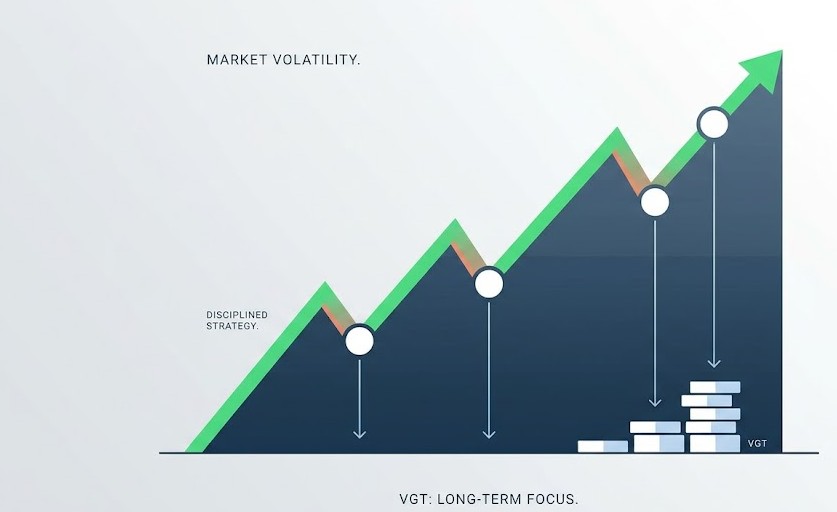
For long-term investors, a disciplined approach can capture the benefit of lower entry points without timing the exact bottom.
Dollar-cost averaging into VGT during the correction can reduce average cost and mitigate timing risk, while concentrated lump-sum buys may suit investors with higher conviction and longer time horizons.
Risk-tolerant investors should assess their exposure to mega-cap concentration and consider complementing tech exposure with diversification across sectors and factor strategies.
Evaluate valuation metrics such as the fund's weighted price-to-earnings multiple relative to history and peers, and monitor interest-rate moves and earnings revisions for the largest holdings.
Rebalance portfolios to maintain target allocation rather than adding excess risk, and use tranche-based buying to scale into positions as the market tests lower levels.
Income-focused investors should note that VGT is growth-oriented and offers a modest yield compared with dividend-focused ETFs.
Cost, liquidity and implementation
VGT's low cost and liquidity make it an efficient vehicle for accessing the sector.
The ETF typically carries an expense ratio near 0.10%, and strong trading volumes provide tight bid-ask spreads for both institutional and retail investors.
This structure supports cost-effective implementation for strategies such as dollar-cost averaging and phased entry.
Risk factors
Key risks include prolonged rate pressure, a sharper-than-expected slowdown in consumer and enterprise IT spending, and regulatory developments affecting major vendors.
A sustained rotation away from growth could extend the drawdown period and delay recovery, particularly if macro data weakens materially.
Investors should account for higher volatility and reassess position sizing if liquidity needs or shorter time horizons could force selling at unfavorable prices.
Conclusion and outlook
The Nasdaq correction has created an attractive setup for investors who believe in the long-term secular trends underpinning technology growth.
Vanguard Information Technology ETF offers diversified exposure to industry leaders that have historically delivered above-market returns, but the path higher is likely to be uneven.
Patient investors who manage position sizing, use dollar-cost averaging, and remain focused on fundamentals may find the current pullback a prudent buying opportunity as markets stabilize.
VGT declined as investors re-priced growth exposure during a Nasdaq correction driven by rising Treasury yields and rotation away from high-multiple tech stocks.