Vita Coco (COCO) Slides 1.9% as Shares Outpace Broader Market
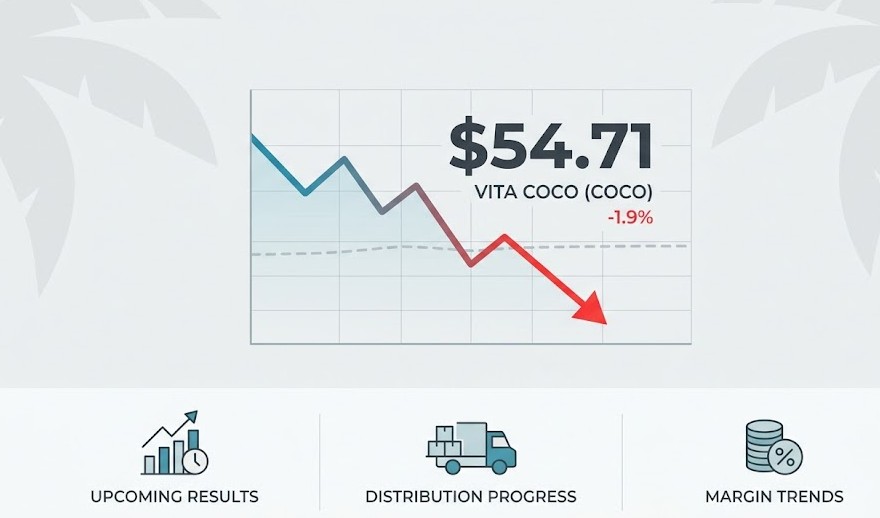
Vita Coco Company, Inc. (COCO) shares fell 1.9% to close at $54.71 in the latest trading session, a decline that outpaced the broader market's modest movement that day.
The drop is notable for investors in consumer-packaged beverages because it underscores how sentiment, trading flows and sector rotation can affect individual names even without an immediate company-specific announcement.
Background and recent performance
Vita Coco, a producer and marketer of coconut water and related beverage products, trades under the ticker COCO on Nasdaq. The company has built a global brand presence through direct-to-retailer distribution in North America, Europe and Asia, and has expanded its portfolio with flavored waters and other beverage extensions.
Over recent quarters the company has been navigating a post-pandemic consumption environment, managing cost inflation, and investing in marketing to support volume growth. Since listing, Vita Coco has attracted a mix of growth and consumer staples investors; however, the stock has exhibited periods of volatility tied to broader consumer discretionary sentiment and shifts in retailer inventory.
Fiscal results and guidance remain primary drivers of medium-term share performance, while quarterly sales growth and gross margin trends shape near-term expectations. In the absence of fresh company disclosures on the day of the move, the decline should be viewed in the context of these ongoing operating variables.
Analysis of the move
The 1.9% decline to $54.71 has several plausible explanations even if no single causative press release was issued. Stocks of consumer-packaged goods can be vulnerable to intraday profit-taking after stretches of gains, to rebalancing by funds, and to rotation into or out of growth-oriented or defensive sectors.
In markets where headline macro news or sector flows dominate trading, well-known brands like Vita Coco often trade on sentiment and liquidity as much as on fundamentals in the short term.
Absent confirmed company news, investors should also consider the timing of earnings calendars, analyst coverage updates and retail data points that can influence expectations for demand. For Vita Coco specifically, any commentary on distribution expansion, promotional intensity with major retailers, or raw material cost trends (coconuts, packaging, freight) could quickly alter the stock trajectory.
Small moves on individual days can therefore reflect positioning ahead of such catalysts.
Market reaction and analyst commentary
On the day of the decline, market summaries flagged COCO’s underperformance relative to the general market; however, public analyst notes tied directly to the drop were not cited in the headline report.
Historically, sell-side analysts emphasize topline growth, market share gains in core channels, and trajectory of gross margins when reassessing their models for beverage companies. Institutional investor behavior—especially among ETFs or basket traders that overweight consumer staples or growth categories—can also exacerbate moves when flows are concentrated.
Given the available information, the most measured read from market commentators would be that this was a modest, non-disruptive pullback rather than an indication of structural deterioration.
Investors and analysts typically look for follow-up confirmation in trading volume, new guidance, or changes in company commentary before revising long-term assumptions about brand equity or competitive positioning.
What this means for investors
For investors, this episode reinforces a few practical steps.
First, monitor upcoming company filings and investor events: quarterly earnings, investor presentations or conference appearances can provide fresh data on volume growth, price/mix, and cost management.
Second, watch retail and point-of-sale indicators: SKU-level performance at major grocery and convenience chains will be a near-term barometer of demand.
Third, pay attention to margin drivers—commodity inputs and freight costs remain meaningful for beverage margins and can swing operating leverage quickly.
Longer-term investors should re-evaluate thesis components rather than react to a one-day move. Key questions to revisit include Vita Coco’s ability to expand internationally, the success of product extensions, and the sustainability of marketing-driven volume gains.
Active traders, by contrast, may view the decline as an opportunity for short-term entries if technical indicators and liquidity profiles align.
Risks and potential catalysts
Risks that could lead to further downside include weaker-than-expected wholesale reorder rates from large retailers, an intensification of price competition in the beverage aisle, or material input-cost inflation that compresses gross margins.
Conversely, upside catalysts include faster distribution gains in new channels, better-than-expected pricing power, margin improvement through supply-chain optimization, or favorable quarterly results that beat consensus estimates.
Conclusion and outlook
The 1.9% selloff to $54.71 is a reminder that even established consumer brands can experience short-term share price volatility driven by market flows and sector sentiment.
For investors, the prudent course is to watch for concrete, company-level signals—quarterly results, margin commentary, and distribution updates—before making material portfolio changes.
Over the medium term, Vita Coco’s performance will hinge on its ability to translate brand recognition into sustained category share gains and margin resilience as input costs normalize.
COCO declined 1.9% to $54.71 largely because of market sentiment and trading flows rather than a disclosed company-specific catalyst.