VOO Faces Hidden Risk: Concentration Could Hurt S&P 500 for Investors
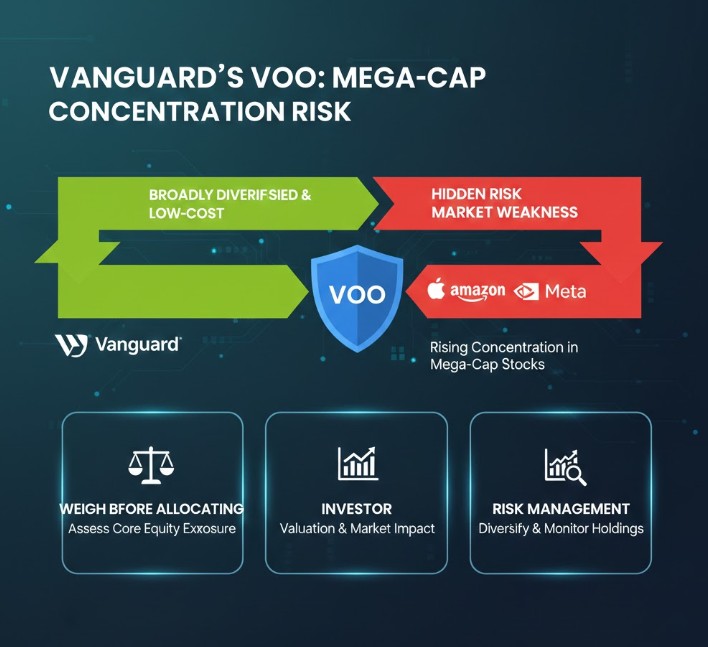
Vanguard’s S&P 500 ETF (VOO) remains one of the lowest-cost, highest-liquidity ways for investors to own broad U.S. large-cap equities, but a hidden concentration risk is prompting reassessment. With a handful of mega-cap technology and consumer stocks representing an outsized share of the fund, investors face greater downside exposure if those leaders falter.
Company Background and Recent Performance
VOO, managed by Vanguard Group, tracks the S&P 500 index and delivers market-cap-weighted exposure to roughly 500 U.S. large-cap companies. The ETF has an ultra-low expense ratio (about 0.03%) and assets under management measured in the high hundreds of billions, making it a core holding for many retail and institutional portfolios.
Performance has closely mirrored the broader index, returning strong gains in recent years driven largely by a narrow group of high-growth technology names.
Detailed Analysis of the News Event and Implications
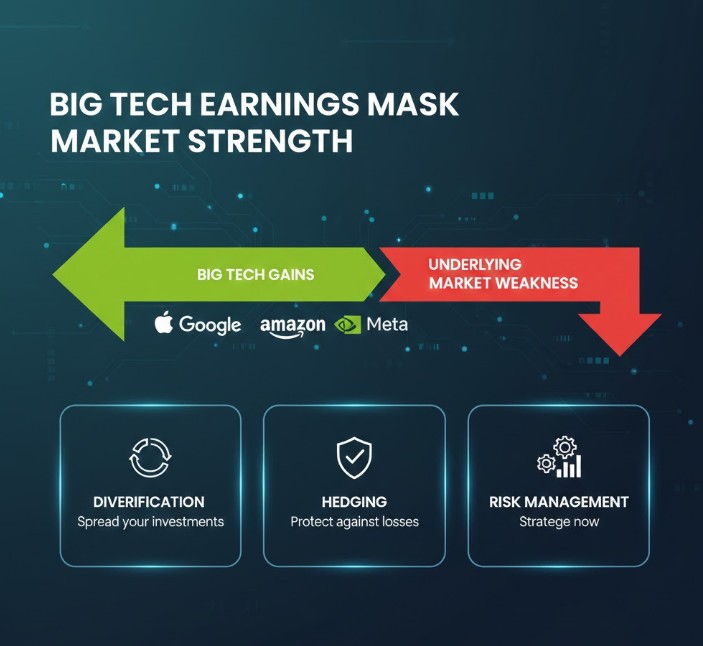
The “hidden risk” flagged in recent commentary centers on VOO’s market-cap weighting, which naturally concentrates weight in the largest companies. As of early 2026, the top five holdings typically Apple, Microsoft, Amazon, NVIDIA, and Alphabet represent roughly a quarter of the ETF’s assets, while the top 10 account for around 30% to 35%.
That concentration means investors buying VOO are taking meaningful single-name and sector exposure without making an explicit choice. This matters because those mega-cap names now carry a substantial share of the market’s gains. If sentiment shifts, regulatory pressures intensify, or growth expectations for the largest firms disappoint, the impact on VOO could be amplified.
Market-cap weighting also means investors implicitly “buy high” and “sell low” across rebalancing cycles: as a company’s market value rises, the ETF allocates more to it, increasing concentration rather than trimming it back.
Market Reaction and Analyst Commentary
Market reaction to coverage highlighting concentration risks has been measured rather than panicked. VOO’s liquidity and rock-bottom fee make it hard to displace as a core equity holding; trading volumes and inflows remain robust in most market environments.
Analysts and portfolio strategists acknowledge the ETF’s practicality for core allocation while urging investors to remain mindful of active concentration risk. Several advisors recommend complementing a market-cap-weighted core with diversification tools. Equal-weight S&P 500 ETFs, sector-tilted funds, or small- and mid-cap exposure can help mitigate the impact of a megacap drawdown.
Others stress maintaining long-term discipline: if the U.S. large-cap market resumes broad participation, concentrated returns could disperse over time, reducing the near-term concern.
What This Means for Investors Actionable Insights
- Re-evaluate portfolio concentration: Examine how much of your total equity exposure is tied to the handful of mega-cap stocks that dominate VOO. If those names already represent a high share of your direct and indirect holdings, consider trimming or diversifying.
- Consider complementary allocations: Equal-weight S&P 500 ETFs, low-cost total market ETFs, or targeted small- and mid-cap funds can provide a counterbalance to market-cap concentration.
- Use rebalancing and risk controls: Regular rebalancing can trim outsized positions and harvest gains, while stop-loss or hedging strategies (options or inverse exposure) can be appropriate for investors seeking downside protection.
- Maintain a long-term perspective: For many investors, VOO remains an efficient core holding due to its low fee, tax efficiency, and liquidity. The ETF’s structural advantages mean it is unlikely to be replaced wholesale; the question is how it fits within a diversified total-portfolio framework.
Professional Conclusion and Forward-Looking Perspective
VOO’s value proposition as a low-cost, liquid proxy for U.S. large caps remains intact, but the spotlight on concentration risk is timely. In an environment where a small cohort of firms account for an outsized share of returns, investors should not treat market-cap-weighted indexing as synonymous with broad economic diversification.
Going forward, prudent portfolio construction will involve pairing VOO with complementary exposures, disciplined rebalancing, and a clear understanding of how concentrated leadership affects risk and return.
For investors who recognize and manage that concentration, VOO can still serve as an efficient core allocation. For those uncomfortable with the implicit bets, adding diversification tools will be necessary to align risk with long-term objectives.
Summary: Investors are reassessing VOO because its market-cap weighting concentrates exposure in a few mega-cap stocks, raising downside risk if those leaders reverse.