Wall Street Backs Shopify Despite AI-Driven Software Selloff
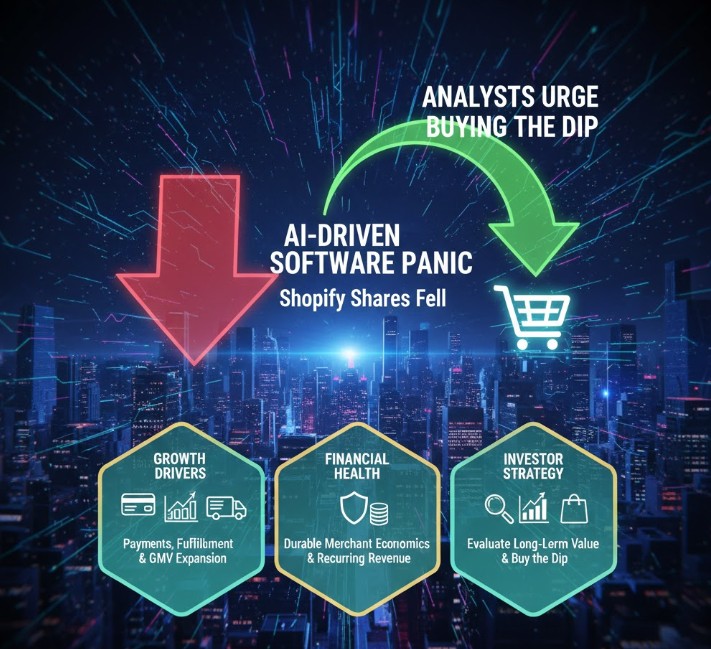
Shopify Inc. shares tumbled after a broader selloff in software stocks as investors fretted that generative artificial intelligence could disintermediate e-commerce platforms. Wall Street analysts, however, largely called the dip a buying opportunity, arguing Shopify’s merchant ecosystem, payments, and fulfillment services give it durable competitive advantages.
Company Background and Business Model
Shopify (ticker: SHOP) provides cloud-based commerce tools that enable merchants of all sizes to build online stores, process payments, manage fulfillment, and sell across channels. Since its 2015 IPO, the company has expanded from subscription-based storefront software into payments, merchant services, and logistics, creating recurring revenue streams and value-added integrations.
Its long-term narrative centers on monetizing gross merchandise volume (GMV) through:
- Subscription solutions (storefront and platform access)
- Merchant solutions (payments, shipping, lending, advertising, and fulfillment)
The company has built network effects between merchants, developers, and buyers — strengthening its ecosystem and increasing switching costs.
Why the Stock Sold Off
Recent headlines suggested generative AI could make traditional storefronts less necessary by enabling:
- Conversational commerce
- Automated marketplaces
- Instant personalized product aggregation
That thesis triggered a rotation out of high-growth software names, including Shopify, as investors reassessed platform economics in an AI-first world.
The concern is not irrational. If AI layers replace key platform touchpoints, take rates and customer acquisition funnels could face pressure. Investors fear that AI-native commerce experiences could sit between merchants and customers, weakening Shopify’s control over transaction flows.
However, many analysts argue this fear may be overstated. Shopify’s moats — including payment processing, one-click checkout, fraud protection, Shopify Capital, and fulfillment integration — require trust, compliance infrastructure, logistics scale, and embedded merchant workflows. These are not easily replicated by a standalone AI interface.
AI: Threat or Tailwind?
Buy-side commentary suggests AI is more likely to augment merchant experiences rather than eliminate the need for a commerce backbone.
AI tools can improve:
- Product discovery
- Personalization
- Marketing automation
- Inventory forecasting
But merchants still need payments, compliance, checkout infrastructure, working capital, and shipping integration — all areas where Shopify monetizes transactions.
Merchant solutions, which typically grow faster and generate higher margins, are central to Shopify’s margin expansion thesis. As merchants scale, Shopify earns a percentage of transactions, increasing its effective take rate.
Key Metrics Investors Should Track
Investors evaluating the pullback should monitor:
- Gross Merchandise Volume (GMV) growth
- Take rate expansion
- Subscription revenue growth
- Merchant churn
- Average revenue per merchant
- Merchant solutions margin
- Operating cash flow trends
Quarterly guidance and commentary around Shopify Payments and Fulfillment Network adoption will serve as near-term signals of execution strength.
If merchant solutions continue scaling with improving margins, it would validate the premium valuation many analysts assign to the stock.
Market Reaction and Analyst Sentiment
The market reaction was swift. Shopify shares retraced a meaningful portion of prior gains amid a broader software selloff, compressing forward multiples and creating what several analysts described as a valuation gap.
Short-term selling appears driven by macro risk-off positioning and thematic rotation toward AI beneficiaries and lower-multiple cyclical stocks.
Across the selloff, many research teams reiterated buy or overweight ratings, citing:
- Durable GMV growth
- Multi-product monetization
- Expanding payments penetration
- Long-term margin leverage
Some analysts even raised price targets, arguing the valuation reset improved risk-reward dynamics.
More cautious voices pointed to:
- Execution risk in scaling logistics
- Capital intensity of fulfillment
- Competitive pressure from major players
Still, even cautious analysts acknowledged long-term upside if Shopify increases merchant adoption of payments, fulfillment, and advertising services.
Competitive and Structural Risks
Risks remain tangible. Shopify faces competition from:
- Amazon
- Meta Platforms
- Emerging AI-native commerce entrants
Accelerated AI adoption could shift buyer behavior in ways that compress platform economics. Additionally, regulatory scrutiny of payments and data practices could increase compliance costs.
Execution also matters. Scaling fulfillment infrastructure and payments requires capital and operational precision. Missteps could pressure margins.
Investment Strategy Considerations
For long-term investors, the pullback may represent an opportunity to accumulate shares gradually, particularly if Shopify sustains mid-teens top-line growth and modest take-rate expansion.
Potential strategies include:
- Accumulating shares in tranches
- Tying position size to GMV and margin progression
- Comparing enterprise value to projected GMV and free cash flow over 12–24 months
Short-term traders should watch earnings reports closely, particularly GMV beats and merchant solutions margins.
More conservative investors may prefer confirmation that AI adoption enhances rather than displaces the platform before initiating positions.
Professional Conclusion
Shopify’s recent decline reflects a thematic reassessment of software winners in an AI-driven market rather than a clear deterioration of its core business fundamentals.
The company’s breadth of services, recurring revenue streams, and embedded merchant relationships create structural advantages that are difficult to replicate quickly.
With forward multiples compressed, valuation discipline now plays a larger role in the investment thesis. If Shopify sustains GMV growth, expands take rates, and improves margin leverage, the recent weakness may ultimately prove to be a buying opportunity rather than a structural warning.
Summary: Shares fell as investors rotated out of high-growth software on fears generative AI could disintermediate e-commerce platforms, compressing valuations.