Wall Street Eyes January Jobs Report as Futures Rise Ahead of Data

Lead: U.S. equity futures ticked higher as Wall Street braced for Friday’s January jobs report, a data release that could reshape expectations for the Federal Reserve’s path on interest-rate cuts. Investors are parsing signs of cooling in the labor market — from slowing hiring to soft wage growth — to gauge whether the central bank will accelerate, delay or keep unchanged its timeline for easing.
Background: Market context and recent performance
The S&P 500 has traded in a narrow range in recent weeks as market
participants balanced solid corporate earnings against macroeconomic
crosswinds. The SPDR S&P 500 ETF Trust (SPY) has mirrored this cautious
tone, with volatility remaining below its long-term average even as headline
indexes hover near record territory. Fixed-income markets have been equally
attentive: Treasury yields and the shape of the yield curve have been volatile
around key data releases, reflecting shifting bets on the timing and magnitude
of future rate cuts.
Why the January jobs report matters
The January nonfarm payrolls, unemployment rate and average hourly earnings are
central to policymakers’ views on labor-market slack and inflation persistence.
A materially weaker print — fewer jobs created, a tick-up in unemployment, or
stagnant wages — would bolster market expectations that the Fed can justify
cutting rates sooner. Conversely, a stronger-than-expected report would likely
push back anticipated easing, supporting higher yields and pressuring equities,
particularly rate-sensitive growth names.
Detailed analysis of the news event
Reports over the past month have flagged emerging soft spots in hiring across
select sectors, including leisure and hospitality and certain pockets of
manufacturing. Those indicators, coupled with anecdotal signs of firms holding
off on hiring, have led strategists to price a nontrivial chance that payrolls
growth slows in January. If so, market-implied probabilities for a cut in the
first half of the year would rise, compressing term premiums and putting
downward pressure on longer-dated Treasury yields. That dynamic typically
benefits cyclically oriented sectors such as consumer discretionary and
financials in the short run, while boosting sentiment for risk assets more
broadly.
How fixed income and the dollar factor in
Bond markets act as the transmission mechanism between economic data and policy
expectations. A softer labor report would likely lower front-end rates and
flatten portions of the curve as investors push out the timing of the Fed’s
first move. The dollar tends to weaken on lower rate expectations, which can
provide a tailwind to multinational exporters and commodity-linked equities.
Conversely, stronger employment figures would lift the dollar and increase
borrowing costs for equity valuations, a headwind to high-multiple growth
stocks.
Market reaction and analyst commentary
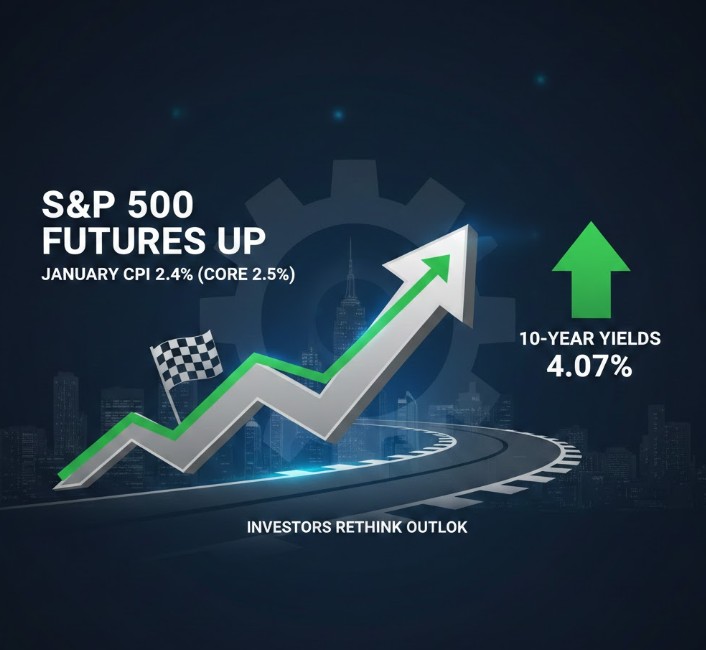
Ahead of the print, futures for the Dow, S&P 500 and Nasdaq were trading
with modest gains as traders sought to position ahead of the headline numbers.
Options markets showed elevated demand for gamma and short-dated protection,
signaling hedging activity around the release. Market strategists cautioned
that while the headline payrolls figure receives the most attention, internals
such as participation rates, revisions to prior months and the breadth of job
creation across industries often provide the clearest signal about trend
momentum.
Analysts from major banks noted the report’s potential to shift probabilities rather than deliver a binary outcome. One economist observed that middling payrolls growth paired with soft wage gains would be the most constructive scenario for equities because it preserves consumer demand while removing some inflation upside. Another strategist highlighted the potential for idiosyncratic market moves — such as volatility in regional banking stocks or rate-sensitive technology names — depending on how the data affects rate trajectories.
What this means for investors: actionable insights
- Reassess duration exposure in fixed-income portfolios: a soft report increases the odds of lower short-term yields, favoring longer duration in a tactical window, while a strong print argues for shortening duration.
- Trim or hedge rate-sensitive growth names if jobs data surprise to the upside; protect through options or adjust equity exposure to more cyclically exposed sectors if the report weakens.
- Monitor dollar-sensitive and commodity-exposed positions: a weaker dollar following softer data can benefit dollar-priced assets and multinational revenue streams.
- Watch market internals, not just the headline: revisions to prior payrolls and wage trajectories frequently alter market interpretations and should inform rebalancing decisions.
Conclusion and forward view
The January jobs report will not only influence the immediate direction of
equities and bonds but also recalibrate the market’s calendar for Fed action.
Investors should treat the release as a high-conviction data point that can
shift probabilities across asset classes rather than a deterministic event.
Over the coming weeks, attention will turn to subsequent inflation readings and
regional labor indicators that either confirm or contradict the jobs snapshot.
For disciplined investors, the period calls for active risk management:
position sizing, tactical duration adjustments and selective sector rotation
can help capture opportunities while limiting downside in a data-driven market
environment.
U.S. equity futures rose as investors anticipated the January jobs report and adjusted rate-cut probabilities based on signs of labor-market cooling.