Whirlpool Shares Slip 1.1%: What Investors Should Watch Carefully Now
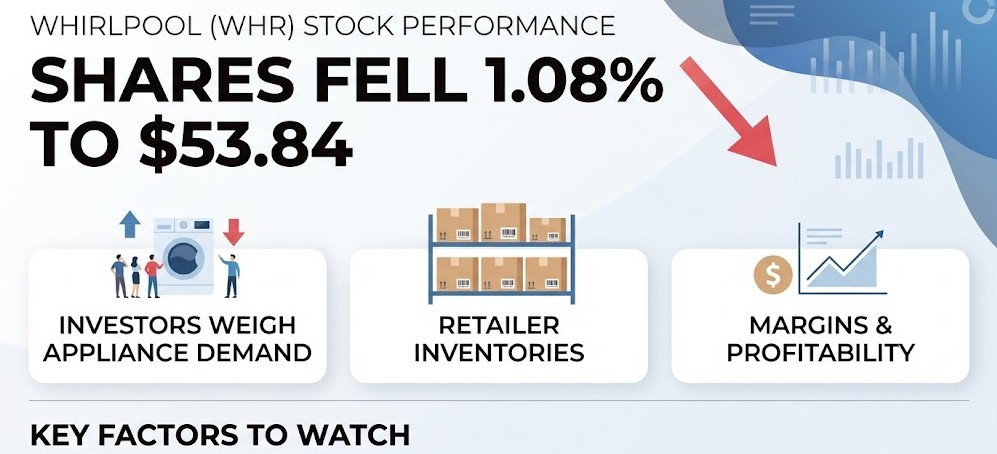
Whirlpool Corp. shares closed at $53.84 in the most recent session, down 1.08% from the prior day, a decline that outpaced broader market moves and underscored investor wariness toward cyclical consumer names.
The roughly one-percent drop was not accompanied by a company-specific press release or regulatory filing, leaving market participants to weigh broader demand trends, inventory dynamics and margin pressures for guidance on near-term performance.
Company background and recent performance
Whirlpool Corporation is the world's largest manufacturer of major home appliances, operating brands that include Whirlpool, Maytag and KitchenAid and selling through retailers, e-commerce and distribution partners globally.
The company is highly sensitive to consumer discretionary spending, housing turnover and retail inventory cycles; its revenue and margins typically track home sales, replacement cycles and macroeconomic indicators such as employment and interest rates.
In recent quarters Whirlpool has navigated a mixed consumer environment, balancing durable-goods demand with elevated inventory levels and shifting retail promotions.
Management has emphasized cost discipline, pricing and product mix to protect margins while investing in energy-efficient and connected appliances to capture premium segments.
Investors watch quarterly results for signs that order trends and retailer inventories are normalizing after inflation-driven buying spikes and supply-chain disruptions in earlier periods.
Analysis of the move
The immediate news event that sent WHR lower appears to be a routine market reaction rather than a response to fresh corporate disclosures.
With no new earnings or guidance update reported alongside the close, the share movement likely reflects short-term profit-taking, sector rotation and continued investor focus on macro drivers of appliance demand.
Traders often reduce exposure to cyclicals ahead of key consumer data releases, and appliance stocks can be vulnerable to shifts in housing activity, mortgage rates and retail inventories.
Key fundamental watchpoints
From a fundamentals perspective, Whirlpool remains exposed to several watchpoints.
First, order trends from large retail partners and replacement demand in the U.S. remain the primary near-term revenue drivers; any softness in same-store sales or promotional intensity can pressure margins.
Second, commodity and freight costs continue to influence gross margin trajectory even as the company pursues productivity initiatives.
Third, currency translation and international demand patterns affect consolidated results, particularly in markets with heavy discounting or different product cycles.
Market reaction and analyst focus
The market reaction to the decline was measured. Volume in the session did not spike to the levels typically associated with news-driven sell-offs, suggesting the move was relatively orderly.
Analysts covering the sector generally emphasize forward-looking metrics rather than single-session moves; consensus focus remains on Whirlpool’s upcoming quarterly report, management commentary on demand and the trajectory of retailer inventories.
While no new analyst downgrades were linked to the session’s close, sell-side models are sensitive to changes in guidance and any signs of sustained weakness in replacement cycles.
Valuation considerations
Valuation metrics will be central in determining whether short-term weakness is an opportunity.
Whirlpool typically trades on earnings multiple sensitive to cyclicality; should consensus estimates trend lower on weaker-than-expected orders, valuation multiples could compress, while sustained pricing power and margin improvement would justify premium to peers.
Investors should compare Whirlpool’s price-to-earnings and enterprise-value-to-EBITDA against appliance and industrial peers and factor in free cash flow conversion when assessing the risk-reward.
Catalysts to watch
Potential catalysts to watch in the near term include quarterly earnings, updated management guidance, retailer inventory reports and macro releases such as U.S. retail sales and housing starts.
Any indication that large retail customers are clearing excess inventory or that promotional intensity is easing would be constructive for Whirlpool; conversely, heightened discounting at retail or a slowdown in replacement cycles would be negative.
What this means for investors
For investors, the drop offers a prompt to revisit exposure and thesis.
Long-term shareholders should assess whether Whirlpool’s strategic positioning including product innovation, price realization and cost programs still supports multi-year cash-flow generation and dividends.
Short-term traders may view a 1% decline as an opportunity to trade around earnings expectations or hedge exposure ahead of macro releases such as retail sales, consumer confidence, or housing data that can move appliance demand.
Risk management and actionable steps
Risk management remains critical. Investors should check upcoming event dates, including earnings releases and investor-day presentations, and monitor retail inventory reports and major U.S. consumer data.
If Whirlpool reports sequential order deterioration, more meaningful multiple compression could follow; conversely, evidence of inventory normalization and sustained pricing power would support a valuation re-rate.
Position sizing should reflect the cyclical nature of the business and potential volatility around economic inflection points.
Actionable steps for investors: review exposure against portfolio goals; consider trimming positions if macro indicators weaken; use option strategies to hedge near-term event risk; and watch margin indicators in company releases such as gross margin, pricing realization and commodity cost trends.
Conclusion
Whirlpool’s 1.08% retreat to $53.84 is a modest but notable reminder that appliance makers remain sensitive to cyclical swings and retail inventory dynamics.
With no immediate company-specific catalyst driving the move, the session highlights investor attention to macroeconomic indicators and upcoming corporate disclosures.
Looking forward, Whirlpool’s near-term performance will hinge on order trends from key retailers, pricing and margin management, and whether housing and consumer spending stabilize data points investors should monitor closely in the weeks ahead.