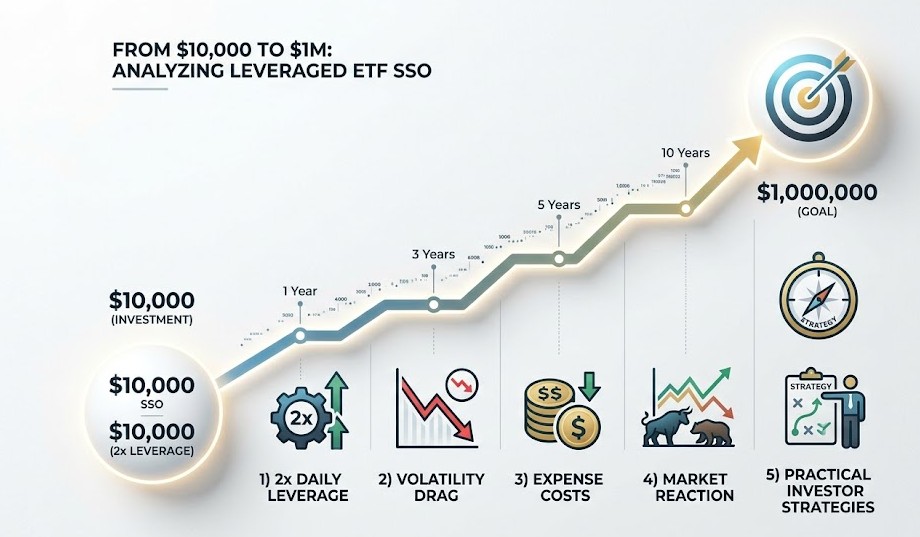
Why $10,000 in ProShares SSO Won’t Make Most Investors Millionaires
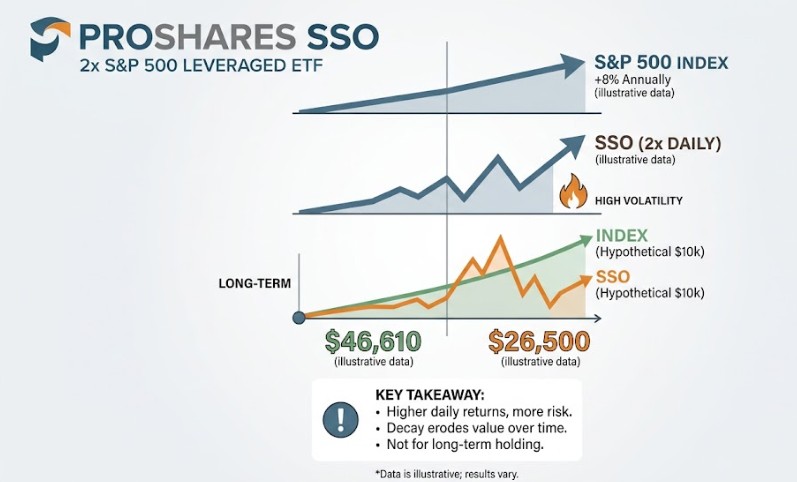
ProShares's ProShares Ultra S&P 500 (SSO) has attracted renewed attention following discussions about whether a $10,000 investment could eventually grow into $1 million.
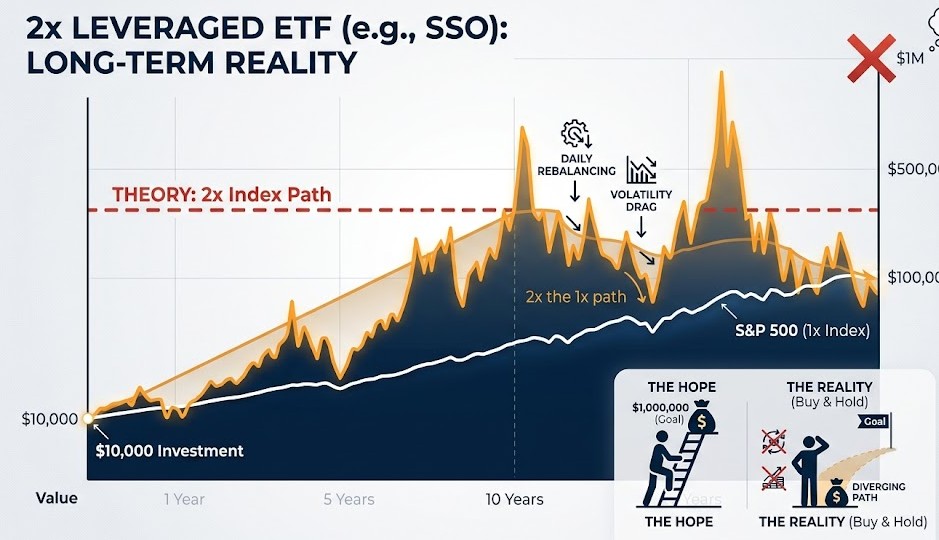
While such an outcome is mathematically possible under certain market conditions, the reality is far more complex. Structural characteristics of leveraged ETFs, including daily rebalancing, volatility+drag" title="More analysis on volatility drag">volatility drag and ongoing expenses, make this outcome highly unlikely for most long-term investors.
SSO is primarily designed as a short-term trading instrument rather than a buy-and-hold investment vehicle.
Understanding How SSO Works
SSO seeks to deliver two times the daily performance of the S&P 500 Index.
To achieve this objective, the fund uses:
- Derivatives
- Swap agreements
- Daily leverage adjustments
The fund resets its exposure at the end of each trading day, meaning its performance over longer periods can differ significantly from simply doubling the S&P 500's long-term return.
Leveraged ETFs like SSO are generally intended for:
- Short-term tactical trades
- Active portfolio management
- Temporary market exposure
They are not typically designed for multi-year investment horizons.
The Mathematics Behind the $1 Million Claim
The hypothetical scenario suggests turning $10,000 into $1 million through long-term investment in SSO.
To achieve that result, an investor would need a 100-fold return.
Over a 30-year period, this would require an annualized return of approximately 16.6% per year, compounded annually.
At first glance, the math may appear achievable:
- Historical S&P 500 returns have averaged roughly 7% to 10% annually over long periods.
- A simple assumption might suggest that a 2x leveraged ETF could generate 14% to 20% annually.
However, this assumption ignores several important factors that significantly affect real-world returns.
Volatility Drag Is the Biggest Challenge
The primary reason leveraged ETFs often underperform long-term expectations is a phenomenon known as volatility drag.
Because SSO targets twice the daily return of the index, gains and losses compound differently over time.
Example
Assume the S&P 500:
- Gains 10% on Day 1
- Falls 9.09% on Day 2
The index ends approximately flat over the two-day period.
A 2x leveraged ETF would:
- Gain 20% on Day 1
- Lose 18.18% on Day 2
Instead of breaking even, the ETF would end the period with a loss of approximately 1.8%.
When similar fluctuations occur repeatedly over months and years, performance erosion accumulates and reduces long-term returns.
Daily Reset Mechanics Create Path Dependence
Unlike traditional index funds, leveraged ETFs are heavily influenced by the sequence of market movements.
This concept is known as path dependence.
Two investors may experience very different outcomes even if the market reaches the same ending level, depending on:
- Market volatility
- Timing of gains and losses
- Duration of holding periods
As a result, long-term returns can differ substantially from what investors might expect when simply multiplying index performance by two.
Fees and Financing Costs Reduce Returns
Another factor working against long-term investors is cost.
SSO incurs expenses related to:
- Fund management
- Derivative contracts
- Financing leverage exposure
- Trading and rebalancing activities
These costs create an ongoing performance headwind and further widen the gap between theoretical and actual returns.
Over decades, even seemingly small annual expenses can have a meaningful impact on compounded wealth.
Performance Depends on Market Conditions
SSO can perform exceptionally well during strong, sustained bull markets.
In these environments:
- Market gains are persistent
- Volatility remains relatively low
- Daily leverage compounds positively
However, in volatile or sideways markets:
- Volatility drag increases
- Compounding becomes less favorable
- Long-term returns can lag expectations significantly
This makes future outcomes highly dependent on market conditions rather than simple arithmetic projections.
How Professionals View Leveraged ETFs
Financial advisors and portfolio managers generally view leveraged ETFs as tactical tools rather than long-term investment vehicles.
Professional investors often use products like SSO for:
- Short-term directional trades
- Portfolio hedging
- Tactical asset allocation adjustments
Most advisors discourage using leveraged ETFs as core retirement or wealth-building holdings due to their structural characteristics.
Key Considerations for Investors
Treat SSO as a Tactical Instrument
SSO is generally best suited for short-term investment horizons measured in days, weeks or months rather than decades.
Implement Strict Risk Controls
Investors using leveraged ETFs should establish:
- Position size limits
- Stop-loss levels
- Maximum holding periods
- Clear exit strategies
Model Realistic Scenarios
Assume that:
- Volatility will occur
- Fees will reduce returns
- Actual performance will differ from a simple 2x multiple of index returns
Consider Simpler Alternatives
For long-term wealth accumulation, many investors may find greater success through:
- Broad-market index funds
- Consistent contributions
- Diversified portfolios
- Long-term compounding without leverage
Conclusion
The idea of turning $10,000 into $1 million through SSO serves as an interesting thought experiment, but it should not be viewed as a realistic base-case investment strategy.
While SSO can generate significant gains during strong market trends, its daily reset structure, volatility drag and ongoing costs create substantial challenges for long-term investors.
For most individuals seeking long-term wealth creation, low-cost exposure to broad market indices combined with consistent investing and disciplined portfolio management remains a higher-probability approach.
Sophisticated traders may use SSO effectively as a tactical tool, but doing so requires active monitoring, strict risk management and a clearly defined investment plan.
The discussion surrounding SSO highlights how daily leverage, volatility drag and fund expenses can significantly reduce long-term returns, making millionaire scenarios possible but statistically unlikely for most buy-and-hold investors.