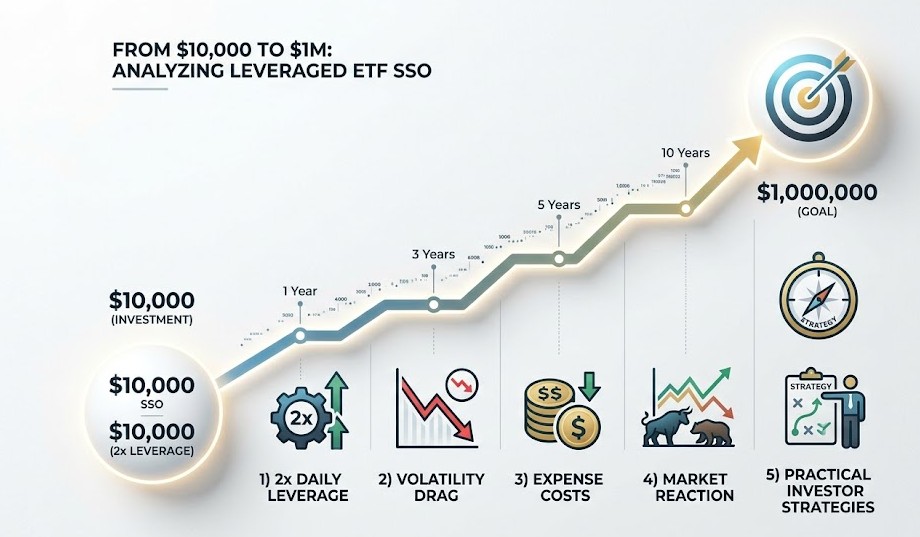
Why $10,000 in SSO Is Unlikely to Become a $1 Million Bet Here's Why
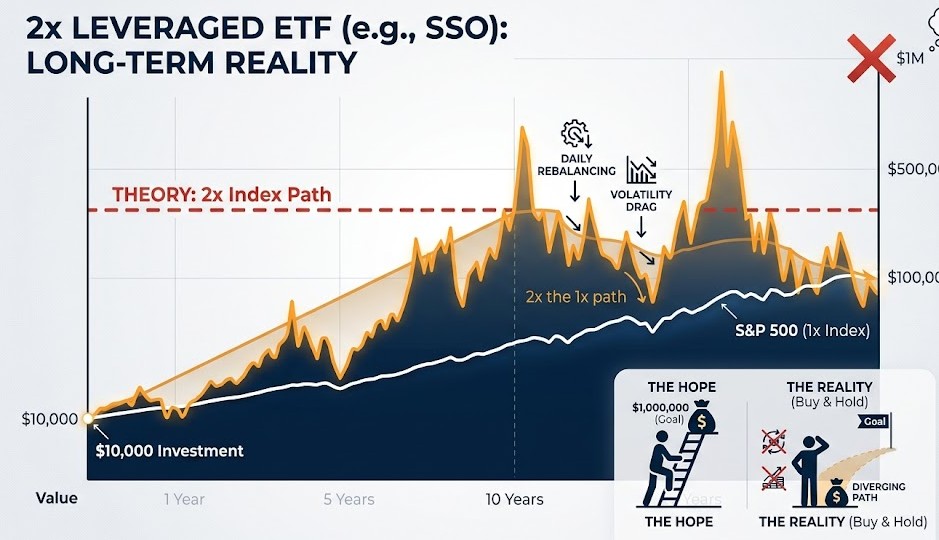
ProShares’ SSO, a 2x daily leveraged ETF tied to the S&P 500, has reappeared in retail headlines after a popular piece asked whether $10,000 invested today could grow to $1 million. The question highlights the trade-off between outsized short-term gains and structural long-term risks, including volatility+drag" title="More analysis on volatility drag">volatility drag, daily compounding, and higher costs that can erode returns for buy-and-hold investors.
Company Background and Recent Performance
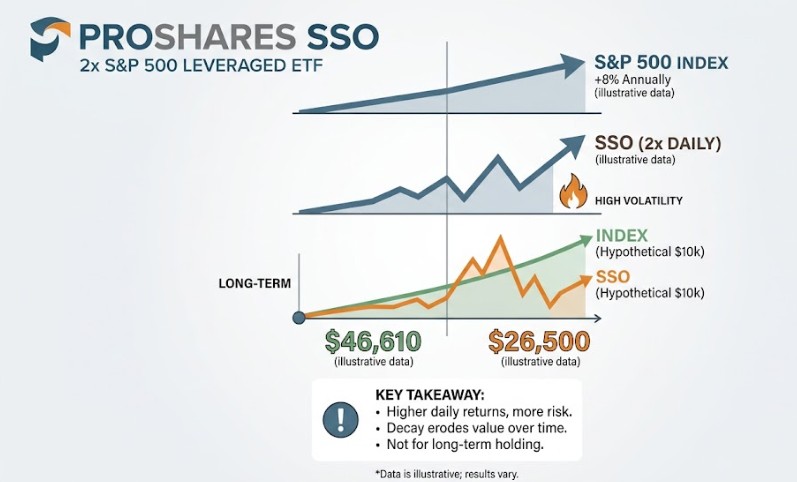
SSO (ProShares Ultra S&P 500) seeks to deliver twice the daily performance of the S&P 500 by using derivatives and leverage. As a daily leveraged product, it is designed for short-term tactical exposure rather than long-term ownership. Its returns are path-dependent, meaning they do not simply equal double the index over extended periods.
Historically, the S&P 500 has delivered roughly 10 percent annualized nominal returns over long time horizons. In a low-volatility, frictionless environment, a 2x exposure could imply significantly higher returns. However, real-world factors such as volatility, financing costs, and expense ratios materially alter this outcome.
The News and Why It Matters
Recent coverage explored a hypothetical scenario in which a $10,000 investment in SSO compounds to $1 million over time. While mathematically possible under sustained high annualized returns, the key takeaway is that for most investors, the risks outweigh the potential long-term reward.
Leveraged ETFs like SSO reset daily, and intraperiod volatility can cause returns to diverge significantly from a simple multiple of cumulative index performance. This effect becomes more pronounced in choppy or sideways markets, where even small fluctuations can reduce overall returns.
Detailed Analysis: Leverage, Compounding, and Volatility
Turning $10,000 into $1,000,000 requires a 100-fold return. Over 30 years, this implies an annualized return of approximately 16.6 percent, and over 40 years about 12.2 percent.
While a simplified assumption might suggest that a 10 percent annual return from the S&P 500 translates into 20 percent with 2x leverage, daily resets and volatility introduce a compounding drag. Frequent market reversals and sustained volatility create a “volatility tax” that can significantly reduce long-term performance.
Additional costs, including financing charges, derivative expenses, bid-ask spreads, and higher expense ratios compared to traditional index funds, further reduce net returns.
Market Reaction and Expert Commentary
The recent discussion has driven increased retail interest in SSO and similar leveraged products, reflected in higher trading volumes and engagement across platforms.
Market professionals and advisory firms continue to emphasize that leveraged ETFs are best suited for short-term trading or hedging rather than long-term wealth accumulation. In trending markets, these products may outperform, but in range-bound or volatile environments, they often underperform comparable unleveraged investments over time.
What This Means for Investors
Investors should align the instrument with their objectives. SSO may be appropriate for short-term, high-conviction trades or tactical exposure but is generally unsuitable as a core long-term holding.
Understanding path dependency is critical. Scenario analysis and stress testing under varying volatility conditions are necessary, as simple doubling assumptions do not hold in real-world market behavior.
Position sizing and disciplined rebalancing can help manage risk, although frequent adjustments may introduce transaction costs and tax implications. Alternatives such as unleveraged broad-market ETFs, options strategies, or diversified portfolios may offer more stable long-term outcomes.
Risk Management and Practical Tactics
For those choosing to trade SSO, it is essential to define clear time horizons, set stop-loss or profit targets, and monitor positions actively. Limiting leveraged exposure to a small portion of the portfolio, often in the single-digit percentage range, is a commonly recommended approach.
Tax efficiency should also be considered, particularly in taxable accounts where frequent trading may lead to short-term capital gains. Investors should track the ETF’s expense ratio, tracking error, and performance across different market conditions.
Regulatory and Cost Considerations
Leveraged ETFs include clear disclosures about their structure, but many retail investors may not fully understand daily reset mechanics. Higher expense ratios and derivative-related costs compound over time and can materially impact performance.
Regulators and advisors consistently stress the importance of investor education regarding the appropriate use of these products.
Conclusion and Forward Looking Perspective
SSO can amplify returns during sustained bull markets, but the structural realities of daily leverage, volatility drag, and higher costs make it unsuitable as a primary long-term investment vehicle for most investors.
Rather than relying on aggressive projections, investors may benefit from focusing on asset allocation, risk management, and low-cost diversified investments to build long-term wealth.
For disciplined traders with defined strategies and active risk management, SSO remains a viable tactical tool. However, for long-term investors, its performance rarely aligns with the simplified projections often highlighted in headline scenarios.
The recent coverage underscores SSO’s risks, including daily leverage, volatility drag, and higher costs, driving renewed retail interest while reinforcing caution among long-term investors.