Why Intuit’s Shares Slid Despite AI Leadership — What Investors Should Know
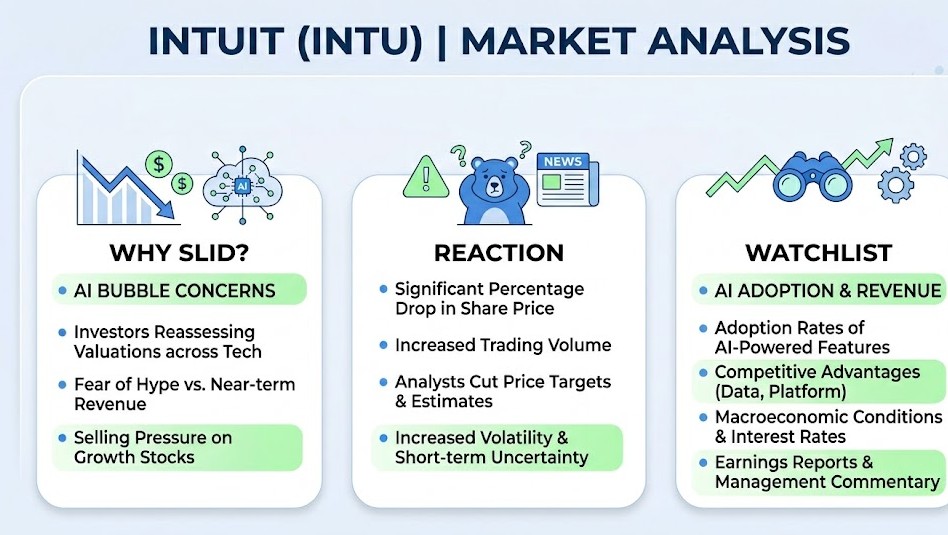
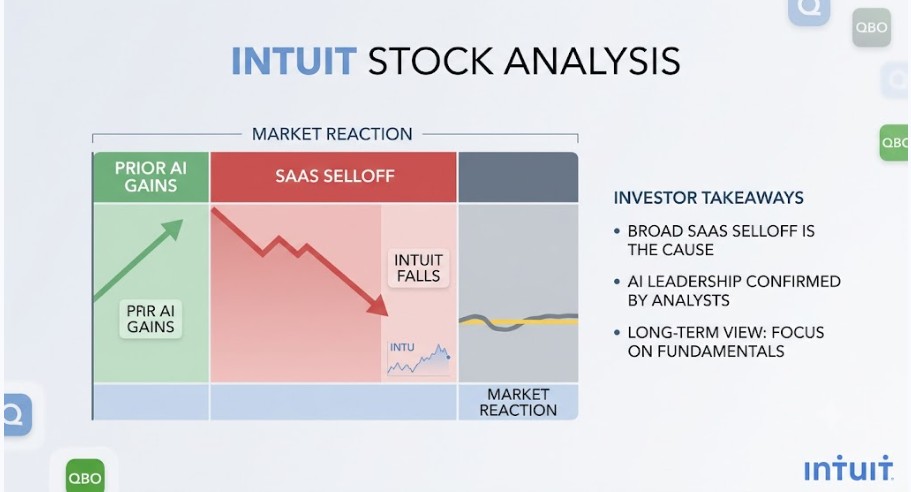
Intuit Inc. (INTU), the software company behind TurboTax, QuickBooks, and Credit Karma, saw its shares decline sharply in a broad selloff targeting high-valuation software names, even as the company positions itself as an early adopter of artificial intelligence across its products. Investors reacted to heightened sensitivity around growth and margins in the software sector, turning a narrative of AI leadership into a near-term pressure point for a richly valued SaaS company.
Company Background and Strategic Positioning
Intuit has spent several years embedding machine learning and AI capabilities into its core offerings. The company introduced AI-driven tax guidance within TurboTax, conversational assistance and automation features in QuickBooks, and expanded its consumer finance presence through the 2020 acquisition of Credit Karma for approximately $7.1 billion.
In 2021, Intuit also acquired Mailchimp for around $12 billion to strengthen its small-business ecosystem. These initiatives support its positioning as an AI-enabled platform, combining data, workflows, and machine learning models to automate processes and personalize financial outcomes.
Market Reaction and Recent Selloff
Despite these strategic investments, the recent stock decline highlights investor concern over near-term execution and valuation. Intuit trades at a premium compared to many software peers due to its recurring revenue model and historically strong operating margins. However, that premium makes it vulnerable to any signals of slowing revenue growth, rising AI-related investment costs, or weakening demand from small businesses.
The selloff was driven in part by a broader market rotation favoring a narrower group of perceived pure-play AI companies. This shift has led investors to reassess established SaaS firms, particularly those requiring continued investment to maintain competitive positioning.
AI Narrative and Competitive Debate
The core debate centers on whether Intuit’s AI capabilities represent a durable competitive advantage or incremental enhancements requiring ongoing heavy investment. Some market participants argue that the increasing availability of large language models and commoditized AI infrastructure could reduce differentiation.
Others highlight Intuit’s strengths, including its proprietary tax and financial data, integrated product ecosystem, and advisory network, as defensible advantages that are difficult to replicate.
Analyst Perspectives and Key Metrics
Analyst sentiment remains mixed. Some have reduced near-term earnings expectations, citing potential headwinds in small-business software adoption, payroll services, and customer acquisition trends.
Conversely, other analysts emphasize Intuit’s long-term strengths, including high customer retention, cross-selling opportunities across its platform, and the potential to monetize AI-driven features to increase customer lifetime value.
Investors are closely monitoring key performance indicators such as annual recurring revenue growth, gross margin trends, customer acquisition costs, and AI-related operating expenses to assess how effectively investments translate into revenue.
Sector Rotation and Valuation Reset
The market response reflects both macroeconomic caution and a broader re-rating of software valuations. Investors have shifted capital toward companies perceived as more directly exposed to AI-driven growth, funding these moves by reducing exposure to diversified software names like Intuit.
This has resulted in increased volatility across the sector, particularly for companies with elevated valuation multiples. The pullback in Intuit shares should be viewed within this broader context of changing market preferences and expectations.
Investor Takeaways
The recent decline offers several considerations for investors. Distinguishing between short-term market movements and long-term fundamentals is critical, as Intuit’s recurring revenue model and diversified product portfolio remain intact.
Monitoring operational performance over the coming quarters will be key, particularly subscription growth, customer retention, and the pace at which AI features contribute to revenue and pricing power. A sustained improvement in these metrics would support the investment thesis.
Valuation also plays a central role. A meaningful correction may present a more attractive entry point if the company continues to demonstrate strong retention and successfully monetizes its AI initiatives.
Risk Management and Strategy
Investors with concentrated exposure may consider managing risk through position adjustments or hedging strategies to navigate near-term volatility. Those looking to build positions may benefit from setting clear entry criteria, such as improved guidance, stronger recurring revenue growth, or tangible evidence of AI-driven monetization.
It is also important to consider capital allocation priorities, as increased investment in research, development, and integration efforts could affect shareholder returns in the near term.
Outlook and Forward Perspective
Intuit’s long-term outlook depends on its ability to convert AI investments into measurable customer value, sustained revenue growth, and stable margins. Its proprietary data across tax, financial, and small-business domains remains a significant strategic advantage.
In the near term, volatility is likely to persist as the market evaluates which companies can effectively translate AI capabilities into profitable growth. Investors should monitor upcoming earnings reports, management commentary on AI strategy, and integration progress across recent acquisitions for signs of stabilization.
If Intuit demonstrates clear progress in monetizing AI features while maintaining margin discipline, investor sentiment could improve. If not, valuation pressure may continue.
Conclusion
Intuit remains strategically well positioned but faces a near-term execution challenge. The company must demonstrate that its AI investments can drive predictable revenue growth and margin expansion.
The recent decline reflects a broader rotation away from premium SaaS names, driven by concerns that AI-related spending and slowing growth could compress valuation multiples.