Why Investors Are Rethinking GE Vernova (GEV) After 28% Rally
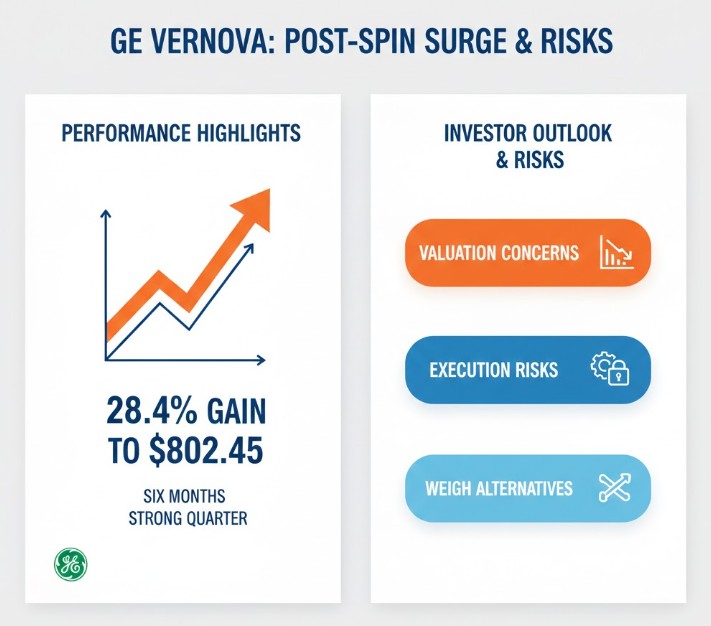
GE Vernova’s stock has surged 28.4% over the past six months, outpacing the S&P 500 by 22.5% and reaching $802.45 per share after a string of stronger-than-expected quarterly results. The rally reflects improving execution on power and renewable contracts, but it has also pushed valuation metrics higher, prompting some investors to reassess risk relative to reward.
Company Background and Recent Performance
GE Vernova, spun out from General Electric’s industrial businesses, combines conventional power equipment, grid solutions, and renewable energy assets. The company reported a quarter of solid revenue growth and margin improvement, which management credited to higher service volumes and cost discipline.
Although still early in its independent life as a public company, GE Vernova has delivered consistent operational beats that have attracted momentum buyers and long-term strategists alike. The recent price move has been driven by concrete earnings beats and bullish forward commentary.
Investors rewarded the company for sequential margin expansion and stabilizing backlog trends, driving a six-month total return of 28.4%. That advance outpaced the S&P 500’s gain over the same period by roughly 22.5 percentage points, underscoring the stock’s leadership within industrial and energy sectors.
Valuation Concerns Begin to Emerge
Despite those positives, valuation now stands as the principal concern. A near-term share price of $802.45 implies elevated multiples relative to historical norms for power-equipment and renewables peers, narrowing the margin of safety.
For companies exposed to large, multi-year contracts and commodity-linked demand, stretched valuations increase sensitivity to execution disappointments, contract delays, or adverse weather cycles that can compress margins and free cash flow.
Relative to peers, GE Vernova now commands a premium that reflects both its scale and the market’s willingness to pay for energy-transition exposure. That premium can be justified if the company converts revenue growth into consistent margin expansion and predictable free cash flow, but absent those proof points the stock’s multiple leaves little room for disappointment. Investors should compare trailing and forward multiples to industrial and renewable peers to quantify the premium.
Balance Sheet and Operational Execution in Focus
Balance-sheet dynamics will be critical. Historically, large industrial spinoffs carry transitional liabilities, including working capital swings and legacy pension or warranty obligations. Management’s ability to convert operational gains into deleveraging and positive free cash flow will underpin long-term valuation.
Investors should watch net debt trends, capital expenditure guidance, and the company’s stated targets for cash conversion.
Operational execution remains a second point of focus. GE Vernova’s businesses depend on complex project delivery, parts availability, and long-tail service agreements. While management has reported progress in project timelines and supply-chain efficiency, any setbacks in large turbine installations or grid-harden projects could meaningfully affect near-term cash flow and investor sentiment.
Investors should weigh recent operational improvements against the legacy complexity inherent in industrial turnarounds.
Market Reaction and Analyst Perspective
Market response has been mixed. Momentum investors and some institutional buyers have piled into the stock following the quarter, while more cautious analysts have flagged valuation and concentration risks.
Commentary from sell-side and independent strategists has emphasized a need for margin proof points and predictable free cash flow before assigning premium multiples. Trading volume around earnings and price updates suggests conviction among buyers, but also increased volatility on intraday moves.
What This Means for Investors
For shareholders and prospective buyers, a disciplined stance is warranted.
Partial Profit-Taking:
Near-term holders may consider taking partial profits to lock in gains given
the 28.4% lift over six months.
Wait for Confirmation:
Prospective investors would be prudent to wait for clearer signs of sustainable
margin expansion or a meaningful pullback that restores a more conservative
entry valuation.
Gradual Entry Strategy:
Risk-tolerant investors who prefer exposure can scale in gradually, tying
purchases to specific operational milestones such as consistent quarterly cash
flow improvement or backlog conversion metrics.
A viable alternative for investors seeking exposure to energy transition and utilities without concentrated execution risk is to consider larger, more diversified operators that trade at lower cyclicality. Names such as NextEra Energy (NEE) offer regulated asset exposure and steady cash flow profiles, while ETFs focused on clean energy infrastructure can provide diversified access and lower single-stock risk.
Key Catalysts to Watch
Key near-term catalysts include the next quarterly report, updated backlog disclosures, capital allocation decisions, and any forward guidance changes.
Sequential improvement in adjusted EBITDA margins, conversion of backlog to revenue, and clearer free cash flow guidance would materially de-risk the investment thesis. Conversely, missed guidance, order cancellations, or deteriorating service margins would likely trigger a rapid re-pricing.
Conclusion
Looking ahead, GE Vernova’s prospects hinge on translating recent operational gains into repeatable free cash flow and reducing project execution variance. If management sustains margin improvement and converts backlog into predictable revenue, premium valuations can be justified.
Conversely, any slip in execution or macro-driven demand softness would likely prompt a sizable re-rating given the current price level. Investors should monitor quarterly cash flow trends, margin guidance, and backlog conversion rates as primary signals of whether the current valuation is warranted.
With a 28.4% six-month gain and a share price at $802.45, the stock now sits at a crossroads between justified premium for improving fundamentals and potential vulnerability to execution risk. A measured, milestone-driven investment approach will serve investors best as the company moves through the next reporting cycles.