Nifty Near Its Lows: Is This the Right Time to Invest, or Should We Protect Our Capital First?
When the market falls sharply, one question comes to almost every investor's mind:
Should I buy now, or wait for the market to fall further?
With the Nifty under pressure and investor confidence being tested, this question has become increasingly important.
Some investors are waiting for a clear recovery before investing. Others believe the recent weakness could offer an opportunity to buy quality stocks at better prices.
Both approaches have a risk.
If you wait too long, you might miss part of the recovery. If you invest everything too early, you could face further losses if the market continues to decline.
So, what is the sensible approach?
As a quantitative researcher, I believe the answer starts with a simple principle:
Don't focus only on when to enter the market. Focus on how much risk you take when you enter.
1. History Teaches Us That Markets Move in Cycles
Market declines are not new.
During the 2008 global financial crisis, Indian equities experienced a severe sell-off as the global financial system came under pressure.
In March 2020, the COVID-19 pandemic triggered another sharp market decline. Fear spread quickly, uncertainty increased, and investors struggled to estimate the impact on businesses and the economy.
In both periods, the market eventually recovered from its lows, although the recovery path was different in each case.
Investors who remained invested in the right assets through subsequent recoveries benefited from the market's longer-term growth.
But there is an important lesson here.
Knowing that markets have recovered historically does not tell us when the next recovery will begin.
Markets can fall further after appearing cheap. Some stocks recover strongly, while others never return to their previous highs.
History should help us prepare for uncertainty, not convince us that every decline is a buying opportunity.
2. Is This the Right Time to Invest?
My answer is simple: it depends on your investment horizon, financial situation, and ability to manage losses.
If you are investing for the long term, have adequate emergency savings, and can tolerate market fluctuations, a sharp correction may create opportunities to build positions gradually.
But if you need the money in the near future, taking substantial equity risk simply because prices have fallen may not be appropriate.
There is also a difference between buying a fundamentally strong business at a more attractive valuation and buying a stock simply because its price has dropped.
A falling price alone does not make a stock cheap.
The better questions are:
Has the business outlook changed?
Is the valuation reasonable?
Is the stock showing persistent weakness?
How much could the investment lose if the market falls further?
Does the investment fit within the overall portfolio?
These questions are more useful than trying to identify the exact bottom.
3. The Biggest Mistake: Investing Without a Risk Plan
Imagine two investors entering the market at the same time.
Investor A puts all available capital into a few stocks because prices look attractive.
Investor B invests gradually, diversifies across suitable assets, limits excessive concentration, and reviews the portfolio as market conditions change.
If the market rises immediately, both may benefit.
But if the market declines further, Investor A could face significant pressure to sell at the wrong time. Investor B may have more flexibility, depending on their allocation and available capital.
This does not mean gradual investing always outperforms investing a lump sum. It doesn't.
The point is that a good investment decision should consider what happens if the market moves against you.
Risk management is not about avoiding every loss.
It is about understanding potential losses before they occur and making decisions that you can sustain through different market conditions.
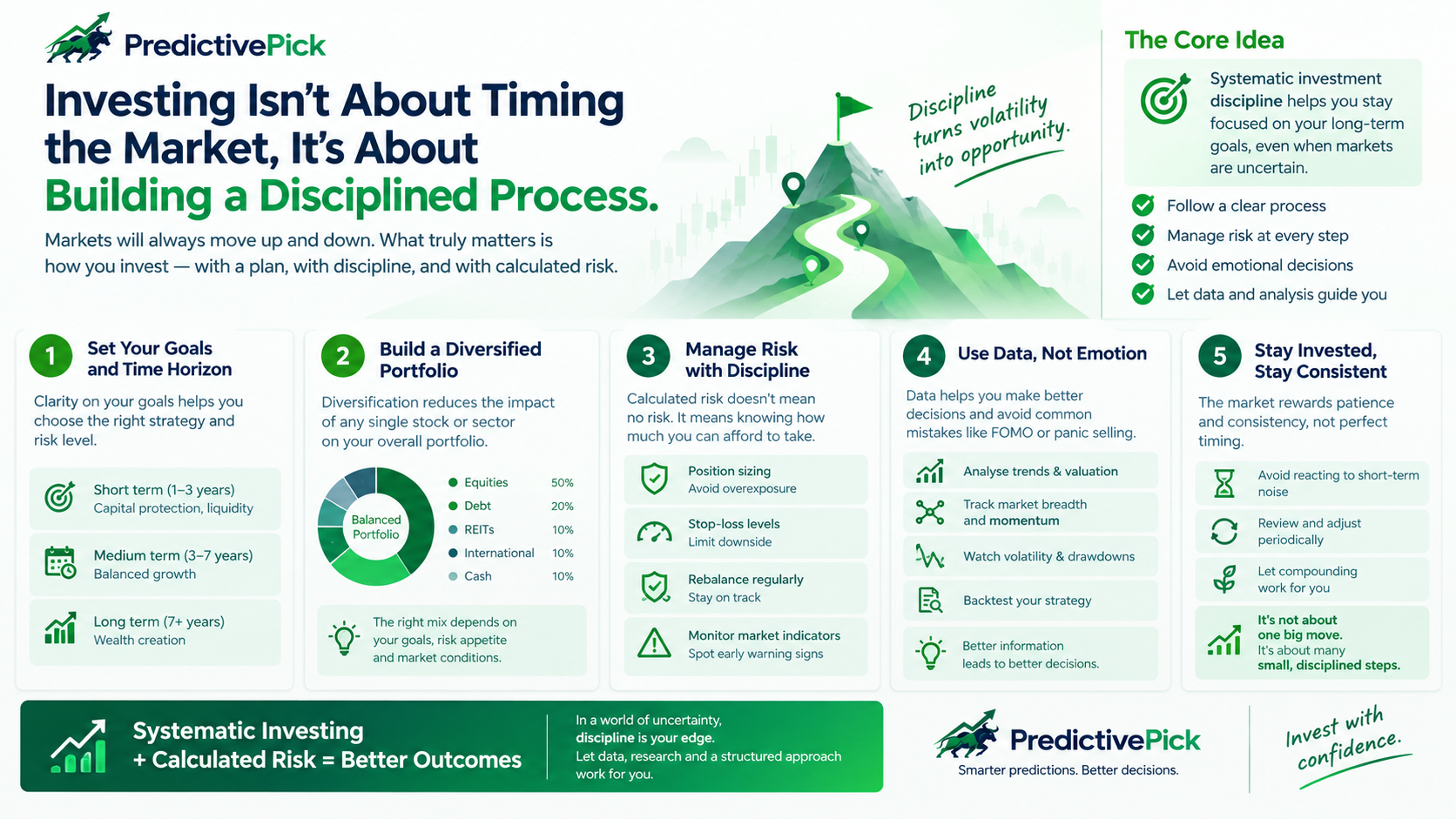
4. What Does Risk-Controlled Investing Actually Mean?
Risk control does not require complicated financial models to understand.
It begins with a few practical principles.
First, manage position sizes.
Avoid allowing a single stock or sector to dominate your portfolio unless you deliberately accept that concentration risk.
Second, diversify thoughtfully.
Holding many stocks does not automatically create diversification if they respond to the same market forces.
Third, invest according to your time horizon.
Money needed soon should not depend on an uncertain equity-market recovery.
Fourth, monitor downside risk.
Don't measure a portfolio only by its returns. Understand how much it falls during difficult periods and how long it may take to recover.
Finally, review decisions using evidence.
A portfolio strategy should have a clear process for evaluating opportunities, monitoring risk, and responding when the evidence changes.
These principles are straightforward. Applying them consistently is the difficult part.
5. Can Data and Predictive Intelligence Help?
This is where quantitative research becomes particularly useful.
Instead of relying entirely on market sentiment or intuition, we can examine historical prices, volatility, momentum, correlations, and drawdowns to understand how investments behave under different conditions.
For example, a risk-aware investment process can investigate:
Which stocks show stronger or weaker momentum?
Is market volatility increasing?
Are several portfolio holdings becoming more correlated?
How much could the portfolio lose under adverse scenarios?
Does the current allocation expose the investor to excessive concentration?
How has a similar strategy performed across different historical market environments?
These signals do not predict the future with certainty.
Historical backtests can also be misleading if they ignore transaction costs, changing market conditions, or overfitting.
That is why a quantitative strategy must be tested carefully and evaluated beyond its best-performing periods.
The objective is not to eliminate risk. It is to make risk more visible, measurable, and manageable.
6. Our Next Step at PredictivePick
At PredictivePick, we have been exploring how data, quantitative analysis, and predictive intelligence can support more disciplined investment decisions.
Our focus is not simply on identifying stocks that might rise.
We are interested in the bigger question:
How can we evaluate opportunities while keeping portfolio risk at the centre of the decision?
We are working towards a predictive-intelligence-based, risk-control investment fund concept that brings this philosophy closer to practical portfolio management.
The idea is to put greater emphasis on systematic research, portfolio construction, risk monitoring, and evidence-based decisions rather than relying on market predictions alone.
We are still working towards the next stage, and there is much to validate before making claims about its effectiveness.
I believe the real test of any investment approach is not how it performs when markets are rising.
It is how well its process handles uncertainty, changing conditions, and periods of sustained pressure.
More on this initiative soon.
7. The Opportunity Is Not Just About Buying at the Bottom
Nobody can consistently identify every market bottom in advance.
Trying to do so can lead to hesitation, emotional decisions, and excessive risk.
A better approach is to prepare for multiple possibilities.
If the market recovers, your investment plan should allow you to participate appropriately.
If the market declines further, your portfolio should not be exposed to more risk than you can reasonably tolerate.
And if conditions remain uncertain, your decisions should be guided by your goals, available capital, and a defined investment process.
That is the difference between simply reacting to the market and managing a portfolio with discipline.
My takeaway as a quant researcher
Market corrections can create opportunities, but they also expose weaknesses in how investors make decisions.
The question is not whether the Nifty has reached its lowest point.
The question is whether we have a process that can help us make rational decisions when the next move is uncertain.
Markets may be unpredictable. Our investment process doesn't have to be.
At PredictivePick, we believe smarter investing begins with better analysis, disciplined portfolio construction, and a serious focus on risk.
We are working on bringing that philosophy into our upcoming predictive-intelligence-based risk-control initiative. Stay tuned.
What matters more to you in the current market: identifying the next opportunity, or controlling the risk of getting the decision wrong?
I'd be interested to hear your perspective.