Is the AI Bubble Bursting? What the US Selloff Tells Us
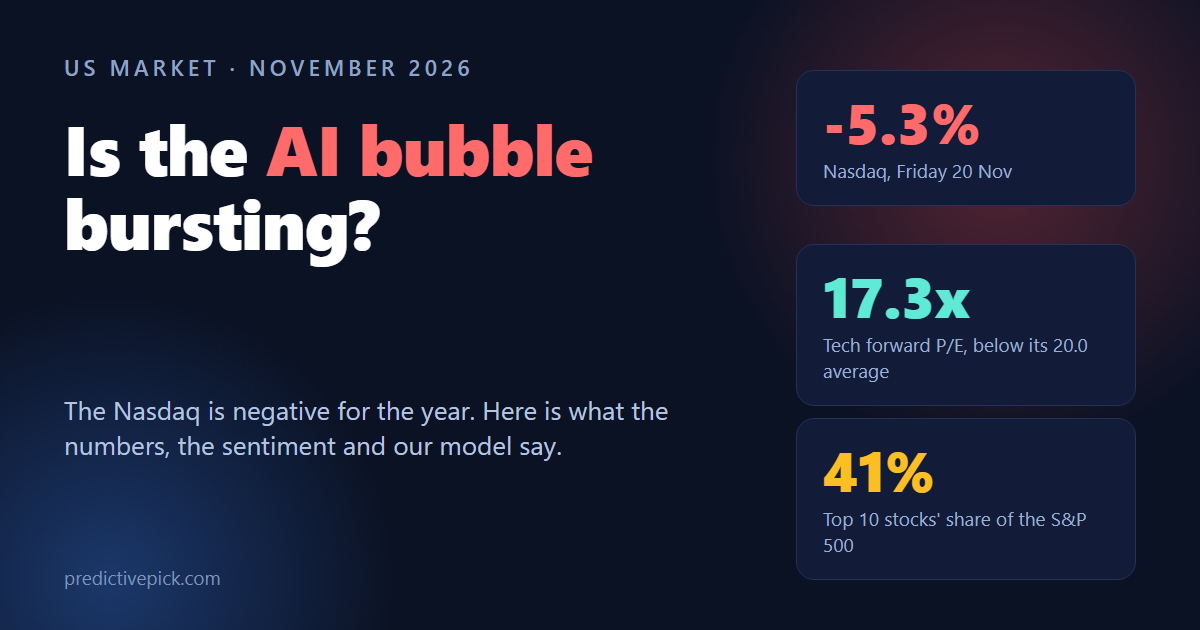
The Nasdaq is now negative for 2026, and every investor is asking the same thing: is the AI bubble finally bursting?
On Friday, 20 November, the S&P 500 fell 3.7% and the Nasdaq Composite fell 5.3%, according to NPR. The S&P 500 and the Dow closed in correction territory after their worst week in more than eighteen months, and the Nasdaq wiped out its gains for the year.
The trigger was not bad news from the leader of the trade. Nvidia reported strong results that same week, and the stock still fell. Shares of Anthropic, which listed at $83, dropped 8.5% to $88.91 a day after a blockbuster debut. When good news cannot lift a stock, the market is no longer pricing the news. It is pricing the doubt.
So is this a bubble bursting, or a reset inside a bull market? The honest answer is that the data points both ways, and you should be suspicious of anyone who is certain.
1. The case for "bubble": too much money, too concentrated
Four companies, Amazon, Alphabet, Microsoft and Meta, have guided to roughly $720 billion to $740 billion of combined capital spending in 2026, most of it on predictivepick.com/?q=AI+infrastructure" title="More analysis on AI infrastructure">AI infrastructure. That is an enormous bet that demand will arrive on time.
Investors are starting to ask who pays if it does not. In Bank of America's November fund manager survey, 34% named an AI bubble as the biggest tail risk, and 52% expect at least one hyperscaler to cut capital spending within six months. Fund managers also cut their net overweight in technology from 37% to 12% in a single month, the sharpest monthly cut since 2006.
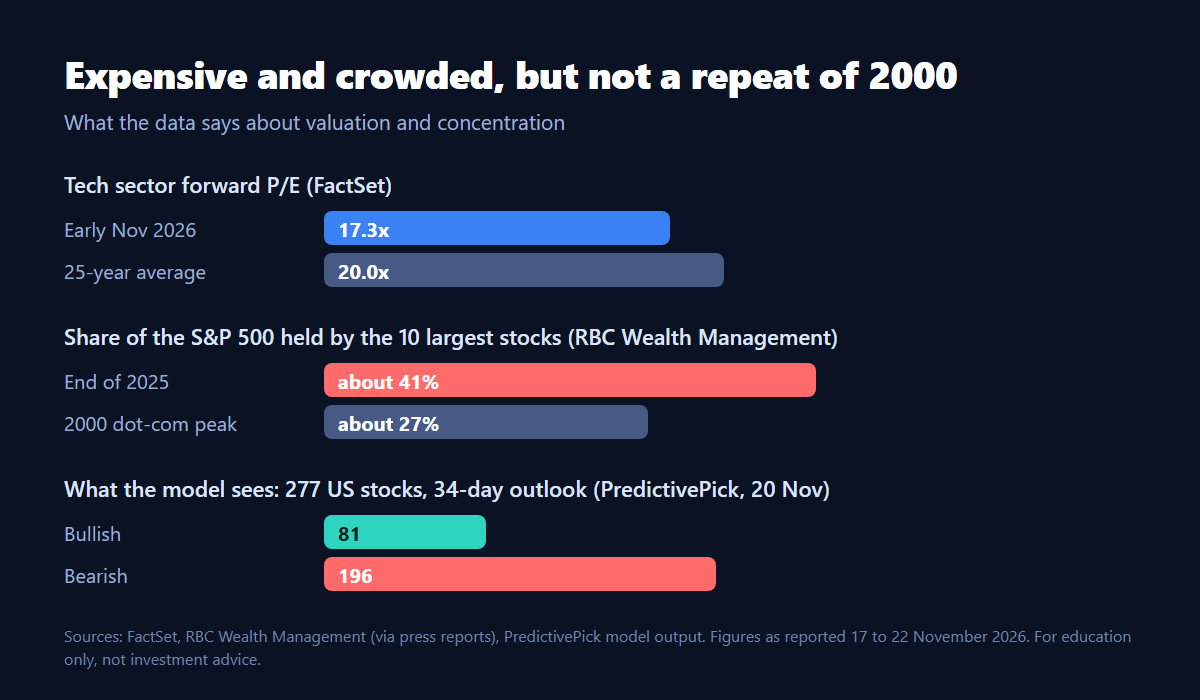
Concentration adds fuel. According to RBC Wealth Management, the ten largest companies made up nearly 41% of the S&P 500 at the end of 2025, against roughly 27% at the peak of the dot-com bubble. When a few stocks carry the index, one bad week for them becomes a bad week for everyone.
2. The case against: this is not 2000
Here is what the bubble argument struggles with. According to FactSet, the forward price-to-earnings ratio of the S&P 500 technology sector was 17.3 in early November, below its 25-year average of 20.0 and its lowest level since March 2020. In 2000, many market leaders traded on triple-digit multiples. Today's leaders are earning real profits.
That matters. Bubbles are built on prices that have run far ahead of earnings. This selloff arrived with valuations already compressed and earnings still growing, which looks more like a collapse in confidence than a collapse in profits.
A market can fall hard without being a bubble. It can also be a bubble and keep rising for years. Neither fact tells you what happens next month.
3. What is really hurting: rates and funding, not just AI
The AI story is not the only pressure. According to CME FedWatch, traders now see close to an 85% chance of a Fed rate increase in December. Higher rates reduce what investors will pay today for profits that arrive years from now, and that hits long-duration growth stocks hardest.
There is also a funding question. Large AI projects increasingly rely on debt and on deals between companies in the same ecosystem, where one firm invests in, lends to or buys from another. That works while confidence is high. It becomes fragile when confidence turns.
4. What our model sees
At PredictivePick, we do not try to call a bubble. Our US model scores 277 S&P 500 stocks on the probability of a positive trend over the next 34 days. As of 20 November, the average probability across the universe was 38.7%. Only 81 stocks scored bullish, while 196 scored bearish.
The ranking is telling. The highest-scoring names are defensive: McKesson, Labcorp, Motorola Solutions, Coca-Cola and W.W. Grainger. The highest risk scores sit in AI hardware and storage, including Seagate, Western Digital and Teradyne. The model has not turned against the market. It is rotating away from the most crowded AI trades and towards steadier earnings.
This is one model's reading of recent data, not a forecast and not a recommendation.
You can see the live rankings on our US momentum page and the stocks the model flags as risky on the risk page.
5. What a sensible investor does now
Forecasters disagree. Capital Economics expects the S&P 500 to be about 9% lower by the end of next year, while others see only a valuation reset. Baird's Michael Antonelli has said the idea that AI spending can continue without limit and keep supporting the market is coming to an end. Nobody knows which view will be right, so the useful questions are about you, not about the bubble.
How concentrated are you? If most of your portfolio is a handful of AI-linked stocks, a 5% index day can feel like a 15% day.
What is your horizon? Money needed within a year should not depend on a recovery arriving on schedule.
Do you have a rule for losses? Decide your maximum acceptable drawdown before the market decides for you.
Are you adding gradually? Spreading purchases over time protects you from buying the exact top or waiting for the exact bottom.
The bottom line
This is a sentiment shock hitting an expensive, concentrated and debt-funded part of the market, at a time when rates are moving the wrong way. Whether history later calls it a bubble or a correction will depend on one thing: whether AI revenue grows into the spending before patience runs out.
Until that is clear, the winning move is not to guess the label. It is to control the size of your risk.
Frequently asked questions
Is the AI bubble bursting in 2026?
The Nasdaq is negative for the year and the S&P 500 is in correction, but technology valuations are lower than in 2000 and earnings are still growing. Many analysts call it a reset rather than a collapse, though that is an opinion and not a certainty.
Why did Nvidia fall after strong earnings?
Because investors are focused on whether heavy AI spending will pay off, not on one good quarter. Rising rate expectations added to the pressure.
Is the stock market going to crash?
No one can say. Corrections of 10% or more are common over long periods, and most are followed by recoveries, but timing and depth vary widely.
Which US stocks does PredictivePick rate highest right now?
The rankings update daily on the momentum page. At the 20 November update, the top names were defensive rather than AI-linked.
Market figures are as reported by NPR, CNN, FactSet, RBC Wealth Management, Bank of America and CME Group between 17 and 22 November 2026, and may be revised. Model scores are as of 20 November 2026. This article is for education only. It is not investment advice or a recommendation to buy or sell any security. Investing involves risk, including the loss of capital.